Asia

A Family Battles Over a Disappearing Trove of Chinese Paintings

“A Family Battles Over a Disappearing Trove of Chinese Paintings”

By Graham Bowley via “New York Times

It has evolved into one of New York’s longest-running fights over an estate.

For more than a decade, the family of C. C. Wang, a collector whose name graces a gallery at the Metropolitan Museum of Art, has been battling over a trove of classical Chinese paintings and scrolls that has been described as among the finest in the world.

Now, the feud has escalated. In the past month, two of Mr. Wang’s children, who have been fighting in Surrogate’s Court in Manhattan since his death in 2003 at 96, filed lawsuits in state and federal courts accusing each other of looting and deceit.

But beyond the family strife, a broader issue is dismaying Chinese-art experts for whom the Wang collection has long been a source of wonder.

Dozens, perhaps hundreds, of works from an estate once valued in court papers at more than $60 million have gone missing, including an 11th-century scroll, “The Procession of Taoist Immortals,” that is viewed in China as a national treasure.

“This is heartbreaking, and it is happening right here in the city,” said Laura B. Whitman, a specialist in Chinese art formerly with Sotheby’s and Christie’s, who used to visit Mr. Wang at his apartment in New York to view his collection.

Divining who rightfully owns these works, and who is to blame for the disappearance of so many of them, has consumed the family for more than a decade.

The case has become so complex, and so expensive, that the Surrogate’s Court has suspended discussing matters of inheritance until it can come up with a reliable inventory of what was initially in the collection to see if the estate will be able to pay lawyers and other creditors.

Among the few certainties at this point is that Mr. Wang demonstrated the ability to acquire objects of historical importance, objects that since his death have increased many times in value as the Chinese art market has boomed.

Born near Suzhou, China, in 1907, he moved to the United States during China’s political upheavals in 1949, settling in Manhattan, where he built a career teaching, consulting at Sotheby’s, and dealing in real estate and in art. He became the dean of the rarefied market for Chinese art in New York and was an accomplished artist in his own right. By the end of the 1990s, the Met had bought some 60 works that were once part of his collection and named a gallery in his honor.

Among the Met acquisitions was a colossal hanging scroll titled “Riverbank,” attributed to the 10th-century painter Dong Yuan, but which attracted its own controversy after some scholars declared it a 20th-century forgery.

Maxwell K. Hearn, chairman of the Met’s Asian art department, said Mr. Wang acquired much of his important collection early on, when the market for Chinese art didn’t exist.

“He saw their continued relevance as sources of artistic inspiration,” Mr. Hearn said. “Now, they have become enormously valuable, because people are recognizing their cultural significance and acknowledge him as a source of validation.”

Before his death, Mr. Wang left some works to his daughter Yien-Koo Wang King, now 79, and some to his son, Shou-Kung Wang, now 85, both of whom served during different periods as confidant and business agent to their father.

READ MORE

Art I Love ~ “The Green Parasol”

“The Green Parasol” by Emanuel Phillips Fox (1912)

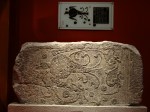
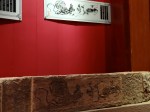
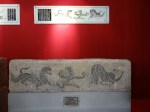
Nanyang Museum of Han Stone Gravings, Henan, China

Recently, I traveled abroad with about 20 other teachers to Southern Henan during the Fall Holiday.  We hired a tour guide to arrange our trip, and one of the places on his list was the Nanyang Museum of Han Stone Gravings. 

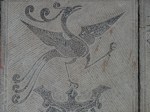
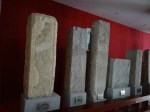
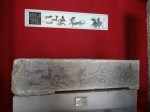
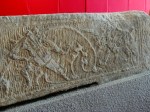
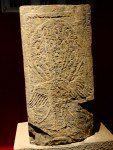
This was a really fascinating place. The museum holds hundreds of stones engraved with various pictures and images collected from ancient Han tombs. We were told that they were more than 1000 years old!

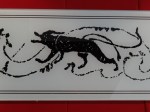
I was intrigued by the carvings themselves. Naturally, they varied on the subject of their work – dinners, hunting, musicians, kings and counsels. It’s always neat to see art demonstrating the use of ancient musical instruments or to watch fashions change as the years go by. But I was really interested to see some of the animals are actually pre-historic. One was clearly a dinosaur (you know the kind that is Sarah on The Land Before Time?). Two were dragons, but only one had wings.

You kind of expect the dragons, but the differences in how they were depicted suggests two origins to the dragon legend. One was wingless and quite fat. The other had wings and was longer and thinner. Add in the dinosaur, and it was all really cool!


Coming Exhibition: Abu Dhabi Art Fair

“Abu Dhabi Art Fair”

New Section for Abu Dhabi Art - Artists' Waves

Who:  Abu Dhabi Art 

When: Nov. 5, 2015 – Nov. 8, 2014 (View Hours Here)

Where: 

Saadiyat Island
UAE Pavillion
PO BOX 126888 Abu Dhabi
UAE – Abu Dhabi
United Arab Emirates
+971 2 657 5800

How Much:  (View Pricing Here)

More Information: Here

“Abu Dhabi Art presents museum quality artworks from modern, contemporary and design galleries. This year it includes a wide spectrum of installations and large-scale sculptures, as well as a new section titled Artists’ Waves that places the discovery and re-discovery of artists at the core of Abu Dhabi Art, through a curated exhibition.”


Han relics on show in Paris

Han relics on show in Paris

by Lin Qi via “China Daily

Han relics on show in Paris

Valuable Chinese relics are to be exhibited in France, giving European visitors a glimpse ofthe rich traditions of the Han Dynasty. Lin Qi reports.  It is probably the largest exhibition of Chinese relics outside thecountry. Curators describe it as “an unrivaled show” as itexplains why the majority of Chinese are called the Han peopleand why they speak the language of Han people and write Hancharacters. The exhibition, Han Dynasty, will open at the MuseeGuimet in Paris in October, and will display about 457 artifactsthat bear testimony to the dynamism of the Middle Kingdom.

The exhibition, which celebrates the 50th anniversary of theSino-French diplomatic relations, will present a retrospective ofthe Han Dynasty (206 BC-AD 220), the empire that hadprofound and long-lasting influences on Chinese history.Antiquities, including dozens of national grade one collections,are on loan from 27 Chinese museums and cultural institutions.They provide various perspectives on the dynasty’sadministration system, its agriculture, its alliances with borderingcountries and the start of Silk Road through which itcommunicated with the West.

“The exhibition will demonstrate the most complete and beautifulgems of the Han Dynasty, helping people to understand the foundation of Chinesecivilization,” says Sophie Makariou, director of the Musee Guimet.

“One of the highlights of the exhibition is the juxtaposition of archaeological discoveries made over the past five decades,which continue to renovate Chinese archaeology.”

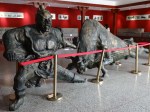
These breakthroughs have been largely achieved during burial excavations, with the objectsfound revealing the relationship between emperors and feudal princes. Terracotta warriorsare some of the best examples of the imperial power, which come from the mausoleum of LiuQi (188-141 BC), the empire’s fourth emperor, which has been turned into a museum in Xi’an.Visitors will also see lamps and incense burners from the tomb of Liu Sheng (165-113 BC),son of Liu Qi and titled Prince Jing of Zhongshan. . . . .

READ MORE