2000s

Art I Love ~ Street Art

#StreetArt:

The art of Burning Man: skeletons, temples and flaming Tetris

“The art of Burning Man: skeletons, temples and flaming Tetris”

by Steven W Thrasher via “The Guardian

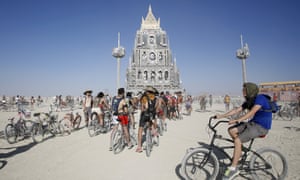
Festivalgoers gather at the Totem of Confessions at Burning Man.

Burning Man is not the typical place people would go to view art in the “default world” (the term “Burners” have for the “muggle world” those of you who are not here in Black Rock City inhabit). It’s extremely hard to get here – far less accessible than most public municipal art – and upon arrival, it is more physically inhospitable than the most uptight New York art gallery.

It’s so filthy here that the least dusty place you visit each day is a port-a-potty, and the cleanest part of your body is the inside of your shoe – not exactly the way you feel when visiting the Museum of Modern Art.

But Burning Man is a launching site of the most interesting and fun large-scale public art, architecture and public planning projects on the face of the planet. Many pieces get major exposure here before being placed elsewhere. Long before the Big Rig Jig hovered in Banksy’s Dimsaland, the Raygun Gothic Rocket Shiplanded in San Francisco, or Cube-a-tron arrived in Zurich’s train station, I saw it years ago here on the playa.

Burning Man is also a beautiful locale for viewing the bigger picture, from the curvature of the earth to the stars and the moon. And, for all the tech-enabled festivalgoers (or “burners”) among the 70,000 people in attendance this year, cell service is so poor that it’s very rare to see people holding phones or even taking pictures. The experience of looking at art and nature without a screen – and actually talking to other people about it – makes the festival a great way to experience new works.

Here’s a guide to a few of this year’s most interesting art and architecture projects, large and small – not including the Burning Man himself, immolated on Saturday night. If you can’t imagine schlepping all the way into the desert to see them, it’s OK: some of the ones not burned to the ground may very well be coming to a public plaza near you.
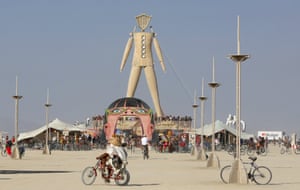
The Man dominates the Playa.

Straightedge and 2πR by Ardent Heavy Industries
Advertisement

One of the most ambitious project at this year’s burn – and at 2.6 miles long, the physically largest project ever built here – is the cerebral but playful Straightedge by Ardent Heavy Industries. Straightedge illustrates the curvature of the earth, and dispels our visual assumption that any stretch of the planet is as flat as it looks. The collective of artists achieves this by placing poles 50 feet apart for 2.6 miles, each adorned with two LED lights controlled by satellite to blink in unison. At one end of Straightedge, the lights are right next to each other. But one line of lights follows the surface of the actual earth: the other is actually straight. At first, the two lines start to drift apart incrementally by inches. By the end of the 2.6 miles, they lines are about five feet apart, and shattering the idea that the flat looking playa is so level after all.

Ardent Heavy Industries also returned to Burning Man this year with an updated version of 2πR, a delightful interactive piece where users dance on a circular stage and their movements create corresponding bursts of flames around them. It’s a slightly safer cousin of AHI’s infamous piece Dance Dance Immolation, in which participant would dance in a flame-retardant suit; when they put a foot wrong, they would be blasted by fire. (As Ardent member KC Crowell explained, Dance Dance Immolation won the Guinness Record for Hottest Video Game and the project was destroyed in a blaze of glory “by dropping a piano on it” a couple of years ago.) . . . .

READ MORE

THIS ARTIST’S POP CULTURE OREO ART IS JUST TOO AWESOME TO EAT

“THIS ARTIST’S POP CULTURE OREO ART IS JUST TOO AWESOME TO EAT”

by Joe Berkowitz via “Fast Co Create

Some artists prefer acrylics. Others are into clay. For Tisha Cherry, however, Oreos are where she dunks her inspiration.

“Two years ago, I twisted open an Oreo and thought the cream looked like a Nike Dunk,” Cherry says. “I immediately became obsessed with trying to see how many different things I could create out of them. Now, I feel like I’m looking at the world through some sort of Oreo crème lens and it’s become my favorite medium to express my creativity through.”

Cherry’s Oreo art absorbs everything from pop culture to fine arts. She’s just as likely to recreate the poster from Jaws as she is the work of Mondrian. And she’s been documenting it all on her Instagram page.

So far, the biggest challenge she’s faced is recreating the famous “American Gothic” painting. (A piece of art with which Amy Schumer is intimately familiar.) Creating portraits on a small surface with Oreo crèmes is apparently even more difficult and complex than it looks—and it already looks like a cavalcade of tiny details.

But the amount of effort required to imprint such extraordinary detail on such a tiny canvass is a difficult task Cherry is more than willing to meet head-on.

“A lot of my art is trial and error and that’s what makes it fun,” she says. “So I usually try to pursue any idea and everything that inspires me regardless of how challenging it might be.” . . .

READ MORE

Stairway to heaven: Artist creates stunning 1,650ft ladder in the sky with FIREWORKS

“Stairway to heaven: Artist creates stunning 1,650ft ladder in the sky with FIREWORKS”

by Edward Chow and Emily Chan via “Daily Mail

  • Cai Guoqiang used metal and gunpowder for the show in Quanzhou, China
  • The ladder, which measured 18ft wide, was taken up using a hot air balloon
  • Artist drew a draft of the show 21 years ago when he visited Bath, England
  • It was a labour of love for Mr Cai’s elderly grandmother who raised him
  • Same artist designed the spectacular fireworks to open Beijing Olympics  

A Chinese artist has found a unique way to express his love to his grandmother: a gigantic staircase in the air.

These stunning photographs show the 1,650ft ladder, which was made with fireworks, stretch right up into the sky in Quanzhou, south-eastern China, on Monday.

This is the work of Cai Guoqiang, an artist who is originally from the city and now based in New York, reported the People’s Daily Online.

Sky Ladder: A Chinese artist has created this incredible burning ladder that stretches for 1,650ft into the sky

Sky Ladder: A Chinese artist has created this incredible burning ladder that stretches for 1,650ft into the sky

Lit up: The artwork, called 'Sky Ladder', is  the artist's way of thanking his grandmother who raised him

Lit up: The artwork, called ‘Sky Ladder’, is the artist’s way of thanking his grandmother who raised him

The ladder, which was made of metal wire and aluminum, was filled with gunpowder and attached to the bottom of a hot air balloon.

The balloon, which was made with special material, was launched from a boat off the shore of nearby Huiyu Island.

Called the ‘Sky Ladder’, the project started off as a dream for Mr Cai 21 years ago when he was visiting Bath, England. He designed the performance by drawing a draft of the design on the window of an art gallery.

He said he wanted to put on a spectacular fireworks show to thank his grandmother for supporting his dream of being an artist.

‘My grandma was born in a small fishing village in Quanzhou and sold fish to help her grandson realise his artistic dream,’ the artist revealed. . . . .

READ MORE

TaiwanFest showcases culture, art, and paper cranes

“TaiwanFest showcases culture, art, and paper cranes”

by Alison Shouldice via “The Star

Harry Chen folded 2,345 paper cranes while recovering from kidney cancer.

For Harry Chen, a folded paper crane is a hope for many things: freedom, democracy, world peace — and his own good health.

Chen, a Taiwanese-Canadian, has recently made a habit of folding small origami paper cranes.

He has also spent the last two years living with kidney cancer.

“When I was in the hospital, I started to fold those things,” he said, but it’s a skill he’s had for some time. At six years old, his kindergarten teacher first taught him origami to stop his crying.

After undergoing surgery, chemotherapy and radiation, Chen’s cancer is now under control. In July 2014, when he was out of the hospital but still recovering, he began folding more cranes in his spare time: on the bus, in the doctor’s waiting room and while out shopping with his wife.

He was inspired by the story of Sadako Sasaki, a Japanese girl who famously attempted to fold 1,000 paper cranes in 1955 for good health. Sasaki developed leukemia after she had been exposed to radiation from the Hiroshima atomic bomb as a young child.

With Sasaki in mind, Chen kept folding, and just 10 months later, he stopped at 2,345: a representation of Taiwan’s 23.45 million population.

Chen is displaying his cranes, attached onto mobiles, at TaiwanFest this weekend at the Harbourfront Centre. On Friday evening, a crowd had already gathered around Chen’s display.

Organizers expect up to 50,000 people to pop in between Friday and Sunday for the festivities.

In addition to Chen’s mobiles, there are several other art and cultural pieces on display throughout the Harbourfront grounds. The festival is multidisciplinary, incorporating art, music, culture and food.

It’s held for two weekends back to back: this weekend in Toronto the next in Vancouver. The guests tend to be Taiwanese-Canadians coming from all areas of the city, according to the festival’s managing director Charlie Wu.

But the event is also for Torontonians who may not know a lot about Taiwan.

“It’s important for TaiwanFest to be in downtown venues,” Wu said. “We always feel that Taiwanese-Canadians and Asian-Canadians like to share their cultures in a more mainstream environment where other Canadians get to see it.”

Diverse programming is the key to attracting non-Taiwanese Canadians to the festival, he said. For instance, this year, they are hosting a fashion designer whose heritage is of Taiwan’s indigenous peoples, who dwelled on the island for thousands of years before the now-predominant Han Chinese began arriving in numbers in the 17th century. It’s hoped that presence of the designer, known simply as Andre, attracts Torontonians with a general interest in fashion or indigenous peoples’ culture and art. . . . .

READ MORE