Copyright: The Constitutional Background

***This is not intended to be legal advice. First, this is an ESL Primer, and so is fairly simplified. Second, each person’s situation is different.  Please contact your attorney for legal advice as it applies to you!! 

Copyright:

The Constitutional Background

by Profs. Olivia L. Blessing, JD and Angela K. Blessing, MBA, JD

 via “Cultured Muse

Introduction

When asked to think back to the American Constitution, many Americas recall dusty memories of political office age restrictions and voting laws. Yet, the founding fathers were not only devoted to taxes and wars; they were interested in cultural and scientific issues as well.

In fact, they considered art and inventions so important to American culture and development as to warrant Constitutional protection. In America, the Constitution is the highest law in the country, it trumps everything.  If it is in the Constitution, it is extremely important to the Government. And Copyright protection is one of those extra important issues the Government is involved in.

So what exactly does the Constitution say?  As we saw before, Article 1, Section 8 of the U.S. Constitution says Congress has the power “to promote the progress of science and useful arts, by securing for limited times to authors and inventors the exclusive right to their respective writings and discoveries.”

Cool! Now, what does that mean?

Basically, it means that the Government encourages the arts and sciences by offering authors and inventors the right to stop anyone else from copying or using their writings or inventions for a limited amount of time.

More specifically, there are two things of note revealed in this rule.

  1. Copyright belongs to Federal Law

“Congress has the power. . . “

We are not going to get into the distinctions between U.S. federal and state government here; the concept is difficult enough for law students and needs no confusing explanations here.  Suffice to say, any argument or issue regarding Copyrights is going to end up in Federal Court with Federal Judges and controlled by Federal Law.  “Federal” meaning the national government based in Washington, D.C.  Think President, Supreme Court, the Senate, and the House of Representatives.

This is convenient in that artists and business professionals only need to remember the Federal approach to the law rather than struggling with 50 different states’ rules.

We’ll talk more about the  actual laws itself later.

  1. The Federal Govern Has a Very Specific Reason for Enforcing Copyright Law

“[T]o promote the progress of science and useful arts. . .”

Why on earth would the National Government get involved in the subject of rewarding author’s and creator’s for their work? It’s not like the Government is usually involved in business affairs such as this—they don’t honor plumbers for their work on the pipes or protect firefighters for their time fighting fires.  What makes “artists” and “inventors” so special that they get extra governmental rewards?

First of all, the purpose for Copyright protection is not to reward the artist.  It is to promote the sharing of knowledge, ideas, and information with the public who can use it to promote the public good. As the Supreme Court has explained, the Copyright Clause in the Constitution is intended to realize “the creation and dissemination of information. . . .[promoting] knowledge and learning” (Eric Eldred v. Ashcroft, 537 U.S. 186 (2003)).   They went on to say, the Clause accomplishes this goal by “motivating the creative activity of authors” via “the provision of a special reward.” (Sony Corp. of America v. Universal City Studies, Inc., 464 U.S. 417, 429 (1984)).  By offering a reward (a certain time during which the creator controls the use of their work), the Government encourages them to share it with the public thus benefitting society as a whole.

  1. What is the General Result of Copyright Law?

All in all, a Copyright gives the inventor a monopoly over the use of their work for an extensive period of time.

Traditionally, Americans have been adverse  to monopolies, but in the case of Copyrights it is generally considered a good thing that benefits society in the long run.  There are three primary results that Congress believes Copyrights achieve:

The Creation of New Ideas.  There is a reason developing countries focus so intention on “innovation” and “entrepreneurship.” Without this, the society stagnates and ceases to grow and improve.  Only with the introduction of new ideas, inventions, or discussions will the public continue to find new methods of becoming better and better versions of themselves.

Thus Congress offers inventors and creators a limited time of protection so that they might benefit from their work and thus be encouraged all the more to share what they discover with society.

First, it is during that time that the author or inventor will profit the most from their work. Think about it.  Once a book is available free online and people have free access to it, does the original creator make as much money as they do when they control all the prices and places where the book is sold?  No. Once you lose control, you start to lose money.  So in exchange for them sharing their creation with the world, Congress gives them a limited time to benefit monetarily.

Second, this protection gives the creator a great deal of control–monitoring who can sell, who has access, who can use the work and for what purpose.  Because of that control, they supposedly are more comfortable sharing their new findings.  Let’s say you are a really great film-creator, but your newest historical work deals with mature topics–illnesses, death, war.  You want people to have access to your movies, but you strongly believe that children younger than 13 are too young.  With a Copyright, you have the right to tell the theatres and sellers that the film must include a warning against showing it to children.  You also know that no one will distort your work or change your message because the Government will punish them if they do.  Because you have that control, Congress believes you feel more comfortable sharing your work with the world.

Fairness.  American law was founded upon the important concept of “fairness”—what is the most fair thing to do?  Fairness is why courts enforce contracts, why bad production is punished under torts, and why criminals are guaranteed a lawyer.  In our hearts, it seems only fair that people who work hard to create something should be rewarded for their hard work so long as the public still benefits. As John Locke, a great English philosopher, said “Every man has a property in his own person: this no body has any right to but himself. The labour of his body, and the work of his hands, we may say are properly his”(Locke, “Second Treatise of Civil Government“).

 The Dissemination of Those Ideas Freely Amongst the Public. The government does not want the creator to have a permanent monopoly over the work or concept forever.  Society will not improve unless the public can actually use the new inventions and ideas in their own lives and work.

Remember the use of the word “limited” in the Constitution.   After the time runs out, the idea/work belongs to the public and is free for their use.  They can in turn build upon it or work with it to create even newer ideas or inventions.

CONCLUSION

Having decided that Copyright is the best way to protect your efforts, you need to understand what Copyrights do and how the Government views them.  You benefit from the fact that Copyright protection was important enough to be in the Constitution; this means that the court should take your situation very seriously.  As an element of Federal Law, your protection goes beyond simply your local state or city—it extends nationwide. Furthermore, it is comforting to know that fairness is so important to the courts and that they are prepared to offer you an incentive for sharing what you’ve learned.

However, don’t forget that the final purpose of the law is not to benefit you but to benefit society as a whole.  Fairness is important, but it is not your strongest selling point if you are in a court case.  The government is primarily looking out for the interests of society, and that is where your strongest argument for the protection of your work should come from.  You need to convince the Government that by offering you this protection, they will be ultimately  helping to improve and help the  public.


Coming Exhibition: Bharti Kher~ Not All Who Wander Are Lost

Bharti Kher:

Not All Who Wander Are Lost

Who:  

Isabella Stewart Gardner Museum

When: July 1, 2015 – January 31, 2016 (Hours Vary)

Where: 

Isabella Stewart Gardner Museum
25 Evans Way
Boston, MA 02115

More Information: Here.

Bharti Kher is the sixth artist-in-residence invited to create a temporary site-specific work for the Museum’s façade. Kher’s project reflects on maritime travel, highlighted by her interest in mapping and typography and references the migration of people in Africa, the Middle East and Europe. Kher uses bindis, a popular forehead decoration worn by women in India, and a signature element in her work, to map demographic movement in an abstract way.

Bharti Kher’s (b. 1969, England) is an art of dislocation and transience, reflecting her own, largely itinerant life. Born and raised in England, the artist moved to New Delhi in the early 1990s after her formal training in the field. Consequently, the concept of home as the location of identity and culture is constantly challenged in her body of work. In addition to an autobiographical examination of identity, Kher’s unique perspective also facilitates an outsider’s ethnographic observation of contemporary life, class and consumerism in urban India.

Presently, Kher uses the bindi, a dot indicative of the third eye worn by the Indian women on their foreheads, as a central motif in her work. Bharti Kher often refers to her mixed media works with bindis, the mass-produced, yet traditional ornaments, as “action paintings.” Painstakingly placed on the surface one-by-one to form a design, the multi-colored bindis represent custom, often inflexible, as well as the dynamic ways in which it is produced and consumed today. The artist is also known for her collection of wild and unusual resin-cast sculptures and her digital photography.

How my family recovered a painting stolen by the Nazis and sold it for $2.9 million

“How my family recovered a painting stolen by the Nazis and sold it for $2.9 million”

by Peter J. Toren via “Yahoo! News

toren2.jpg

On a warm, humid June evening on Regent Street in London, among the fanciest stores in the world, the international art auction house, Sotheby’s, auctioned the Max Liebermann painting Two Riders on a Beach, for many times the pre-sale estimate to an unknown buyer. The painting, a 1901 scene of two elegantly dressed men riding chestnut horses with the surf breaking behind them, belonged to my great great uncle David Friedmann, and was stolen from him by the Nazis.

I saw the painting in person with my son for the first time the day before the auction. German tax investigators found the painting in the Munich home of Cornelius Gurlitt, the son of the infamous art dealer to the Nazis, Hildebrand Gurlitt. Two Riders was part of a 1,200-work trove that was found in Gurlitt’s home in Munich, which included some invaluable pieces that had been stored in tomato crates. While a number of the other works were likely also stolen from Jewish owners, the German government has only returned one painting to its rightful Jewish owner other than Two Riders.

The history of the painting, and especially its recovery, represents a story of success, struggle, survival and redemption that many Jewish families have gone through in the last 100 years.

David Friedmann’s family, a wealthy and successful German-Jewish family, owned a 10,000-acre sugar beet farm, that included a distillery for making schnapps and a “castle,” near Breslau, now Wroclaw in western Poland. Friedmann was an avid collector of art, and in addition to Two Riders, also owned works by Camille Pissarro, Gustave Courbet, Jean Francois Raffaelli, and Henri Rousseau, along with a remarkably comprehensive collection of Italian, German and Dutch fine pottery.

Villa Grisebach, the German auction house, also sold from the Gurlitt trove another Liebermann, The Basket Weavers, looted from Friedmann. My father, who vividly remembers Two Riders hanging in a sunroom in Friedmann’s home in Breslau, recalls him as a kindly, though imposing man, who liked to give parties, attended by German intellectuals including the composer Richard Strauss.

My father and his brother were the only members of his family to survive the Holocaust and as a child of a survivor, I grew up listening to my father tell me stories of my family’s German history and the connection to David Friedmann. My grandfather was a prominent lawyer in Breslau, and as dispensation for serving as a Colonel in the German Army in the First World War, he was able to continue to represent Jewish clients even after other German Jewish lawyers could no longer do legal work. On November 10, 1938, the morning after Kristallnacht, when Jewish stores and businesses were looted, and Jews were beaten and killed, my grandfather was required to assist Friedmann in “selling” some of his property to the Nazi General Ewald von Kleist. . . . .


 READ MORE

Some of World’s Best Art Is Made in Cuba

Some of World’s Best Art Is Made in Cuba”

by Miles Mogulescu via “Huffington Post

2015-07-08-1436377643-9188006-Cuba2015Canon099.JPG

Cuban artists are creating some of the most exciting and innovative contemporary art in the world. The best Cuban art can stack up against the best contemporary art being created in New York, Los Angeles, Paris, London or other world art centers, while still maintaining an essential Cuban spirit.

That’s my observation after returning from the 12th Havana Art Biennial in June and spending a week visiting with some of Cuba’s leading artists in their homes and studios.

The trip coincided with a tipping point in US-Cuban relations. A week after our return, the US and Cuban governments announced that after a 54-year schism, they are reopening embassies in each others’ Capitals on July 20th, even though the US embargo of trade with Cuba remains in place and may only be lifted by an act of Congress.

“Cuba probably has more artists per capita than any country in the world,” says Sandra Levinson, Executive Director of the Center for Cuban Studies and Curator of the Cuban Art Space, one of the few places where US citizens can purchase first-rate Cuban art without personally travelling to Cuba.

“I think Cubans are dreamers and poets from birth and put their dreams and their poetry into music and art,” adds Levinson, who has been leading people-to-people visits to Cuba for decades. (She accompanied Jack Nicholson on a 2-hour visit with Fidel Castro.)

And I think Cuba as a nation recognizes the importance of art because Cubans are artists from birth, in the way they live, in the way they produce, in the way they construct their lives. They are not the most practical people in the world — practical people don’t make revolutions — but they are super smart, and they relate to one another. That’s allowed them to build a real community, and if you live in a real community you can accomplish miracles.

In addition, the multiple dualities in Cuban reality engender a creative tension which can lead to unique forms of artistic expression, found in few other countries in the world.

Cuba has been somewhat isolated from its nearest neighbor due to the 54-year-old US economic blockade; but at the same time, Cuban artists are highly educated, sophisticated and aware of what’s going on the rest of the world in general and the art world in particular.

Cuban artists are still driven more by their own creative muses than by the dictates of the commercial art market. They often depict the creative tension between consumerism and Cuba’s shortage of consumer goods. And their work often slyly, and not so slyly, critiques social conditions in Cuba. A lot of Cuban art includes strikingly contemporary takes on gender identity, race and sexuality.

As Levinson told me, “the arts, including visual arts, music and poetry may be Cuba’s greatest exports.” . . . .

READ MORE

Artists (and Others) Talk About Art and Destruction

“Artists (and Others) Talk About Art and Destruction”

by John Seed via “Huffington Post

“Every act of creation is first of all an act of destruction.” ― Pablo Picasso

During my last year of graduate school one of my art professors came by my studio one evening to lead a group critique session. “Someday,” he told me, “you will have a storage problem.”

Those were wise words. I took most of my graduate school work to the dump two years later.

2015-07-01-1435781730-1494350-dump.jpg

The author’s post grad school dump run

Being an artist means making things, and those things can pile up fast. Only lucky works of art survive — or deserve to survive — while numerous other works are slashed, smashed, burned or trucked to the dump.

When I recently asked artist friends on my Facebook page to tell me stories about art and destruction I found that I had opened up a nerve-hitting topic. Artists destroy works both during and after their making, and they both savor and sometimes later regret their destructive impulses.

Here, in edited form, are some of the many anecdotes, comments and bits of wisdom that artists and others had to offer on the topic of art and destruction.

***

‪Stacy Rosende Bykuc‬‬‪

“Every piece has several destroyed compositions beneath. I call it ‘process.’ If a piece sucks, it’s just not done.‬‬‬”

‪April Zanne Johnson‬‬‪

If, as an artist, you love everything you make all the time and are never self-critical, it is impossible to grow and evolve‬‬‬.

‪Maria Teicher‬‬‪

“Shredded by hand with a razor (or ripped if paper)… the sound is intoxicating and freeing. Never had a single regret. I took photos before so I had it archived but have never looked back. I do a purge of work every 3-4 years and it’s great. Not everything goes but those I am not proud of or works that have lost their meaning in my life.‬‬‬”

Kate Shepherd

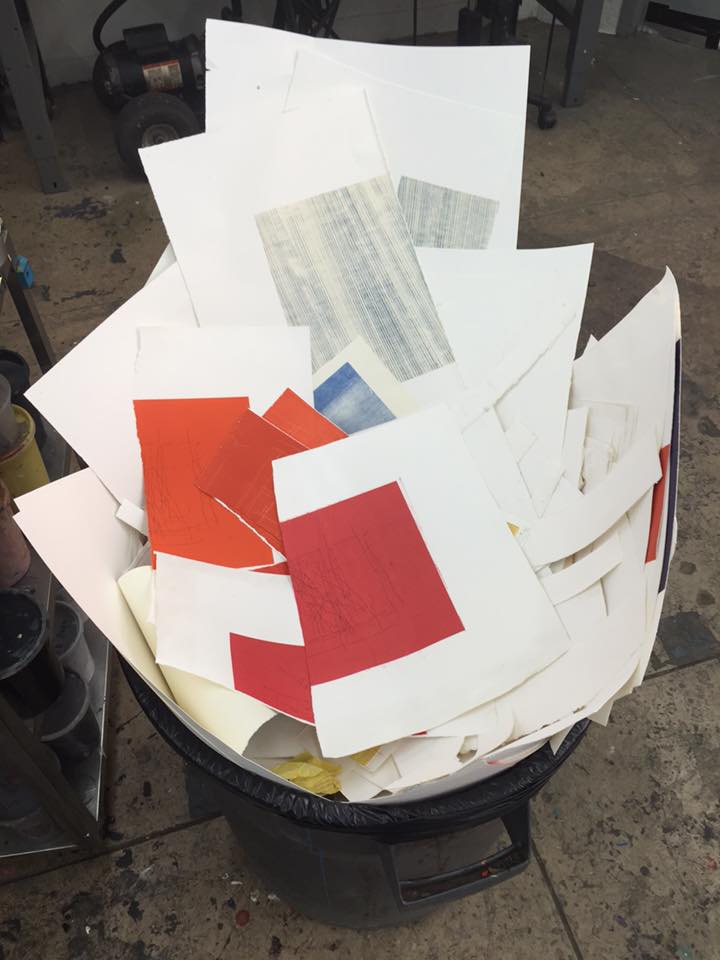
Just today. Etchings.

2015-07-01-1435780291-2877951-Kate.jpg

Nathan Lewis

“I destroyed a 52 ft. wide painting. Tired of storing. Tired of hanging onto it. Some things are better in memory.”

Lauren Levato Coyne

“In an essay I just posted I detail throwing a six foot drawing out the window. No regrets.”

‪Joe Fay‬‬‪

“When I left LA I threw out a few really old paintings in the dumpster at my studio. Before I left I saw a homeless person had made a shelter out of them. I was happy. More recently I’ve been cutting up and recycling old paper pieces and using them on my painted wall reliefs.”

‪Kenn Raaf‬‬‪

“75% of the finished work I do is deconstructed. Cut, torn, burned, sanded and then reassembled and recomposed into something radically different. As for paper used in sketch work I oftentimes cut into strips and weave to use as texture in my abstract work, and filler in my sculpture.‬‬‬” . . . .

2015-07-01-1435777525-6647126-paintings_flames.jpg

Digital collage by Photofunia.com based on a photo by David Michael Slonim


READ MORE