Art

Arrests over 18th Century icon theft from Chester Cathedral

Arrests over 18th Century icon theft from Chester Cathedral

via “BBC

The artwork seized by police

Five people have been arrested over the theft of an 18th Century piece of religious art from Chester Cathedral.

Police discovered the Greek Orthodox icon “The raising of Lazarus”, which was stolen in August, at a property in Edleston Road, Crewe, on Wednesday.

Officers also seized other artworks at the property and said they were trying to identify where they have come from.

Four men aged between 31 and 59 and a 57-year-old woman are being questioned over the theft.

The icon was gifted to the cathedral by the late Dean Ingram Cleasby’s family.

Vice Dean, Canon Peter Howell-Jones said it was taken from the altar of the Chapel of Saint Anselm and a small Christmas tree decoration of an angel was left in its place. .. . .

READ ORIGINAL

Chicago Tops the World’s Best Museum List – Guess Who Else Made the Cut?

“Chicago Tops the World’s Best Museum List – Guess Who Else Made the Cut?”

by Greg Keraghosian via “Yahoo News

Chicago Tops the World’s Best Museum List – Guess Who Else Made the Cut?

The Art Institute of Chicago was founded in 1879, but it still must be winning visitors over, because for the second straight year it was named the most-liked museum in the U.S. in TripAdvisor’s Travelers’ Choice awards. This year, it was also named the world’s favorite.

The Getty Center of Los Angeles also drew high marks as the second-favorite museum in the U.S. and fourth favorite in the world.

TripAdvisor bases the awards on millions of reviews and opinions from their members, spread out over 12 months. The site says it uses an algorithm that measures the quantity and quality of reviews to determine the winners

The Art Institute rose from No. 3 in the world last year to No. 1 this year. It has 300,000 pieces of art from the likes of Vincent van Gogh, Paul Gauguin, Claude Monet, Rembrant, and many other famous artists. Among the most famous works is “American Gothic,” that famous 1930 farmer/pitchfork painting by Grant Wood. . . . .

READ MORE

“Australia Returns Two Stolen Ancient, Priceless Idols to India”

“Australia Returns Two Stolen Ancient, Priceless Idols to India”

via “IBNLive.com”

New Delhi: Australian Prime Minister Tony Abbott who is on a state visit to India is returning two looted idols seized from Australian museums during a meeting with the Prime Minister Narendra Modi in New Delhi on Friday.

Abbott is personally delivering the National Gallery of Australia’s Rs 30 crore ($5 million) Dancing Shiva or Nataraja Ardand and the Art Gallery of New South Wales’s Rs 2 crore ($300,000) Ardhanarishvara to Modi as a “gesture of good will” at a state reception at the Rashtrapati Bhawan in the evening.

Both priceless objects were stolen from temples in India and later sold to the museums by Manhattan dealer Subhash Kapoor, who, his gallery manager has admitted, created falsified ownership documents to hide their illicit origins.

Australia returns two stolen ancient, priceless idols to India

Australian Prime Minister Tony Abbott is personally delivering the Dancing Shiva or Nataraja Ardand and Ardhanarishvara to Narendra Modi.

The Australian returns mark the first major repatriations in the Kapoor case, but are unlikely to be the last. Dozens more Kapoor objects acquired by the Australian museums were sold with false ownership histories similar to those used with the returned objects. Several will likely play a prominent role in Kapoor’s criminal trial in Chennai, India, which has been on hold pending the return of the NGA’s looted Shiva says an exclusive website for the Hunt for Looted Antiquities in the World’s Museums ‘Chasing Aphrodite’.

The Tamil Nadu Police had produced evidence to establish that the idol was stolen from a temple at Sripuranthan in Tamil Nadu. They had arrested Kapoor for his alleged involvement in the theft. He is now lodged in the Chennai prison and is facing trial.

Meanwhile, Kapoor’s international network of looters and smugglers is still being mapped by authorities in the United States, who have already seized over Rs 600 crore ($100 million) in art from the dealer’s Manhattan gallery and storage facilities.

Federal investigators in the United States are methodically working through mountains of evidence seized from Kapoor, probing his ties to a number of American and foreign museums that did business with the dealer. Indian authorities, meanwhile, are considering a broader campaign to reclaim stolen antiquities from foreign institutions.

Over the past two years, we’ve traced hundreds of suspect Kapoor objects to museums around the world. To date, the Kapoor case has received the most attention in Australia, whose National Gallery for months stonewalled press and government inquiries and dismissed mounting evidence before agreeing to take the stolen idol off display. The Art Gallery of New South Wales took a slightly more proactive approach, releasing the ownership history that Kapoor supplied for its sculpture of Ardhanarishvara (left.) Soon after, Indian art blogger Vijay Kumar identified the temple from which the sculpture was stolen. . . . .

READ MORE

The Ruth E. Aten World Doll Collection: Americas

The Ruth E. Aten World Doll Collection: Americas 

via “Department of Folklore and Ethnomusicology”

Caribbean

Caribb1. Nassau, Bahamas. Junkanoo Doll. 9 ½ “Junkanoo is a carnival-like parade that takes place in the Bahamas on December 26th and January 1st annually. The parade grew out of celebrations held by African slaves at Christmas time. Today, groups of paraders known as Junkanooers compete against each other for cash prizes. Groups range in size from 10 to 1000 people. All group members wear elaborate costumes made from strips of colorful crepe paper pasted onto cardboard that has been shaped into a variety of forms. Junkanoo is accompanied by music performed on traditional Junkanoo instruments such as cowbells, foghorns, whistles, conch shells and goatskin Goombay drums, as well as “modern” wind instruments such as trumpets, trombones and tubas.Given by Nina Wood (student). Nina was from Nassau and arranged for a personal tour guide on one our trips to Nassau. My husband, Bob, and I actually got a chance to see a parade. 1996 Junkanoo Doll, Nassau, Bahamas
Caribb2. St Thomas, Bahamas. Bahamas Girl. 2’ Stuffed cloth dolls with long legs, yarn hair with scarf, polka dotted top and flowered skirt. Given by Ruth Aten. 1995 Bahamas Girl, St. Thomas, Bahamas
Caribb3. Matanzas, Cuba. Black Cuban Doll. 10” Stuffed black cloth doll with pearl earrings, blue and white plaid head wrap and dress with yellow rickrack trim and blue ruffles. Given by John McDowell (faculty). 2000 Black Cuban Doll, Matanzas, Cuba
Caribb4. Nassau, Bahamas. Straw Doll. 16” Woven straw doll with orange straw pom-poms on hat, dress and shoes. Doll was purchase in Nassau at the Straw Market. It was a popular souvenir doll. The famous Nassau Straw Market burned down shortly after this doll was purchased. Given by Ruth Aten from a trip to Nassau. 1995 Straw Doll, Nassau, Bahamas
Caribb5. St. Maarten, Bahamas. Bahamas Lady. 12” Painted wood ball head on dowel frame with wood bead arms and stuffed body.  Doll dressed to depict current fashion in St. Maarten with flowered print skirt and head wrap. Given by Ruth Aten from a trip to St. Maarten. 1995 Bahamas Lady, St. Maarten, Bahamas

READ MORE

Organized Crime, Military Linked to Theft of Cambodian Artifacts

Organized Crime, Military Linked to Theft of Cambodian Artifacts

by Robert Carmichael via “VOA News

Seoul

 —

Over the past 40 years Cambodia’s cultural heritage has been looted on a massive scale, with countless thousands of artifacts taken from hundreds of sites, smuggled out of the country and into museums and private collections around the world. New research indicates that not only was much of this the work of organized networks, but that most pieces have disappeared from public view – probably forever.

Between the start of Cambodia’s civil war in 1970 and the eventual end of hostilities some 30 years later, the country’s 1,000-year-old temples and other historic sites were comprehensively plundered. In one incident in the early 1970s, government soldiers used a military helicopter to airlift artifacts from the 12th century citadel of Banteay Chhmar in the northwest.

At the same complex in 1998 – generals spent a fortnight tearing down and carting away 30 tons of the building. Just one of the six military trucks that went to neighboring Thailand loaded with artifacts was stopped and its contents returned. The rest disappeared, likely sold on the black market.

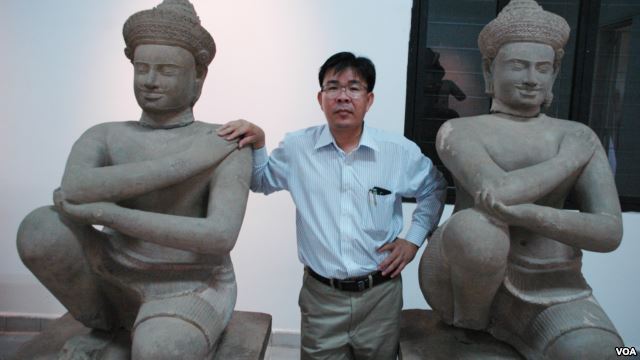
The Duryodhana statue is one of three returned to Cambodia from the United States in early June, Phnom Penh. (Robert Carmichael/VOA)The Duryodhana statue is one of three returned to Cambodia from the United States in early June, Phnom Penh. (Robert Carmichael/VOA)

For many years, researchers assumed that such brazen, well-organized looting was the exception rather than the norm, and that most of the looting of Cambodia’s heritage was a low-level affair, with local people plundering ancient sites and selling statues, carvings and stone reliefs in haphazard fashion.

But a new study carried out by researchers from the University of Glasgow in Scotland shows that was not the case.

“The organized looting and trafficking of Cambodian antiquities was tied very closely to the Cambodian civil war and to organized crime in the country,” explained Tess Davis, a lawyer and archaeologist, and member of the study team that also included criminologists.

“It began with the war, but it long outlived it, and was actually a very complicated operation, a very organized operation, that brought antiquities directly from looted sites here in the country to the very top collectors, museums and auction houses in the world,” she added.

Davis said the Cambodian and Thai militaries were often involved in looting, as was organized crime. Local people were often forced to work as laborers.

Researchers say that at the end of the chain in Thailand was a Bangkok-based dealer who provided the laundering link between the criminals and the collectors and museums.

READ MORE