“What the Internet’s free culture has cost us in art”
via “PBS Hours“
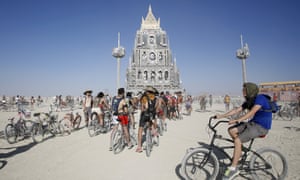
Burning Man is not the typical place people would go to view art in the “default world” (the term “Burners” have for the “muggle world” those of you who are not here in Black Rock City inhabit). It’s extremely hard to get here – far less accessible than most public municipal art – and upon arrival, it is more physically inhospitable than the most uptight New York art gallery.
It’s so filthy here that the least dusty place you visit each day is a port-a-potty, and the cleanest part of your body is the inside of your shoe – not exactly the way you feel when visiting the Museum of Modern Art.
But Burning Man is a launching site of the most interesting and fun large-scale public art, architecture and public planning projects on the face of the planet. Many pieces get major exposure here before being placed elsewhere. Long before the Big Rig Jig hovered in Banksy’s Dimsaland, the Raygun Gothic Rocket Shiplanded in San Francisco, or Cube-a-tron arrived in Zurich’s train station, I saw it years ago here on the playa.
Burning Man is also a beautiful locale for viewing the bigger picture, from the curvature of the earth to the stars and the moon. And, for all the tech-enabled festivalgoers (or “burners”) among the 70,000 people in attendance this year, cell service is so poor that it’s very rare to see people holding phones or even taking pictures. The experience of looking at art and nature without a screen – and actually talking to other people about it – makes the festival a great way to experience new works.
Here’s a guide to a few of this year’s most interesting art and architecture projects, large and small – not including the Burning Man himself, immolated on Saturday night. If you can’t imagine schlepping all the way into the desert to see them, it’s OK: some of the ones not burned to the ground may very well be coming to a public plaza near you.
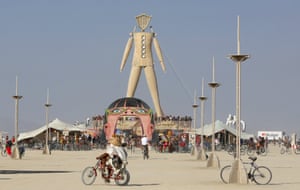
Straightedge and 2πR by Ardent Heavy Industries
Advertisement
One of the most ambitious project at this year’s burn – and at 2.6 miles long, the physically largest project ever built here – is the cerebral but playful Straightedge by Ardent Heavy Industries. Straightedge illustrates the curvature of the earth, and dispels our visual assumption that any stretch of the planet is as flat as it looks. The collective of artists achieves this by placing poles 50 feet apart for 2.6 miles, each adorned with two LED lights controlled by satellite to blink in unison. At one end of Straightedge, the lights are right next to each other. But one line of lights follows the surface of the actual earth: the other is actually straight. At first, the two lines start to drift apart incrementally by inches. By the end of the 2.6 miles, they lines are about five feet apart, and shattering the idea that the flat looking playa is so level after all.
Ardent Heavy Industries also returned to Burning Man this year with an updated version of 2πR, a delightful interactive piece where users dance on a circular stage and their movements create corresponding bursts of flames around them. It’s a slightly safer cousin of AHI’s infamous piece Dance Dance Immolation, in which participant would dance in a flame-retardant suit; when they put a foot wrong, they would be blasted by fire. (As Ardent member KC Crowell explained, Dance Dance Immolation won the Guinness Record for Hottest Video Game and the project was destroyed in a blaze of glory “by dropping a piano on it” a couple of years ago.) . . . .
Some artists prefer acrylics. Others are into clay. For Tisha Cherry, however, Oreos are where she dunks her inspiration.
“Two years ago, I twisted open an Oreo and thought the cream looked like a Nike Dunk,” Cherry says. “I immediately became obsessed with trying to see how many different things I could create out of them. Now, I feel like I’m looking at the world through some sort of Oreo crème lens and it’s become my favorite medium to express my creativity through.”
Cherry’s Oreo art absorbs everything from pop culture to fine arts. She’s just as likely to recreate the poster from Jaws as she is the work of Mondrian. And she’s been documenting it all on her Instagram page.
So far, the biggest challenge she’s faced is recreating the famous “American Gothic” painting. (A piece of art with which Amy Schumer is intimately familiar.) Creating portraits on a small surface with Oreo crèmes is apparently even more difficult and complex than it looks—and it already looks like a cavalcade of tiny details.

But the amount of effort required to imprint such extraordinary detail on such a tiny canvass is a difficult task Cherry is more than willing to meet head-on.
“A lot of my art is trial and error and that’s what makes it fun,” she says. “So I usually try to pursue any idea and everything that inspires me regardless of how challenging it might be.” . . .
I hate Indians. They are a beastly people with a beastly religion. The famine was their own fault for breeding like rabbits.”
-Winston Churchill
The British had a ruthless economic agenda when it came to operating in India and that did not include empathy for native citizens. Under the British Raj, India suffered countless famines. But the worst hit was Bengal. The first of these was in 1770, followed by severe ones in 1783, 1866, 1873, 1892, 1897 and lastly 1943-44. Previously, when famines had hit the country, indigenous rulers were quick with useful responses to avert major disasters. After the advent of the British, most of the famines were a consequence of monsoonal delays along with the exploitation of the country’s natural resources by the British for their own financial gain. Yet they did little to acknowledge the havoc these actions wrought. If anything, they were irritated at the inconveniences in taxing the famines brought about.

The first of these famines was in 1770 and was ghastly brutal. The first signs indicating the coming of such a huge famine manifested in 1769 and the famine itself went on till 1773. It killed approximately 10 million people, millions more than the Jews incarcerated during the Second World War. It wiped out one third the population of Bengal. John Fiske, in his book “The Unseen World”, wrote that the famine of 1770 in Bengal was far deadlier than the Black Plague that terrorized Europe in the fourteenth century. Under the Mughal rule, peasants were required to pay a tribute of 10-15 per cent of their cash harvest. This ensured a comfortable treasury for the rulers and a wide net of safety for the peasants in case the weather did not hold for future harvests. In 1765 the Treaty of Allahabad was signed and East India Company took over the task of collecting the tributes from the then Mughal emperor Shah Alam II. Overnight the tributes, the British insisted on calling them tributes and not taxes for reasons of suppressing rebellion, increased to 50 percent. The peasants were not even aware that the money had changed hands. They paid, still believing that it went to the Emperor.

Partial failure of crop was quite a regular occurrence in the Indian peasant’s life. That is why the surplus stock, which remained after paying the tributes, was so important to their livelihood. But with the increased taxation, this surplus deteriorated rapidly. When partial failure of crops came in 1768, this safety net was no longer in place. The rains of 1769 were dismal and herein the first signs of the terrible draught began to appear. The famine occurred mainly in the modern states of West Bengal and Bihar but also hit Orissa, Jharkhand and Bangladesh. Bengal was, of course, the worst hit. Among the worst affected areas were Birbum and Murshidabad in Bengal. Thousands depopulated the area in hopes of finding sustenance elsewhere, only to die of starvation later on. Those who stayed on perished nonetheless. Huge acres of farmland were abandoned. Wilderness started to thrive here, resulting in deep and inhabitable jungle areas. Tirhut, Champaran and Bettiah in Bihar were similarly affected in Bihar.

Prior to this, whenever the possibility of a famine had emerged, the Indian rulers would waive their taxes and see compensatory measures, such as irrigation, instituted to provide as much relief as possible to the stricken farmers. The colonial rulers continued to ignore any warnings that came their way regarding the famine, although starvation had set in from early 1770. Then the deaths started in 1771. That year, the company raised the land tax to 60 per cent in order to recompense themselves for the lost lives of so many peasants. Fewer peasants resulted in less crops that in turn meant less revenue. Hence the ones who did not yet succumb to the famine had to pay double the tax so as to ensure that the British treasury did not suffer any losses during this travesty.
After taking over from the Mughal rulers, the British had issued widespread orders for cash crops to be cultivated. These were intended to be exported. Thus farmers who were used to growing paddy and vegetables . . . .
Taiwan’s Central News Agency (CNA) reports that security camera footage appears to show a young man falling into and punching a hole through a painting said to be worth $1.5 million. Flowers, a 17th century oil painting and one of the few signed works by Italian master Paolo Porpora, was on display at “The Face of Leonardo, Images of a Genius” exhibition at Huashan 1914 Creative Park in Taipei, according to CNA.
Below is a glimpse at other reports of tourists being clumsy at museums:
• In May, two tourists reportedly broke off the crown atop “Statue of the Two Hercules,” which sits in Piazza del Comune, a medieval square in Cremona, Italy, when the pair allegedly tried to climb it and take photos.
• Also in May, the Greek Culture Ministry said a tourist tried to touch a prehistoric, Minoan-era vase at the Museum of Iraklio and knocked it over, suffering a minor leg injury.
• Last March, a student reportedly climbed onto a 19th century statue depicting a “Drunken Satyr” at Academy of Fine Arts of Brera in Milan, Italy, to take a selfie and broke it.
• Last July, an American student got stuck inside Pi Chacan, a stone sculpture of a vagina by Peruvian artist Fernando de la Jara, which sat in front of Tübingen University’s Institute for Microbiology and Virology in Germany.
• In 2006, a man was arrested for smashing three 17th century Chinese porcelain vases said to be worth £500,000 (about $789,000) at the Fitzwilliam Museum in Cambridge, England. . . . .
 The Cultured Muse