Cultural Heritage

Cultural Sensitivity Debate

New Question for my Readers:

Hawaii is, of course, one of the prime centers for volcano eruptions, as is apparently happening on Honolulu right now.  The volcano Kilauea has been steadily flowing lava since 1983, and over time it has destroyed almost 200 homes in the area.  Usually the lava and the people choosing to live on the volcano have an okay relationship, with the lava flowing in directions that don’t threaten the small communities nearby.  However, every so often  it changes its mind and begins edging in on the towns.   (more…)

The Ruth E. Aten World Doll Collection: Americas

The Ruth E. Aten World Doll Collection: Americas 

via “Department of Folklore and Ethnomusicology”

Caribbean

Caribb1. Nassau, Bahamas. Junkanoo Doll. 9 ½ “Junkanoo is a carnival-like parade that takes place in the Bahamas on December 26th and January 1st annually. The parade grew out of celebrations held by African slaves at Christmas time. Today, groups of paraders known as Junkanooers compete against each other for cash prizes. Groups range in size from 10 to 1000 people. All group members wear elaborate costumes made from strips of colorful crepe paper pasted onto cardboard that has been shaped into a variety of forms. Junkanoo is accompanied by music performed on traditional Junkanoo instruments such as cowbells, foghorns, whistles, conch shells and goatskin Goombay drums, as well as “modern” wind instruments such as trumpets, trombones and tubas.Given by Nina Wood (student). Nina was from Nassau and arranged for a personal tour guide on one our trips to Nassau. My husband, Bob, and I actually got a chance to see a parade. 1996 Junkanoo Doll, Nassau, Bahamas
Caribb2. St Thomas, Bahamas. Bahamas Girl. 2’ Stuffed cloth dolls with long legs, yarn hair with scarf, polka dotted top and flowered skirt. Given by Ruth Aten. 1995 Bahamas Girl, St. Thomas, Bahamas
Caribb3. Matanzas, Cuba. Black Cuban Doll. 10” Stuffed black cloth doll with pearl earrings, blue and white plaid head wrap and dress with yellow rickrack trim and blue ruffles. Given by John McDowell (faculty). 2000 Black Cuban Doll, Matanzas, Cuba
Caribb4. Nassau, Bahamas. Straw Doll. 16” Woven straw doll with orange straw pom-poms on hat, dress and shoes. Doll was purchase in Nassau at the Straw Market. It was a popular souvenir doll. The famous Nassau Straw Market burned down shortly after this doll was purchased. Given by Ruth Aten from a trip to Nassau. 1995 Straw Doll, Nassau, Bahamas
Caribb5. St. Maarten, Bahamas. Bahamas Lady. 12” Painted wood ball head on dowel frame with wood bead arms and stuffed body.  Doll dressed to depict current fashion in St. Maarten with flowered print skirt and head wrap. Given by Ruth Aten from a trip to St. Maarten. 1995 Bahamas Lady, St. Maarten, Bahamas

READ MORE

Organized Crime, Military Linked to Theft of Cambodian Artifacts

Organized Crime, Military Linked to Theft of Cambodian Artifacts

by Robert Carmichael via “VOA News

Seoul

 —

Over the past 40 years Cambodia’s cultural heritage has been looted on a massive scale, with countless thousands of artifacts taken from hundreds of sites, smuggled out of the country and into museums and private collections around the world. New research indicates that not only was much of this the work of organized networks, but that most pieces have disappeared from public view – probably forever.

Between the start of Cambodia’s civil war in 1970 and the eventual end of hostilities some 30 years later, the country’s 1,000-year-old temples and other historic sites were comprehensively plundered. In one incident in the early 1970s, government soldiers used a military helicopter to airlift artifacts from the 12th century citadel of Banteay Chhmar in the northwest.

At the same complex in 1998 – generals spent a fortnight tearing down and carting away 30 tons of the building. Just one of the six military trucks that went to neighboring Thailand loaded with artifacts was stopped and its contents returned. The rest disappeared, likely sold on the black market.

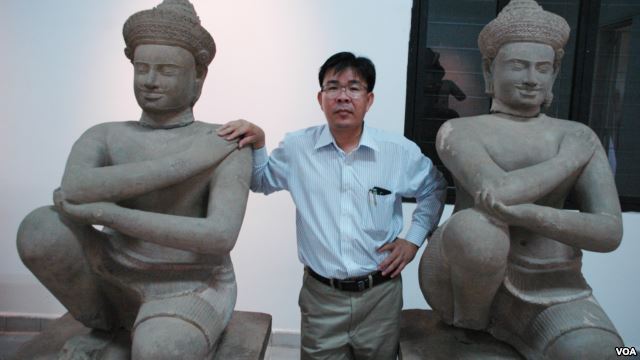
The Duryodhana statue is one of three returned to Cambodia from the United States in early June, Phnom Penh. (Robert Carmichael/VOA)The Duryodhana statue is one of three returned to Cambodia from the United States in early June, Phnom Penh. (Robert Carmichael/VOA)

For many years, researchers assumed that such brazen, well-organized looting was the exception rather than the norm, and that most of the looting of Cambodia’s heritage was a low-level affair, with local people plundering ancient sites and selling statues, carvings and stone reliefs in haphazard fashion.

But a new study carried out by researchers from the University of Glasgow in Scotland shows that was not the case.

“The organized looting and trafficking of Cambodian antiquities was tied very closely to the Cambodian civil war and to organized crime in the country,” explained Tess Davis, a lawyer and archaeologist, and member of the study team that also included criminologists.

“It began with the war, but it long outlived it, and was actually a very complicated operation, a very organized operation, that brought antiquities directly from looted sites here in the country to the very top collectors, museums and auction houses in the world,” she added.

Davis said the Cambodian and Thai militaries were often involved in looting, as was organized crime. Local people were often forced to work as laborers.

Researchers say that at the end of the chain in Thailand was a Bangkok-based dealer who provided the laundering link between the criminals and the collectors and museums.

READ MORE

Art Agenda: ‘Here and Elsewhere,’ Singapore Heritage Festival

Art Agenda: ‘Here and Elsewhere,’ Singapore Heritage Festival

via “RelaxNews

history

Singapore Heritage Festival
July 18-27
Singapore

The 11th edition of Singapore’s annual exploration of cultural history, this year with the theme of “Our Islands, Our Home,” promising a voyage across the 50-island Singaporean archipelago with plentiful festival hubs, island tours and heritage trails.
heritagefest.org.sg

READ MORE

Kingdom, First Among Arab Countries To Set Up Monuments System

Kingdom, First Among Arab Countries To Set Up Monuments System

via “Arab News

history

 General Supervisor of King Abdullah Cultural Heritage Project and vice president of the Saudi Commission for Tourism and Antiquities (SCTA) Ali Al Ghabban said Saudi Arabia is one of the first Arab countries to set up a monuments system with the aim to protect the heritage sites in the Kingdom for their cultural significance and their value as an economic resource.

“Saudi Arabia is one of the first Arab countries to set up a system for monuments,” Al Ghabban said in a press statement issued yesterday.

Applauding the issuance of the new system of monuments, museums and architectural heritage which was issued by the Council of Ministers recently, Al Ghabban asserted that the new system of monuments enhances the protection of national heritage sites as resources for economic benefit.

He added that the former system was issued 40 years ago but it was necessary to effect some changes in light of an evolution in the government’s interest in preserving architectural and urban heritage including museums to develop a system for the protection of monuments.

He revealed that the new system had been under study for a long time with concerned partners prior to being released with requirements which would enhance the process of preservation, protection and investment.

“The new system focuses on the importance of monuments, their preservation and as an important area of investment to benefit the country’s economy,” Al Ghabban underlined.

He further said the new system devotes a special chapter to urban heritage and museums and takes care of investment in national heritage. It also ensures economical benefits with regard to the sunken monuments and seeks cooperation from scientific missions, exploration operations and archaeological surveys to cope with new developments.

It further classified the architectural heritage, which is recorded as a national heritage with various categories and also supports the creation of a fund to support urban and general heritage, the SCTA deputy said.

“All of these combine to make the new system an important step toward the protection and development of the national heritage and culture,” Al Ghabban asserted.

According to him, the important additions of the new system are in the area of protection where government agencies including the ministries of Municipal and Rural Affairs, Agriculture, Transport, Petroleum and Mineral Resources and other agencies are obliged to operate in locations that are earmarked for developmental projects to ensure there are no sunken or visible monuments there.

READ MORE