CulturedMuse

新年快乐 (Happy New Year)

新年快乐 (Xīn Nián Kuài Lè) means Happy New Year in Chinese 🙂 This year is the Year of the Monkey! I think tomorrow I will try to add a description of the Chinese animals theory to DeceptivelyBlonde 🙂 

Anyway, Happy New Year from us in China! Here’s one of the beautiful fireworks that lit up the sky on New Year’s Eve 🙂 No one does firework like the Chinese! They create amazing works of art with fireworks and it is a truly beautiful part of their culture ❤

Firework

Art World Prepares for a Challenging Year

“Art World Prepares for a Challenging Year”

by Scott Reyburn via “New York Times

So now it’s official: The latest art market boom has peaked, according to figures from Christie’s and Sotheby’s, the two biggest international auction houses.

In late January, the companies released their 2015 results, with each reporting a slight decrease in year-over-year sales. It was the first year since 2010 that both failed to show an increase.

Christie’s, a private company based in London, reported auctions and private sales of 4.8 billion pounds, or about $6.8 billion in 2015, a decline of about 5 percent from 2014. Equivalent sales at Sotheby’s, which is publicly traded and based in New York, were $6.6 billion, about 1 percent less than in 2014.

Those figures do not represent a burst bubble, or even a serious correction, but they do suggest that 2016 is going to be a challenging year for the art market, reflecting the volatility and uncertainty of the wider world.

“The froth has been skimmed off,” said Paul Ress, the chief executive of Right Capital, which provides loans secured by art to dealers and collectors. Mr. Ress said that the collapse in the price of oil has taken “a huge amount of cash” out of the art market.

Photo

Peter Doig’s 1991 canvas ‘‘The The Architect’s Home in the Ravine.’’ CreditPeter Doig. All Rights Reserved, DACS 2015

“There aren’t so many Russians and Brazilians involved now, and the Chinese slowdown has had a knock-on effect on the raw materials and equity markets,” he said. “The potential buyers in the art world won’t be feeling as rich as they did last year.”

An examination of Christie’s results reveals key shifts in the market in 2015. Bolstered by huge one-off prices in New York for trophy works by artists like Picasso and Modigliani , auction sales of Impressionist and modern art were up 57 percent to £1.3 billion, while those of postwar and contemporary art — the main driver of growth from 2009 to 2014 — were down 14 percent to £1.5 billion. Year-over-year sales of old master paintings and 19th-century and Russian art shrank 37 percent to £154.9 million. . . . .

READ MORE

Discovery of the World’s Oldest Tea

Archaeologists have discovered a huge stash of the oldest tea in the world buried in the tomb of an ancient Chinese emperor. The tea (pictured right) was badly decomposed, but analysis showed only the finest tips (bottom left) had been picked and buried with the emperor. Similar tea was found in a tomb in Tibet (top left) Archaeologists have uncovered the world’s oldest set of tea leaves from the tomb of an ancient Chinese emperor! 

 Living 2,150 years ago in the Western Han Dynasty, Emperor Jing was a major fan of the delicious drink.  Like all the rest of us tea lovers, Emperor Jing understood the power of the tea leaf and its healing/renewing abilities.  

The collection of tea leaves was 42 feet x 8 inches. That is a major tea haul! If you ever tried drinking tea from leaves rather than a lipton bag, you’ll know that it only takes a small amount to go a long way. This amount probably lasted him a long while in the afterworld!  

This particular type of tea, Camellia Sinesis, comes from a type of small evergreen shrub known as a tea tree. The leaves and buds of the tree are used to create a special, expensive green tea.  There are actually two varieties of the tree–one is used to create the Chinese teas (such as White Tea, Oolong, Pu’er, Green Tea, etc.) and the other is used to create Indian Assam teas. The leaves of the tree have long been applied in Chinese traditional medications and as a caffeine provider.  I’m guessing it was pretty easy to bring the emperor over as a tea supporter 🙂

The tomb was located in Xi’an, China. Xi’an is now world-famous due to the discovery of the Terra Cotta army buried under the local hills and is only about an 8 hour drive from where I live!  I’m really excited; maybe I could see this tea pile 🙂 Emperor Jing’s tomb contained “50,000” terra cotta animals and statues, along with other great treasures.

The extra amazing thing about the tea beyond its age is the fact that it is some of the earliest proof that researchers have about the Silk Road.  It is believed that the emperor may have traded his tea with Tibet where similar tea remains were found dating not long after.  This shows the the Silk Road probably moved thorugh Tibet at the time.  

Resources:

  1. Daily Mail
  2. Medicine.Net
  3. Wikipedia (Don’t Shoot Me)

Angel City Chorale ~ “Africa”

The beginning is a really amazing twist on the traditional song.  I love it when people use nature to replicate nature.  🙂

Artists (and Others) Talk About Art and Destruction

“Artists (and Others) Talk About Art and Destruction”

by John Seed via “Huffington Post

“Every act of creation is first of all an act of destruction.” ― Pablo Picasso

During my last year of graduate school one of my art professors came by my studio one evening to lead a group critique session. “Someday,” he told me, “you will have a storage problem.”

Those were wise words. I took most of my graduate school work to the dump two years later.

2015-07-01-1435781730-1494350-dump.jpg

The author’s post grad school dump run

Being an artist means making things, and those things can pile up fast. Only lucky works of art survive — or deserve to survive — while numerous other works are slashed, smashed, burned or trucked to the dump.

When I recently asked artist friends on my Facebook page to tell me stories about art and destruction I found that I had opened up a nerve-hitting topic. Artists destroy works both during and after their making, and they both savor and sometimes later regret their destructive impulses.

Here, in edited form, are some of the many anecdotes, comments and bits of wisdom that artists and others had to offer on the topic of art and destruction.

***

‪Stacy Rosende Bykuc‬‬‪

“Every piece has several destroyed compositions beneath. I call it ‘process.’ If a piece sucks, it’s just not done.‬‬‬”

‪April Zanne Johnson‬‬‪

If, as an artist, you love everything you make all the time and are never self-critical, it is impossible to grow and evolve‬‬‬.

‪Maria Teicher‬‬‪

“Shredded by hand with a razor (or ripped if paper)… the sound is intoxicating and freeing. Never had a single regret. I took photos before so I had it archived but have never looked back. I do a purge of work every 3-4 years and it’s great. Not everything goes but those I am not proud of or works that have lost their meaning in my life.‬‬‬”

Kate Shepherd

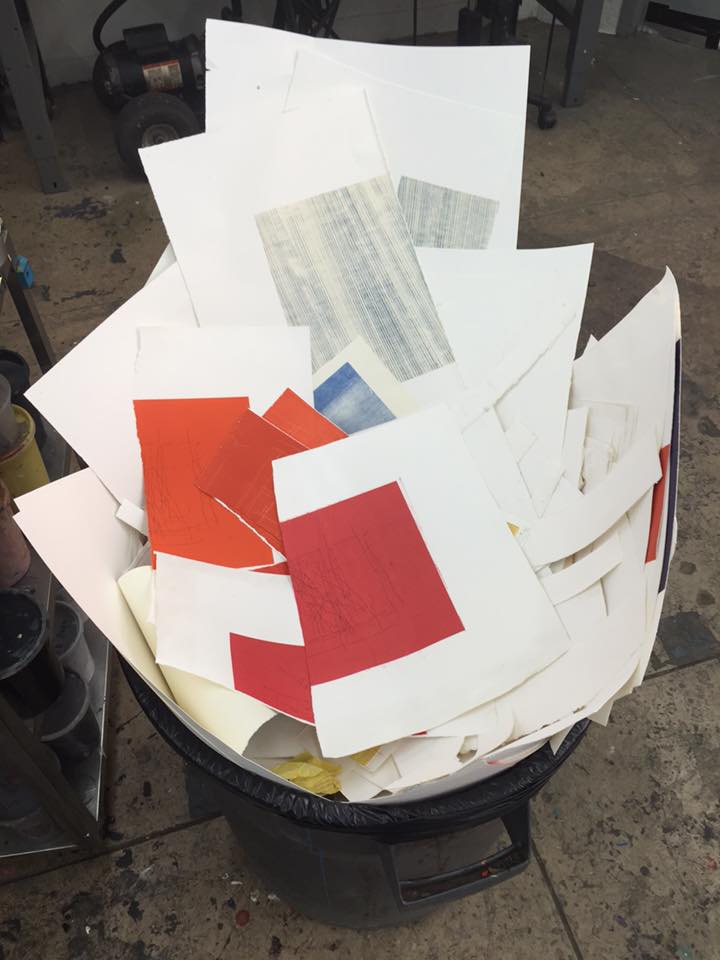
Just today. Etchings.

2015-07-01-1435780291-2877951-Kate.jpg

Nathan Lewis

“I destroyed a 52 ft. wide painting. Tired of storing. Tired of hanging onto it. Some things are better in memory.”

Lauren Levato Coyne

“In an essay I just posted I detail throwing a six foot drawing out the window. No regrets.”

‪Joe Fay‬‬‪

“When I left LA I threw out a few really old paintings in the dumpster at my studio. Before I left I saw a homeless person had made a shelter out of them. I was happy. More recently I’ve been cutting up and recycling old paper pieces and using them on my painted wall reliefs.”

‪Kenn Raaf‬‬‪

“75% of the finished work I do is deconstructed. Cut, torn, burned, sanded and then reassembled and recomposed into something radically different. As for paper used in sketch work I oftentimes cut into strips and weave to use as texture in my abstract work, and filler in my sculpture.‬‬‬” . . . .

2015-07-01-1435777525-6647126-paintings_flames.jpg

Digital collage by Photofunia.com based on a photo by David Michael Slonim


READ MORE