Asia

Festival Carver

DSC08614

Hmong traveling exhibit celebrates 40 years after Laos

“Hmong traveling exhibit celebrates 40 years after Laos”

by Stephen Magagnini via “The Sacramento Bee

From left, Houa Yang,Ker Cha and Brandon Xiong look at historical photographs of the CIA’s secret war in Southeast Asia during a preview Sunday of the “Hmong Story 40” project at Will C. Wood Middle School in Sacramento.

Forty years after Laos fell to the communists, decimating the Hmong people and their culture, a new generation of Hmong American leaders has emerged to preserve their heritage before it’s too late.

About 300 Hmong came to Will C. Wood Middle School in south Sacramento on Sunday to preview four new exhibits of photos and artifacts chronicling their recent history: “Hmong in Laos”; “The CIA’s Secret War against the Communists”; “Refugee Camp Life”; and “New Life in California.”

The displays were created by a group of 30 Hmong young professionals, business owners, educators and community leaders throughout California developing a traveling exhibit, the “Hmongstory40” project. They are urging families in Northern and Central California to “be a part of history” by sharing photos, artifacts and memories of their families’ journeys from Laos to Thai refugee camps and on to America.

Wood Assistant Principal See Lor, 42, who was born in Laos, taught for 10 years at Elder Creek Elementary. “Adults would ask the kids, ‘What is Hmong?’ and young Hmong kids had no clue,” she said. “They don’t know why they’re in this country. They don’t know that we’re political refugees forced to come here, not because (we) were dreaming big about America.”

Lor, clad in traditional Hmong silver and embroidery, said the children’s lack of knowledge about their culture and history “touched my heart and I knew I need to help preserve the history and the culture.”

Hmong history dates back more than 3,000 years. The Hmong once had their own kingdom in China, but they were crushed by the Chinese emperors and driven into the mountains of northern Laos, Thailand and Vietnam.

According to the exhibit, “From developing a written language, to advancements in textiles, farming and fashion … the Hmong identity was strengthened, an identity that would be resilient and spirited enough to survive a secret war and eventual exile.”

At age 5, Lor fled with her family to Ban Vinai, the largest of the Thai refugee camps, where more than 40,000 Hmong awaited sponsorships to the United States. Lor, who came with her family to the United States and entered fourth grade in 1986, said she has no idea where she was born. “When I asked my mom, she said, ‘Joking Mountain.’”

Over the past 40 years, an estimated 250,000 Hmong refugees have resettled in the United States. “There are about 30,000 Hmong now in Sacramento and 32,000 in Fresno,” said Lar Yang, one of the exhibit organizers. He said he expects more than 100,000 people will view the traveling exhibit.

Hmong throughout California – inbcluding those in Sacramento Sunday — are being asked to contribute stories and memorabilia to the history project. The full exhibit is scheduled to go on display in Fresno during the Hmong New Year in December, in Merced in May 2016 and in Sacramento in the fall of 2016. Details are at hmongstory40.org.

“Thanks for coming today and caring about your history,” project director Lar Yang told the audience Sunday. “Now is the time to write the truth about our history before our elders are gone. . . . .”

READ MORE

Outrage in China Over Replicas of Its Own Historic Sites

“Outrage in China Over Replicas of Its Own Historic Sites”

by Laura C. Mallonee

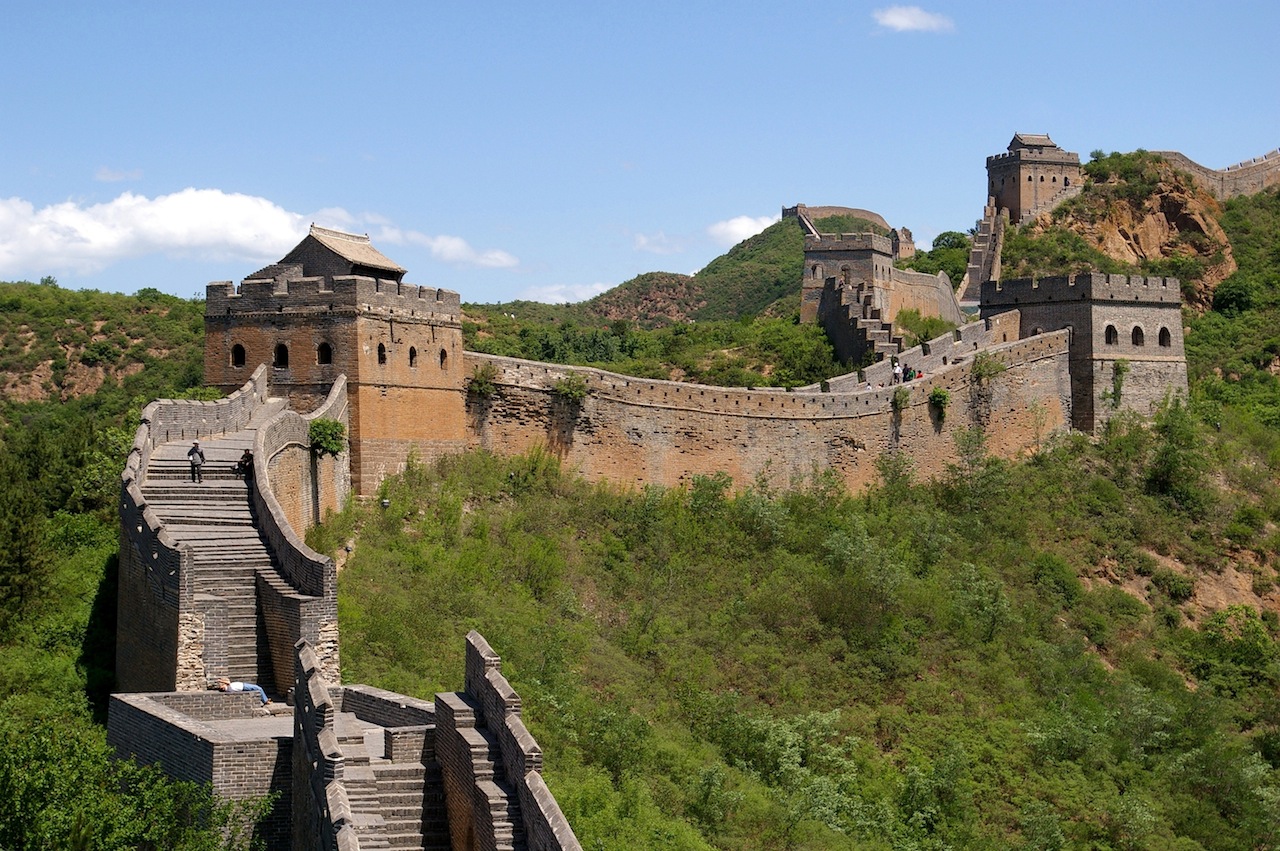
20090529_Great_Wall_8185

Controversy has erupted over two replicas of important heritage sites in China, a country famous for its many reproductions of other nations’ famous structures.

In Hubei province, the Wuhan Institute of Biogengineering has nearly finished its fake version of the Great Wall of China. In Zhejiang province, Hengdian World Studios will soon complete a duplicate of Beijing’s Old Summer Palace at its headquarters, where it has already built copies of the Forbidden City and the Tiananmen Gate.

The replicas are in keeping with the country’s tradition of xeroxing international landmarks. Visitors to the city of Chongqing can snap their photographs in front of Mount Rushmore. In Hangzhou, they can climb the Eiffel Tower and stroll along the Champs-Élysées. The town of Suzhou alone contains 56 such reconstructions, including London’s Tower Bridge, the Sydney Harbour Bridge, and the Pont Alexandre III in Paris.

But now simulations of Chinese cultural heritage are being challenged for varying reasons. According to The Telegraph, social media users have been ridiculing the $650,000 cost of recreating the Great Wall, a mile-long, gray brick replica that will open in September. The original, built between 250 BCE and the 17th century, lies nearly 800 miles to the north.

“The idea of a university is to educate people and not to build tourist spots,” a user on Weibo (China’s Twitter knock-off) wrote. Another quipped: “I can’t believe a university has such a low IQ.”

Ruins_of_Dashuifa_20130126

The $5 billion replica of the Old Summer Palace, parts of which will open to tourists in May, has also drawn criticism, as The Art Newspaper reported. The original was built by the Qing Dynasty in the 18th century, then ransacked by French and British soldiers in 1860 during the Second Opium War. “I think they shouldn’t rebuild it,” a Weibo user wrote. “That history is written in blood. A dilapidated Yuanmingyuan is better able to remind us of that humiliating chapter of history.”

The administration of the original palace’s ruins is threatening to sue the film studio for violation of intellectual property rights. It told Xinhua News Agency — China’s state media arm — that the structure is “unique and cannot be replicated. The construction and development of the site should be planned by authoritative national organizations, and any replication of it should reach certain standards.” . . . .

Read More

History in shambles: World Heritage sites after the Nepal earthquake

“History in shambles: World Heritage sites after the Nepal earthquake”

by Brian Ries via “Mashable

Kathmandu1

History in shambles: World Heritage sites after the Nepal earthquake

A handout photo provided by the International Federation of the Red Cross (IFRC) on 26 April 2015 of rescue workers sifting the ruins of a building for possible survivors in Kathmandu, Nepal, 25 April 2015.

Kathmandu1

The centuries-old monuments spread throughout the Kathmandu Valley were heavily damaged in the massive earthquake that struck Nepal on Saturday, a United Nations official said on Monday. Some of the sites suffered “extensive and irreversible damage.”

Irina Bokova, director-general of the United Nations Educational, Scientific and Cultural Organization (UNESCO), said she was “shocked” by the earthquake’s devastating impact on Nepal’s cultural heritage in the country, in particular the “extensive and irreversible damage at the World Heritage site of Kathmandu Valley.”

UNESCO Site
A photo shows devastation at the World Heritage site in Kathmandu after a earthquake toppled monuments and temples on April 25, 2015.

The sites are made up of seven separate groups of monuments. They include the Durbar Squares of Hanuman Dhoka (Kathmandu), Patan and Bhaktapur, the Buddhist “stupas” of Swayambhu and Bauddhanath and the Hindu temples of Pashupati and Changu Narayan.

The Nepalese government describes the seven sites as “medieval royal palace complexes” or “religious temple complexes,” calling them “archaeologically, historically, culturally and religiously very important” to the Kathmandu Valley.

The Kathmandu Valley was removed from the UN’s list of World Heritage in Danger in 2007, and the government has undertaken a series of conservation efforts to protect them from encroaching development since then.

Three of the sites were “almost fully destroyed”

According to a preliminary assessment done by the organization, the Durbar Squares of Patan, Hanuman Dhoka (Kathmandu) and Bhaktapur, were “almost fully destroyed” in the earthquake.

Basantapur Durbar Square
A general view of the Basantapur Durbar Square that was damaged in Saturday’s earthquake in Kathmandu, Nepal, Sunday, April 26, 2015.

Some of that destruction was captured by Kishor Rana, who flew a drone above the sites in the hours after the earthquake struck.

 “These are desperate times but we must all unite together in times like these,” said Kishor Rana on Facebook, who has pledged to shoot more of the sites. “Out of respect to the victims family, I did not take footages of live rescues taking place. We not only lost many lives and homes but we lost many pieces of our cultural heritage, our history.”

READ MORE

Protecting Indian Culture Need Of the Hour: Guv

“Protecting Indian Culture Need Of the Hour: Guv”

via “Express News Service

Governor Vajubhai Vala and Infosys Foundation chairperson Sudha Murty presenting the Rama Gana Kalacharya Award to instrumentalist Pandit Vishwa Mohan Bhat on Sunday | express photo

BENGALURU: Governor Vajubhai Rudabhai Vala has called for protecting Indian culture, which he said is the only way to achieve progress.

Speaking at the Rama Gana Kalacharya Award programme here on Sunday, he said, “No country can ever make progress if its culture cannot be protected. This is imperative and the need of the hour.”

He said the Mughals and the British, who once ruled the country, tried to destroy Indian culture. “However, we have prevailed and our culture is still rich.”

Vala also rued that the youth these days hardly have any cultural knowledge. “Understanding of one’s culture must be inculcated from a young age. However, the youth these days hardly have any knowledge. This is bad,” he added.

The Rama Gana Kalacharya Award  was presented to Hindustani classical music instrumentalist Pandit Vishwa Mohan Bhat.

READ MORE