Asia

“The Art of Storytelling”

“The Art of Storytelling”

by Yvonne Yan via “Huffington Post

My introduction to pingshu, traditional Chinese storytelling, was Yuan KuoCheng’s “Journey to the West”, a classical Chinese novel popular among all ages. Since then, pingshu has become a significant part of my bedtime story. I fall asleep imagining the Handsome Monkey King angering all the gods and fighting against the deities, swinging his 17,550-pound golden rod from heaven to hell, and using his 72 transformations to overcome all challenges throughout the journey. Words come out of Yuan’s mouth like clips of movies, vivid and captivating, as if the characters appear right in front of me. Listening to pingshu has allowed me, along with generations of Chinese, to appreciate the art of oral stories and the most powerful aspects of Chinese culture.

Most of the pingshu stories that I have listened to are drawn from Chinese history and can be broken into several classifications. The story of loyal and law-abiding officials or chivalrous and dauntless folk heroes, for instance, is my favorite. The characters in this type of pingshu, such as the “Pure Official Bao”, help the commoners fight against evil and corruption in society, symbolizing the virtues of leniency and integrity.

Other types of pingshu also have their own characteristics: the conflicts during the Three Kingdom Period following the Han Dynasty and the early heroes of the Tang Dynasty are typical stories of the establishment of Chinese dynasties; the widely known stories of the Yang family and the renowned Chinese hero Yue Fei both depict tales of dynasties and conflicts, relating to a specific group of soldier’s experiences in resisting barbarian invasions; the last type of story, which differs from the previous three types in both content and narration style, is about fictional legends of monsters, ghosts, or about being challenged in life. The most well known story of this type is “Journey to the West,” which depicts the arduous journey of a small group traveling to see Buddha in order to gain enlightenment.

During my brief interactions with contemporary pingshu artists, I have come to learn more about the art as a folk tradition of telling stories. Since the mid-Qing dynasty, pingshu gradually became an important recreational tool for people to communicate information, share interests, and enjoy their glorious history. Traditional pingshu artists usually perform in teahouses or small theaters, where people can gather around on a nice afternoon.

Like calligraphy and many other Chinese traditional art forms, pingshu requires years of training. Such experience comes from a long apprenticeship with a master. An aspiring storyteller might have to perform years of basic chores, such as cooking for the family and cleaning the house. Most importantly, the artists must passionately devote time, effort, and talent to the business of attracting a permanent audience. The famous Pingshu artist Yuan, who retired several years ago, once characterized pingshu as “difficult mental and physical labor.” Not only do the artists have to memorize long passages, sometimes hundreds of thousands of words long, they also have to incorporate the origins of certain customs, the backgrounds of characters, the history and geography, and other enchanting facts about the stories they tell.

To help the artists narrate stories in a more exciting way, pingshu has also developed a few widely used stage props: a table, a folding fan, and an attention-catching wood (xingmu). It is incredible to imagine that riveting performances can be achieved using such simple objects. The performer usually stands behind the stable during the entire performance. The attention-catching wood, a rectangular piece of dark wood, is knocked against the table to start the performance and to highlight climactic moments of the story. The artist uses the folding fan to illustrate certain physical actions, such as brandishing a sword or reading a book. . . .
READ MORE

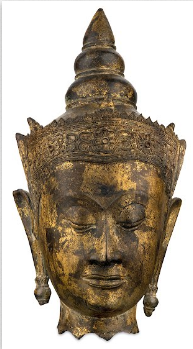
Head of Crowned Buddha

buddha

16th Century Thailand

Europe’s Largest Display of Chinese Lanterns and Illuminations for Festival of Light at Longleat

“Europe’s Largest Display of Chinese Lanterns and Illuminations for Festival of Light at Longleat”

by Nancy Connolly via “Bath Chronicle

Finishing touches are being added to a stunning display of illuminated Chinese scenes at the Longleat estate and visitor attraction in Wiltshire.

A total of around 7,000 individual lanterns, miles and miles of silk and thousands of dazzling LED lights are being used to create a series of stunning tableaux for the Festival of Light at the rural estate.

The highlights of the spectacular event include a 70 metre dragon made up of 23,000 lit porcelain cups, bowls and plates,  and mythical creatures called ‘qilin’, which are each made from over 65,000 glass phials filled with coloured liquid.

The outdoor extravaganza also features a 20 metre tall Chinese temple, huge traditional Chinese masks, a family of life size pandas in a bamboo forest, giant elephants and other animals including zebras, lions and deer.

In total, 30 tonnes of steel has been used to build the frames for the illuminated structures.

A team of 100 highly skilled craftsmen from the village of Zigong in China’s Sichuan province have spent six months creating the structures, which will remain at Longleat from November 14 until the New Year.

Written records of lantern festivals in China date back 2,000 years, and Zigong is considered to be their spiritual home.

Bob Montgomery, Longleat’s chief executive, said: “The Festival of Light is something truly unique.

“We are taking the age old tradition of the Chinese lantern and completely transforming it for a modern audience using giant LED illuminated structures.

“There will be around 20 different scenes to explore within 30 acres, featuring literally thousands of individual illuminations, created from a mixture of silk, satin and vinyl.

“Nothing like it has been attempted on this scale before in the UK – it’s about as far away from those familiar lightweight flying lanterns as it is possible to get.”

READ MORE

Dance Preview: Cambodia Troupe Preserves its Cultural Heritage

“Dance Preview: Cambodia Troupe Preserves its Cultural Heritage”

by Jane Vranish  via “Pittsburgh Gazette

20141104hoCambodiaMag04 The Royal Ballet of Cambodia.

There is a lesson to be learned from the Royal Ballet of Cambodia: that, no matter what, the arts will persevere. When this company tours, it is more than a respected dance troupe; it is a true symbol, much like a phoenix rising from the ashes, of its small southeastern Asia country that has been beleaguered over the centuries.

So when the troupe comes to the Byham Theater Friday as a special presentation of Cohen & Grigsby Trust, it will demonstrate not only the art of dance but the art of survival.

The Royal Ballet of Cambodia
Where: Byham Theater, Downtown.
When: 8 p.m., Friday,.
Tickets: $20-$45; 412-456-6666, http://www.trustarts.org or Theater Square Box Office.

The ballet has recently served as an ambassador, performing its ritualistic dances for heads of state. It also served as a reminder of Cambodia’s attempt during the Vietnam War to remain neutral.

All along the Royal Ballet had been treading a fine line between heaven and earth. It was considered to have ties to the gods, but also served as a harem to Cambodian kings, the dancers restricted to palace grounds.

The company persevered while Cambodia was marked by inner turmoil and outside conflicts with other nations, most notably Thailand and France. The French controlled the country from 1864 to 1953, when Cambodia achieved independence. At one point, the French tried to disband the troupe, but a young King Sihanouk and his mother, Queen Kossamak, recognizing its political and spiritual importance, reinstated it. At that time, the queen codified and modernized the technique. Dancers moved out of the palace and into the city.

The company suffered a setback in 1975, when Cambodia was overtaken by the notorious Pol Pot and his Khmer Rouge. Most of the company was killed in the genocide that followed. Those few who successfully hid among the people emerged in the 1980s to painstakingly reconstruct the company. Today it tours the world, led by Her Royal Highness Princess Norodom Buppha Devi, who serves as the company’s choreographer. In a tribute to the group’s importance in preserving the 1,000-year old Khmer dance style, UNESCO recognized the ballet as part of its Intangible Cultural Heritage of Humanity in 2003.

The Royal Ballet is known worldwide for its delicacy of style and nuance. The dancers stretch every morning into impossibly difficult poses, particularly hand gestures that are remarkable for their flexibility. Chamroeuntola Chap, one of eight female “stars” on the current U.S. tour, says it should feel “like you’re floating.” But she says it took years of training to achieve, including a stint at the university to learn the troupe’s history. . . . .

READ MORE

Coming Exhibition: Collecting Asian Objects in Colonial Korea, 1910-1945

“Collecting Asian Objects in Colonial Korea, 1910-1945”

Lady riding a horse, Astana Tombs, Turpan, 7th-8th century, color on clay, 38.5cm high.

Who:  

National Museum of Korea

When: Oct. 28, 2014 – January 11, 2015 (Hours Vary)

Where: 

National Museum of Korea
137, Seoubinggo-ro (168-6, Yongsan-dong 6-ga)
Yongsan-gu, Seoul 140-797

More Information: Here and Here.

In the late nineteenth century, as Western powers expanded deeper into Asia, the cultures of the East were eagerly commodified to satisfy westerners’ penchant for the exotic. Tomb thefts were just as prevalent as legitimate archeological investigations. With the concurrent boom in the antique market, the acquired artifacts were smoothly incorporated into the category of ‘fine arts’.
At the center of this movement were museums established through the emergence of modern states. Korea, however, was unable to play a leading role in the current of this era. At the time, Japan regarded itself as the only civilized country in Asia, and thus the only country capable of leading the primitive East into modern civilization. Based on this belief, Japan re-interpreted the histories of other Asian countries from its own perspective and attempted to promote these historical revisions through museums.
Notably, the so-called cultural assets collected in museums at that time originated from all across Asia, ranging from Central Asia to China and Japan. Why did Japan collect cultural assets from other Asian countries under its colonial rule? This exhibition represents the first step of a long journey that will yield both a question and a corresponding answer about our museum’s collection of Asian cultural assets and its origins.