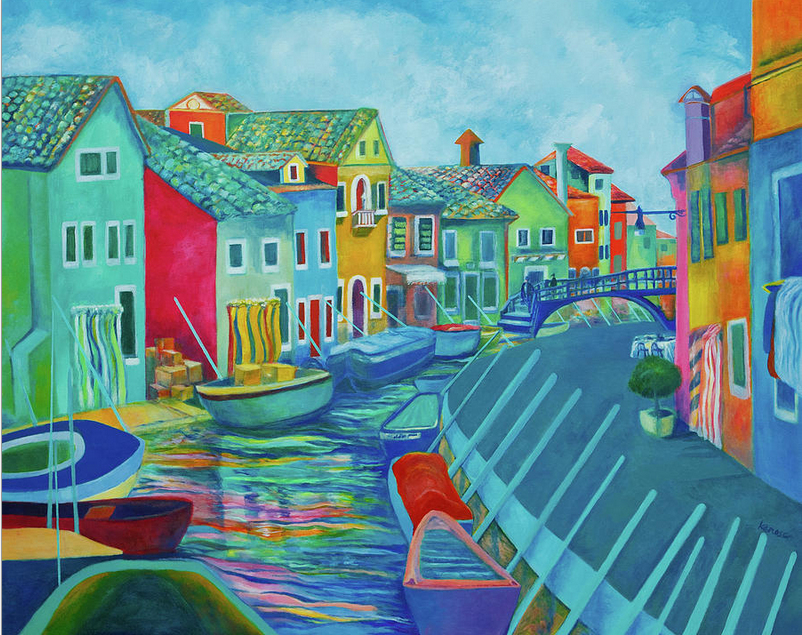
“Boats at Burano” by Kandy Cross
This work, created by an American artist and up for sale, is based upon the painted buildings in Burano, Italy.

“Boats at Burano” by Kandy Cross


“A fisherman dragging a net through a river in Siberia thought he had snagged a rock. Instead he had snared what experts believe is a 4,000-year-old pagan god figurine.
Nikolay Tarasov, 53, considered throwing the 12-inch statuette back, until he wiped away the muck and saw that a ferocious-looking face had been carved into the artifact.
“I pulled it in by getting my pal to help and I was going to chuck it away,” he told the Siberian Times. “But then I stopped when I saw it was a stone with a face. I washed the thing in the river—and realized it was a statuette.”
On the back of the figurine, snagged in the community of Tisul, was what looked like hair, carved behind the head.
Tarasov was told that the relic could be worth its weight in gold, but decided to donate his rare catch to a local museum, free of charge. “Experts there quite literally jumped for joy, and quite high!” he said.
It was later determined, with the help of experts, that the statuette had been carved in horn, probably during the Bronze Age. . . . .”

Who: Gagosian Gallery
When: June 13 – July 26 (Tues-Sat. 10 a.m. – 6 p.m.)
Where:
6-24 Britannia Street
London WC1X 9JD
T. 44.207.841.9960 F. 44.207.841.9961
london@gagosian.com
How Much: Couldn’t Tell
More Information: Here.
“Following the success of her show at the Saatchi Gallery in 1994, which generated a great deal of publicity for her work (the images were ubiquitous that year), Saville went on to take part in the exhibition American Passion, which toured from the McLellan Gallery, Glasgow, to the Royal College of Art and the Yale Center for British Art in New Haven, Connecticut.
By 1994 many people were familiar with Saville’s massive paintings, such as Plan, in which a naked woman is seen from below, her body filling the canvas through a combination of physical bulk and extreme foreshortening. Contour lines, as would demarcate the changes in altitude of land masses on a map, are drawn across the surface of the woman’s skin.”
“

1000 Fifth Avenue (at 82nd Street)
New York, NY 10028
Phone: 212-535-7710 (TTY: 212-650-2921)
May 8, 2014 – August 10, 2014
Sun-Thurs. ~ 10:00 am – 5:30pm
Fri-Sat. ~ 10:00am – 9:00pm
Adults: $25 | Seniors (65 + ): $17 | Students: $12 | Members: Free | Children (12 – ): Free
“The inaugural exhibition of the newly renovated Costume Institute examines the career of the legendary twentieth-century Anglo-American couturier Charles James (1906–1978). Charles James: Beyond Fashion explores James’s design process, focusing on his use of sculptural, scientific, and mathematical approaches to construct revolutionary ball gowns and innovative tailoring that continue to influence designers today. Approximately sixty-five of James’s most notable designs are presented in two locations—the new Lizzie and Jonathan Tisch Gallery in the Anna Wintour Costume Center as well as special exhibition galleries on the Museum’s first floor.
The first-floor special exhibition galleries spotlight the glamour and resplendent architecture of James’s ball gowns from the 1940s through 1950s. The Lizzie and Jonathan Tisch Gallery provides the technology and flexibility to dramatize James’s biography via archival pieces including sketches, pattern pieces, swatches, ephemera, and partially completed works from his last studio in New York City’s Chelsea Hotel. The evolution and metamorphosis by James of specific designs over decades are also shown. Video animations in both exhibition locations illustrate how he created anatomically considered dresses that sculpted and reconfigured the female form.
After designing in his native London, and then Paris, James arrived in New York City in 1940. Though he had no formal training, he is now regarded as one of the greatest designers in America to have worked in the tradition of the Haute Couture. His fascination with complex cut and seaming led to the creation of key design elements that he updated throughout his career: wrap-over trousers, figure-eight skirts, body-hugging sheaths, ribbon capes and dresses, spiral-cut garments, and poufs. These, along with his iconic ball gowns from the late 1940s and early 1950s—the “Four-Leaf Clover,” “Butterfly,” “Tree,” “Swan,” and “Diamond”—are showcased in the exhibition.”
 The Cultured Muse