Chinese

Chinese archaeologists find 2,800-year old burial of chariots and horses

“Chinese archaeologists find 2,800-year old burial of chariots and horses”

by Ruth Schuster via “Reuters

 Grave of chariots, 770 BC-476 BC, Zaoyang (Reuters)

Archaeologists excavating ancient tombs in central China have unearthed 28 chariots and 49 pairs of horse skeletons dating back three millennia.

The 2,800-year-old group of tombs, which dates back to the Spring and Autumn Period (770 BC-476 BC) is located in the city of Zaoyang, in the province of Hubei. Current explorations have found at least 30 tombs of various sizes.

Preliminary studies show that the tombs belong to high-ranking nobles of the period in Chinese history.

Now a new 33-meter long, four-meter wide chariot pit has been discovered. “This chariot and horse pit is different from those discovered previously along the Yangtze River. The chariots and horses were densely buried,” said Liu Xu, professor from School ofArchaeology and Museology of Peking University. ” Many of the wheels were taken off and the rest parts of the chariots were placed one by one.”

At least 28 chariots were discovered in three months of excavation. About five meters away the chariot pit was a horse pit, where at least 49 pairs of horse skeletons were discovered.

“Judging from the way the horses were buried, they were buried after they were killed, as there was no trace of struggle. Second, it is the way they were laid. They were laid back to back, lying on their sides. It means that two horses pull one chariot,” said Huang Wenxin, researcher from the provincial archaeological institute. . . .

READ MORE

“Clearing Rain” – Poetry I Love

Autumn In The Big City by Spirosart

“Autumn in the Big City” by Spirosart

“Clearing Rain” by Du Fu (758)

The sky’s water has fallen, and autumn clouds are thin,
The western wind has blown ten thousand li.
This morning’s scene is good and fine,
Long rain has not harmed the land.
The row of willows begins to show green,
The pear tree on the hill has little red flowers.
A hujia pipe begins to play upstairs,
One goose flies high into the sky.

雨晴(一作秋霁)

天水秋云薄
从西万里风
今朝好晴景
久雨不妨农
塞柳行疏翠
山梨结小红
胡笳楼上发
一雁入高空

yǔ qíng(yī zuò qiū jì)
tiān shuǐ qiū yún báo
cóng xī wàn lǐ fēng
jīn zhāo hǎo qíng jǐng
jiǔ yǔ bù fáng nóng
sāi liǔ háng shū cuì
shān lí jiē xiǎo hóng
hú jiā lóu shàng fā
yī yàn rù gāo kōng

“The Art of Storytelling”

“The Art of Storytelling”

by Yvonne Yan via “Huffington Post

My introduction to pingshu, traditional Chinese storytelling, was Yuan KuoCheng’s “Journey to the West”, a classical Chinese novel popular among all ages. Since then, pingshu has become a significant part of my bedtime story. I fall asleep imagining the Handsome Monkey King angering all the gods and fighting against the deities, swinging his 17,550-pound golden rod from heaven to hell, and using his 72 transformations to overcome all challenges throughout the journey. Words come out of Yuan’s mouth like clips of movies, vivid and captivating, as if the characters appear right in front of me. Listening to pingshu has allowed me, along with generations of Chinese, to appreciate the art of oral stories and the most powerful aspects of Chinese culture.

Most of the pingshu stories that I have listened to are drawn from Chinese history and can be broken into several classifications. The story of loyal and law-abiding officials or chivalrous and dauntless folk heroes, for instance, is my favorite. The characters in this type of pingshu, such as the “Pure Official Bao”, help the commoners fight against evil and corruption in society, symbolizing the virtues of leniency and integrity.

Other types of pingshu also have their own characteristics: the conflicts during the Three Kingdom Period following the Han Dynasty and the early heroes of the Tang Dynasty are typical stories of the establishment of Chinese dynasties; the widely known stories of the Yang family and the renowned Chinese hero Yue Fei both depict tales of dynasties and conflicts, relating to a specific group of soldier’s experiences in resisting barbarian invasions; the last type of story, which differs from the previous three types in both content and narration style, is about fictional legends of monsters, ghosts, or about being challenged in life. The most well known story of this type is “Journey to the West,” which depicts the arduous journey of a small group traveling to see Buddha in order to gain enlightenment.

During my brief interactions with contemporary pingshu artists, I have come to learn more about the art as a folk tradition of telling stories. Since the mid-Qing dynasty, pingshu gradually became an important recreational tool for people to communicate information, share interests, and enjoy their glorious history. Traditional pingshu artists usually perform in teahouses or small theaters, where people can gather around on a nice afternoon.

Like calligraphy and many other Chinese traditional art forms, pingshu requires years of training. Such experience comes from a long apprenticeship with a master. An aspiring storyteller might have to perform years of basic chores, such as cooking for the family and cleaning the house. Most importantly, the artists must passionately devote time, effort, and talent to the business of attracting a permanent audience. The famous Pingshu artist Yuan, who retired several years ago, once characterized pingshu as “difficult mental and physical labor.” Not only do the artists have to memorize long passages, sometimes hundreds of thousands of words long, they also have to incorporate the origins of certain customs, the backgrounds of characters, the history and geography, and other enchanting facts about the stories they tell.

To help the artists narrate stories in a more exciting way, pingshu has also developed a few widely used stage props: a table, a folding fan, and an attention-catching wood (xingmu). It is incredible to imagine that riveting performances can be achieved using such simple objects. The performer usually stands behind the stable during the entire performance. The attention-catching wood, a rectangular piece of dark wood, is knocked against the table to start the performance and to highlight climactic moments of the story. The artist uses the folding fan to illustrate certain physical actions, such as brandishing a sword or reading a book. . . .

READ MORE

Update on Xinzheng Burial Ground

They closed off the site before we could see any more of the progress; however, we do know that they have uncovered about 40 tombs so far.  There are estimated to be at least 200 more not yet excavated.  They have been finding random odds and ends in the graves, including pottery and some gold jewelry.  It is believed that this was the burial ground for the village, so it is  a mixture of lovely graves and less up-kept ones.   At least some date back to the 3rd Century B.C.E., around the late Warring States Kingdom of Han.  Right now, the government has closed the area off to students and visitors, and they will be monitoring the progress.  Xinzheng is the “Birthplace” of China because Emperor Huangdi was born here.  It was the central-point for several dynastic governments, and there is a lot of history here.  It will be fascinating to see what they uncover!

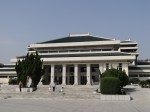
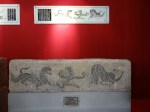
Nanyang Museum of Han Stone Gravings, Henan, China

Recently, I traveled abroad with about 20 other teachers to Southern Henan during the Fall Holiday.  We hired a tour guide to arrange our trip, and one of the places on his list was the Nanyang Museum of Han Stone Gravings. 

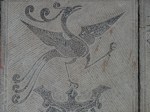
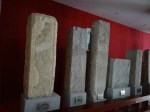
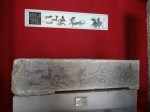
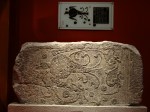
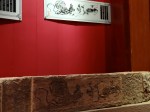
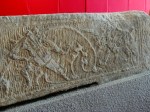
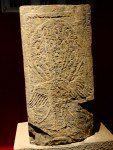
This was a really fascinating place. The museum holds hundreds of stones engraved with various pictures and images collected from ancient Han tombs. We were told that they were more than 1000 years old!

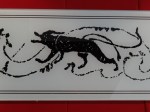
I was intrigued by the carvings themselves. Naturally, they varied on the subject of their work – dinners, hunting, musicians, kings and counsels. It’s always neat to see art demonstrating the use of ancient musical instruments or to watch fashions change as the years go by. But I was really interested to see some of the animals are actually pre-historic. One was clearly a dinosaur (you know the kind that is Sarah on The Land Before Time?). Two were dragons, but only one had wings.

You kind of expect the dragons, but the differences in how they were depicted suggests two origins to the dragon legend. One was wingless and quite fat. The other had wings and was longer and thinner. Add in the dinosaur, and it was all really cool!