Ancient

Coming Exhibition: Loving Devotion: Enter the Mandala

“Enter the Mandala”

Asia

“Taima Mandala” (1300s – 1400s)

Who:  Asian Art Museum

When: Mar. 14, 2014 – Oct. 26, 2014 (Tues-Sun. 10 a.m. – 5 p.m.; Thurs. 10 a.m. – 9 pm.)

Where: 

Asian Art Museum
200 Larkin Street
San Francisco, CA

How Much:  

  • Adults ~ $15
  • Seniors, Students, Youth ~ $10

More Information: Here.

“Mandalas are maps of Buddhist visionary worlds.

Minutely detailed and saturated with philosophical meaning, these works (most often paintings or sculptures) are a feast for the eyes and the mind—nested squares and circles are arrayed to represent the center of the cosmos and the four cardinal directions. For Buddhist practitioners, however, mandalas are not just images to view, but worlds to enter—after recreating the image in their mind’s eye, meditators imaginatively enter its realm.But is it possible to have this experience without years of meditative discipline?  

Enter the Mandala
says yes. In this exhibition, 14th-century paintings align a gallery with the cardinal directions, transforming open space into an architectural mandala—a chance to experience the images in three dimensions, to dwell in the midst of the cosmic symbols and be transported to another world. Visitors can literally “enter the mandala,” exploring places in the cosmos—and perhaps themselves—that might otherwise remain invisible. “

Coming Exhibition: Loving Devotion: Visions of Vishnu

“Loving Devotion: Visions of Vishnu”

Vishnu with Attendants, Bangladesh, 12th century, schist (stone), Collection of the Newark Museum

Vishnu with Attendants, Bangladesh, 12th century, schist (stone), Collection of the Newark Museum

Who:  BYU Museum of Art

When: Sept. 5, 2014 – Feb. 21, 2015 (Mon-Sat. 10 a.m. – 9 p.m.)

Where: 

Brigham Young University Museum of Art
North Campus Drive
Provo, Utah 84602

How Much:  Generally Free, some special exhibits require a ticket.

More Information: Here.

“Featuring a variety of exquisite art objects from the Indian subcontinent, Loving Devotion illuminates the rich heritage and symbolism of Hindu worship in the lives of believers, immersing viewers in the beliefs and culture of one of the world’s oldest and largest religions.

Focusing on images of Vishnu and Krishna that span centuries of history, the exhibition explores how bhakti (the practice of fervent, impassioned devotion to deity) influences the lives and worship of Hindu people and reveals the depth and intimacy of their relationship towards the divine.

Indeed, building a relationship with God is at the core of life’s purpose for the devoted believer, and both Vishnu, the Preserver, and his incarnation, Krishna, are highly revered deities that have both been the focus of significant bhakti worship. Through powerful images of these Gods inscribed on stone, in bronze or in paintings, worshippers and viewers alike are invited to learn that god is love and not fear, and understand how worship can evolve from practice to joyful experience of immense love and devotion. . . . .”


Chinese Calligraphy, Painting Exhibition Opens in Albania

“Chinese Calligraphy, Painting Exhibition Opens in Albania”

by Wang Siwei via “Xinhua English News

Chinese

A woman watches a traditional Chinese painting at a Chinese calligraphy and traditional painting exhibition kicked off in Tirana, capital of Albania on July 25, 2014. About 18 artists from China displayed their masterpieces to Albanians during the exhibition, which will last to July 29. (Xinhua/Wang Siwei)

READ MORE

Organized Crime, Military Linked to Theft of Cambodian Artifacts

Organized Crime, Military Linked to Theft of Cambodian Artifacts

by Robert Carmichael via “VOA News

Seoul

 —

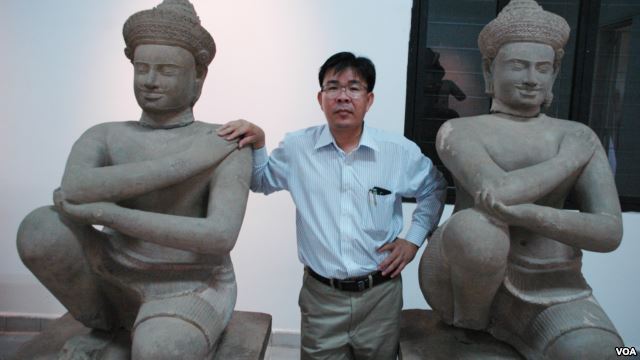
Over the past 40 years Cambodia’s cultural heritage has been looted on a massive scale, with countless thousands of artifacts taken from hundreds of sites, smuggled out of the country and into museums and private collections around the world. New research indicates that not only was much of this the work of organized networks, but that most pieces have disappeared from public view – probably forever.

Between the start of Cambodia’s civil war in 1970 and the eventual end of hostilities some 30 years later, the country’s 1,000-year-old temples and other historic sites were comprehensively plundered. In one incident in the early 1970s, government soldiers used a military helicopter to airlift artifacts from the 12th century citadel of Banteay Chhmar in the northwest.

At the same complex in 1998 – generals spent a fortnight tearing down and carting away 30 tons of the building. Just one of the six military trucks that went to neighboring Thailand loaded with artifacts was stopped and its contents returned. The rest disappeared, likely sold on the black market.

The Duryodhana statue is one of three returned to Cambodia from the United States in early June, Phnom Penh. (Robert Carmichael/VOA)The Duryodhana statue is one of three returned to Cambodia from the United States in early June, Phnom Penh. (Robert Carmichael/VOA)

For many years, researchers assumed that such brazen, well-organized looting was the exception rather than the norm, and that most of the looting of Cambodia’s heritage was a low-level affair, with local people plundering ancient sites and selling statues, carvings and stone reliefs in haphazard fashion.

But a new study carried out by researchers from the University of Glasgow in Scotland shows that was not the case.

“The organized looting and trafficking of Cambodian antiquities was tied very closely to the Cambodian civil war and to organized crime in the country,” explained Tess Davis, a lawyer and archaeologist, and member of the study team that also included criminologists.

“It began with the war, but it long outlived it, and was actually a very complicated operation, a very organized operation, that brought antiquities directly from looted sites here in the country to the very top collectors, museums and auction houses in the world,” she added.

Davis said the Cambodian and Thai militaries were often involved in looting, as was organized crime. Local people were often forced to work as laborers.

Researchers say that at the end of the chain in Thailand was a Bangkok-based dealer who provided the laundering link between the criminals and the collectors and museums.

READ MORE

The Islamic State and the Cultural Destruction of Iraq

The Islamic State and the Cultural Destruction of Iraq

by Hadani Ditmars via “Middle East Eye

Iraq’s monuments have borne witness to and shared the hardships of the country’s long-suffering people

The latest in the surrealist horror show that the nightly news on Iraq has become offers a rich narrative – at least for a writer working on a political travelogue of ancient sites. Once again, the Mongol hordes are at the gates.

After destroying statues of a poet and a musician in Mosul, Islamic State (IS) now threatens to destroy the 2nd-century BC city of Hatra, and UNESCO has sounded the alarm about one of their world heritage sites at risk.

The Director-General of Unesco, Irina Bokova, said earlier this week, “I call on all actors to refrain from any form of destruction of cultural heritage, including religious sites. Their intentional destruction are war crimes and a blow against the Iraqi people’s identity and history.”

In one of many ironies, this well preserved example of a Parthian city that has survived centuries of imperial intrigue and invasions may fall victim to a group of angry- yet well organized and funded- young men, drunk on brutality, wired on ideology run amok, galvanized by decades of war and injustice

Hatra has more recently served as a film set for the 1973 production of the Exorcist, in which a priest discovers a talisman belonging to an ancient demon and brings it back to the US, where it possesses a young American girl.

While it’s not difficult to ascertain that the disastrous invasion of 2003 has unleashed more than it’s fair share of vindictive spirits of which IS is only one- Iraq’s ancient sites- as its people- have been long-suffering.

Iraq’s monuments bear witness to and share in the hardships of her people. After years of war and occupation, historic sites have been badly damaged and neglected. While the Taliban’s destruction of the Buddhas of Bamyan in Afghanistan was universally condemned, outrage about the destruction of Iraqi and indeed world heritage (not to mention the fate of Iraq’s people) has been somewhat restrained.

As Muwafaq al Taei  – who was an architect under Saddam but an unrepentant communist who was simultaneously lionized and spied upon by the ancien regime and then almost killed by US troops after the invasion – (and my erstwhile travel companion on my journey to Iraq’s ancient sites) always says, ‘you have to understand the past to make sense of the present.’

I was inspired to write my next book Ancient Heart when Muafaq took me on a tour of sacred sites in Baghdad, in the midst of sectarian war zones, garbage dumps and displaced people’s camps. It reminded me of the last scene in Planet of the Apes, when Charlton Heston sees the Statue of Liberty half-submerged on the beach.

As I write this I am looking at a map of ancient sites in Iraq. Most maps of Iraq in the popular imagination are divided into three neat sectarian sections, or filled with bullet point punctuations on the evening news.

I am convinced of the power of this map. If applied correctly, it may just transform people’s consciousness. I want people to see Iraq for what it is- whether American generals or IS commanders – to recognize the depth and soul of the land they invaded, not just as another terrorized place to be abandoned but as part of our world heritage.

My map shows Ur, the birthplace of the Prophet Abraham and the home of the Sumerian ziggurat.  Saddam stationed a military base nearby, as did the invading Americans who added a strategically placed Burger King. It was once a temple to the moon god Nanna, and many moons later, its adjoining town of Nasiriyah site of the Shiah uprising, encouraged by George Bush Senior and then brutally repressed by the regime, while the US stood by.

(more…)