Art & Culture

This painting was looted by the Nazis, then seized from my living room

“This painting was looted by the Nazis, then seized from my living room”

by Craig Gilmore via “LA Times”
la-dfunke-1480872321-snap-photo

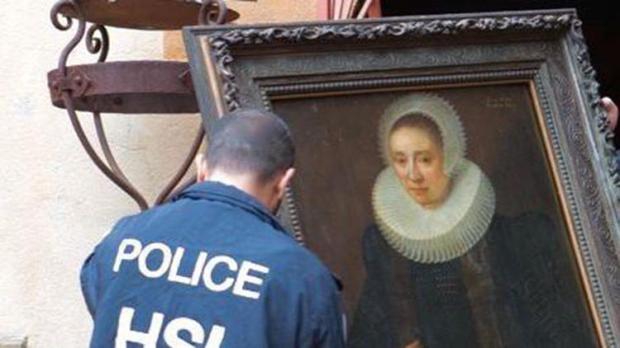
Two agents from U.S. Homeland Security’s ICE unit arrived at my door in September looking for a Polish lady — not a person, but a painting: Melchior Geldorp’s “Portrait of a Lady.” She had, they informed me, been looted by the Nazis from the National Museum in Warsaw.

Unsure if these gentlemen were indeed who they claimed to be, I didn’t invite them in. But I knew exactly what they were seeking: My partner, David, and I had purchased this very portrait — ostensibly the work of a different artist — a decade earlier from a major auction house in New York. 

Upon their leaving, I stood dumbfounded, holding a packet of information about the alleged provenance of our painting. After calling David at work to drop this bombshell, I began a Googling frenzy, eventually bringing me to Poland’s Division for Looted Art website. Seconds later I was gawking at an old black-and-white photo of our beloved lady, a beautiful portrait painted on oak panel in 1628. Tears welled in my eyes with the realization that, without question, if this were true we needed to do our duty and get her safely home.

Being an opera singer, I was among a group of vocalists on a government-sponsored tour of Israel some years ago. During a visit to a community center for Holocaust survivors I was asked to sing. The emotion of being surrounded by people who had prevailed through such unimaginable horrors was overwhelming, and I found myself unable. Excusing myself, I attempted to make up for it by spinning several of the ladies around the dance floor — all the while trying not to look down at the numbers tattooed on their wrists. 

Now this memory flooded back to me, and I found myself once again in tears, hyper-aware of how Nazi atrocities affect us still to this day.

The toll of World War II in Poland — including the deaths of 6 million Poles, Jews, and other outcasts, including homosexuals — is unimaginable. Being gay men, David and I feel a personal connection with these losses and are conscious of how political shiftings can lead to vulnerability. This, added to the knowledge that Poland’s LGBTQ community is still in a struggle for its basic rights, has weighed heavily on our minds. 

READ MORE

Sunburst

Melbourne Street Art

‘Treasure of humanity’: 14,000yo cave paintings found under Spanish town

‘Treasure of humanity’: 14,000yo cave paintings found under Spanish town

via “RT

Pictures released by Provincial Council of Biscay showing 14,000 year old cave engravings in the Basque village of Lekeitio. © Diputacion Foral de Bizkaia

Ancient wall engravings of animals dating back 14,000 years have been discovered by archaeologists in a cave below a seaside Spanish town.

The 50 images were found etched into rock at the Armintxe cave in Lekeitio in Spain’s Basque region and depict animals rarely seen in Paleolithic art, such as lions.

Experts working with the Provincial Council of Bizkaia made the the discovery of the ancient cave artwork, which was reportedly located beneath a building in the small coastal town and confirmed to the public on Thursday.

Archaeologists believe the drawings are identical to ones found in the Pyrenees, according to Basque news outlet Deia, which suggests the people who created them were in close contact.

Cave engravings (top) representing animals like horses, bisons, lions or goats, and a highlighted version, in the Armintxe cave in the Basque village of Lekeitio. © Diputacion Foral de Bizkaia

The artwork contains images of five goats, two bison, 18 horses and a pair of lions. A series of circles and lines also make up the ancient art find.

Local official Andoni Iturbe told AFP how they were found in an “extremely difficult” cave to access – a place which will remain closed to the public.

Biscay council colleague Unai Rementeria has described the etchings as a “treasure of humanity.”

Images from the site reveal how the artwork could easily have been be missed due to their faint outlines.

READ MORE

Treasure Trove of Ancient Human Footprints Found Near Volcano

Treasure Trove of Ancient Human Footprints Found Near Volcano

by Michael Greshko via “National Geographic

01-worlds-oldest-footprints-engare-sero-ngsversion-1476115208177-adapt-885-1

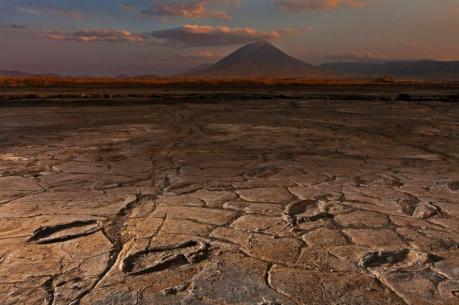
Nine miles from the volcano the Maasai call the “Mountain of God,” researchers have cataloged a spectacularly rare find: an enormous set of well-preserved human footprints left in the mud between 5,000 and 19,000 years ago.

The more than 400 footprints cover an area slightly larger than a tennis court, crisscrossing the dark gray mudflat of Engare Sero, on the southern shore of Tanzania’s Lake Natron. No other site in Africa has as many ancient Homo sapiens footprints—making it a treasure trove for scientists trying to tell the story of humankind’s earliest days. . . .

READ MORE