Lost & Found

Red Sea: Archaeologists Discover Remains of Egyptian Army From the Biblical Exodus

“Red Sea: Archaeologists Discover Remains of Egyptian Army From the Biblical Exodus “

via “World News Daily Report

divers

Suez| Egypt’s Antiquities Ministry announced this morning that a team of underwater archaeologists had discovered that remains of a large Egyptian army from the 14th century BC, at the bottom of the Gulf of Suez, 1.5 kilometers offshore from the modern city of  Ras Gharib. The team was searching for the remains of ancient ships and artefacts related to Stone Age and Bronze Age trade in the Red Sea area, when they stumbled upon a gigantic mass of human bones darkened by age. 

The scientists lead by Professor Abdel Muhammad Gader and associated with Cairo University’s Faculty of Archaeology, have already recovered a total of more than 400 different skeletons, as well as hundreds of weapons and pieces of armor, also the remains of two war chariots, scattered over an area of approximately 200 square meters. They estimate that more than 5000 other bodies could be dispersed over a wider area, suggesting that an army of large size who have perished on the site. . . . .

READ MORE

Update on Xinzheng Burial Ground

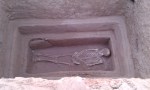
They closed off the site before we could see any more of the progress; however, we do know that they have uncovered about 40 tombs so far.  There are estimated to be at least 200 more not yet excavated.  They have been finding random odds and ends in the graves, including pottery and some gold jewelry.  It is believed that this was the burial ground for the village, so it is  a mixture of lovely graves and less up-kept ones.   At least some date back to the 3rd Century B.C.E., around the late Warring States Kingdom of Han.  Right now, the government has closed the area off to students and visitors, and they will be monitoring the progress.  Xinzheng is the “Birthplace” of China because Emperor Huangdi was born here.  It was the central-point for several dynastic governments, and there is a lot of history here.  It will be fascinating to see what they uncover!

I’m Living In An Archaeology Dig!

I’m apparently living out my dream in an Archaeology Dig!  Students were told today that in the building of the new college library here on campus, they found a massive ancient burial ground!  According to what I’ve been told, they estimate at least 1400 years old.  They believe that the people here were commoners who died peacefully, and after looking at the bodies, they are certainly mostly whole.  It is incredibly fascinating to see.  The students are allowed to simply wander around the burial spots at least until Monday when they will be closed off by the historians and archeologists.  I’ll post more pictures soon.  So Cool!!

‘Stunning’ Roman Cockerel Goes on Display

Question for my Readers! – Is this just good History Preservation, Our right to Cultural Heritage, or Tomb Robbing? ** DB

“‘Stunning’ Roman Cockerel Goes on Display”

by Victoria Woollaston via “Daily Mail

Three years since it was discovered during excavations on an ancient cemetery, a rare bronze Roman cockerel has been given a permanent home.

The 2nd century figurine is believed to be one of only nine ever found in the Roman Empire, and is part of a new exhibition at the Corinium Museum in the Cirencester.

Other finds on display include a hoard of almost 1,500 Roman coins, and the perfectly preserved vase it was found in.

This bronze and enamel cockerel was found in a child's grave in Roman Cirencester in 2011 - and has been painstakingly restored. It is now on display at the Corinium Museum

This bronze and enamel cockerel was found in a child’s grave in Roman Cirencester in 2011 – and has been painstakingly restored. It is now on display at the Corinium Museum

Archaeologists made the discoveries three years ago while excavating a western cemetery at the former Bridges Garage site on Tetbury Road in Cirencester – or Corinium as it was known when it was the second largest town in Roman Britain.

The bronze and enamel cockerel was said to have been placed in the grave of the two-year-old Roman girl by her parents, and experts believe it was used to ask the Gods to protect her.

They also believe the expensive gift was placed in the grave to ease their daughter’s transition into the ‘next world’.

It is the most significant Roman cemetery investigation in the town since the early 1970s,’ said a spokesman for the town’s Corinium Museum.

‘The cockerel found underneath the former Bridge’s Garage site – now St James’s Place – is one of only nine known cockerel figurines from the Roman world, and is the only example with its tail intact.

‘Displayed with the cockerel are an exceptional example of a Roman flagon and a selection of jewellery which include beads and bracelets found in a richly furnished child’s grave.

‘These are high status objects, which give a fascinating insight into the people of Corinium.

Neil Holbrook, Chief Executive of Cotswold Archaeology added: ‘The cockerel is the most spectacular find from more than 60 Roman burials excavated at this site.

‘It was excavated from the grave of young child and was placed close to its head. Interestingly a very similar item was found in Cologne in Germany and it looks like they both could have come from the same workshop based in Britain.’

The Tetbury Hoard, also on display at the museum, contain 1,437 silver and copper-alloy 3rd century Roman coins.

‘The hoard is the museum’s first Roman Coin Hoard and comes from a fascinating period of political upheaval across the Roman Empire,’ continued the museum’s spokesman.

‘It was a time of rapid succession of rulers and usurpers. The coins themselves tell this story.

‘Depictions and inscriptions represent 12 emperors from just a 16 year period.’

The child was buried wearing hobnailed shoes and was accompanied by a pottery feeding vessel and the remarkable enamelled bronze figurine of a cockerel.

The cockerel is 5-inches tall (12.5cm) and the breast, wings, eyes and ‘comb’ are inlaid with enamel, which now appears blue and green.

There is a separately moulded tail plate, also enamelled, with ‘openwork’ decoration. The beak is shown open, in the act of crowing.

READ MORE

Inside the Paris Apartment Untouched for 70 Years

Inside the Paris Apartment Untouched for 70 Years

by Leon Watson via “Mail Online)

Caked in dust and full of turn-of-the century treasures, this Paris apartment is like going back in time.

Having lain untouched for seven decades the abandoned home was discovered three years ago after its owner died aged 91.

The woman who owned the flat, a Mrs De Florian, had fled for the south of France before the outbreak of the Second World War.

She never returned and in the 70 years since, it looks like no-one had set foot inside.

 
Back in time: The flat near the Trinité church in Paris between the Pigalle red light district and Opera

Back in time: The flat near the Trinité church in Paris between the Pigalle red light district and Opera

The property was found near a church in the French capital’s 9th arrondissement, between Pigalle red light district and Opera. Experts were tasked with drawing up an inventory of her possessions which included a painting by the 19th century Italian artist Giovanni Boldini.

One expert said it was like stumbling into the castle of Sleeping Beauty, where time had stood still since 1900. ‘There was a smell of old dust,’ said Olivier Choppin-Janvry, who made the discovery.

But he said his heart missed a beat when he caught sight of a stunning tableau of a woman in a pink muslin evening dress.

The painting was by Boldini and the subject a beautiful Frenchwoman who turned out to be the artist’s former muse and Mrs de Florian’s grandmother, Marthe de Florian, a beautiful French actress and socialite of the Belle Époque.


Under a thick layer of dusk lay a treasure trove of turn-of-the-century objects including a painting by the 19th century Italian artist Giovanni Boldini

Under a thick layer of dusk lay a treasure trove of turn-of-the-century objects including a painting by the 19th century Italian artist Giovanni Boldini

 Untouched: The cobweb-filled flat was discovered in the 9th arrondissement of Paris

Untouched: The cobweb-filled flat was discovered in the 9th arrondissement of Paris

 
Treasure trove: Behind the door, under a thick layer of dusk lay a treasure trove of turn-of-the-century objects
 

Treasure trove: Behind the door, under a thick layer of dusk lay a treasure trove of turn-of-the-century objects, including the Boldini painting that sold for £1.78million. . . . 

READ MORE