Musings

Nanyang Museum of Han Stone Gravings, Henan, China

Recently, I traveled abroad with about 20 other teachers to Southern Henan during the Fall Holiday.  We hired a tour guide to arrange our trip, and one of the places on his list was the Nanyang Museum of Han Stone Gravings. 

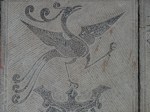
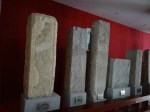
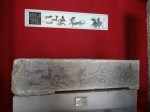
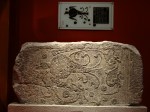
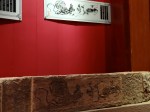
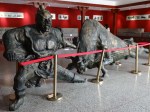
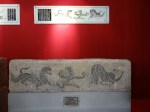
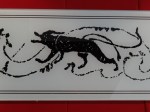
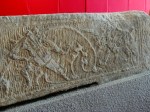
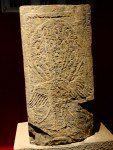
This was a really fascinating place. The museum holds hundreds of stones engraved with various pictures and images collected from ancient Han tombs. We were told that they were more than 1000 years old!

I was intrigued by the carvings themselves. Naturally, they varied on the subject of their work – dinners, hunting, musicians, kings and counsels. It’s always neat to see art demonstrating the use of ancient musical instruments or to watch fashions change as the years go by. But I was really interested to see some of the animals are actually pre-historic. One was clearly a dinosaur (you know the kind that is Sarah on The Land Before Time?). Two were dragons, but only one had wings.

You kind of expect the dragons, but the differences in how they were depicted suggests two origins to the dragon legend. One was wingless and quite fat. The other had wings and was longer and thinner. Add in the dinosaur, and it was all really cool!


Cultural Sensitivity Debate

New Question for my Readers:

Hawaii is, of course, one of the prime centers for volcano eruptions, as is apparently happening on Honolulu right now.  The volcano Kilauea has been steadily flowing lava since 1983, and over time it has destroyed almost 200 homes in the area.  Usually the lava and the people choosing to live on the volcano have an okay relationship, with the lava flowing in directions that don’t threaten the small communities nearby.  However, every so often  it changes its mind and begins edging in on the towns.   (more…)

Chinese Artist: Wang Bu

“Vases with Bird-and-Flower Painting” by Wang Bu (1898–1968)

Artist

Wang Bu was a 20th Century Chinese artist that specialized in working with Ceramics.  He was officially trained in the blue and white art, working under an expert tutor for several years.  Wang Bu’s first significant work came when popular ceramic artist, Wu Aisheng, hired him to design porcelain items in the style so popular during the Ming and Qing periods.  He would continue working with porcelain and ceramics for the rest of his life, preferring to decorate them in the blue and white coloring his father and mentor had loved.

Wang Bu made two great contributions to the art field.  First, He created the innovative method of using Chinese brush drawing to add the blue and white colors onto his ceramics and porcelain works ~ a technique that many other artists would soon pick up.  Second, he invented a “coloring pigment” by using the Chinese ink painting technique.  This pigment helped the colors used on ceramics to stay bright and colorful, as opposed to dulling and spotting as it dried.  

He briefly abandoned the blue and white style  during the tumultuous period of WWII an the Anti-Japanese War. However, he would later return to his roots, and eventually earned the title “King of Blue and White.  In the sixty years that he worked, he designed millions of works, many of which are still famous today.

Influences

  • His father, Xiuquing, who was an expert in blue and white painting. 
  • Xu Yousheng, his teacheer and another expert artist that worked with blue and white painting.
  • Ming and Qing Dynasty ceramic artists.

Stylistic Characteristics

  • Blue and White Coloring ~ particularly over-glazed with colors underneath or paste on paste.
  • Ceramics and Porcelain canvases.
  • Use of Chinese brush drawing or ink painting.
  • Bright, smooth coloring.
  • He seems to have like flowers, animals, and natural subjects.
  • His signature in his later years was often “the old man Taoqing.” 

“New York’s Four Seasons Restaurant Sued over Plan to move Picasso Painting”

This actually could be quite the issue. On the one hand, the  question arises as to the circumstances surrounding the Four Season’s acquiring the painting.   What was the contractual agreement–that they would maintain the painting, that it would stay in the same spot indefinitely,  that it had to always be available to the public.  Did they not make any provisions for this type of situation?  I’m guessing that the case is going to hinge upon how significant the damage to the wall is, how much more damage would postponing the repair cause, and can they move the painting safely out and back.  Maybe they could just cut the wall out with the painting, rebuild behind it, shore it up, then just replacing it in some artsy way?  Or carefully slide boards behind it and lay it down to remove it?  Either way, it’s important to give the owner his rights, but landowner rights are vital too. Plus, if the wall damage causes harm to someone later, who is liable for the injury? ** DB

“New York’s Four Seasons Restaurant Sued over Plan to move Picasso Painting”

Via FoxNews

New York’s storied Four Seasons restaurant has for decades harbored one of the city’s more unusual artworks: the largest Pablo Picasso painting in the United States. But a plan to move it has touched off a spat as sharply drawn as the bullfight crowd the canvas depicts.

Pitting a prominent preservation group against an art-loving real estate magnate, the dispute has unleashed an outcry from culture commentators and a lawsuit featuring dueling squads of art experts.

The building’s owner says Picasso’s “Le Tricorne,” a 19-by-20-foot painted stage curtain, has to be moved from the restaurant to make way for repairs to the wall behind it.

But the Landmarks Conservancy, a nonprofit that owns the curtain, is suing to stop the move. The group says the wall damage isn’t dire and taking down the brittle curtain could destroy it — and, with it, an integral aspect of the Four Seasons’ landmarked interior.

“We’re just trying to do our duty and trying to keep a lovely interior landmark intact,” says Peg Breen, president of the conservancy.

The landlord, RFR Holding Corp., a company co-founded by state Council on the Arts Chairman Aby Rosen, says a structural necessity is being spun into an art crusade.

“This case is not about Picasso,” RFR lawyer Andrew Kratenstein said in court papers. Rather, he wrote, it is about whether an art owner can insist that a private landlord hang a work indefinitely, the building’s needs be damned. “The answer to that question is plainly no.” . . . .”

READ MORE

Small Museums

“Small Museums”

by Orhan Pamuk via “New York Times

“In the age of mega-institutions and competitive building, the Turkish novelist Orhan Pamuk pays homage to the more personal places, like his own Museum of Innocence, whose character and content evoke a deeper experience.

My favorite museums tend to be small, the kind that showcase the inventiveness and the life stories of private individuals. Though I admire national museums like the Louvre or the British Museum, when I’m traveling and whenever I set foot in a new city, the first places I rush to see are not these institutions that fill me with a sense of the power of the state and of the history of its people, but those that will allow me to experience the private world and the vision of a passionate individual. I have so much respect for the efforts of those creative people who devoted the final decades of their lives to the task of turning their homes and their studios into museums for the public to visit after their deaths. These small museums are usually hidden on side streets just outside the center of large Western cities. They have the power to make us rediscover a feeling that the big national museums, looking more and more like fun-filled shopping malls with each passing day, can no longer make us feel, and that we have begun to forget. Museums must not confine themselves to showing us pictures and objects from the past; they must also convey the ambiance of the lost time from which those objects have come to us. And this can only happen through personal stories.

The newly reopened Rijksmuseum in Amsterdam, for example, is a dazzling demonstration of (more…)