Asia

Art I Love: Going Home

Going Home by HRFleur

“Going Home” by HRFleur


Chinese archaeologists find 2,800-year old burial of chariots and horses

“Chinese archaeologists find 2,800-year old burial of chariots and horses”

by Ruth Schuster via “Reuters

 Grave of chariots, 770 BC-476 BC, Zaoyang (Reuters)

Archaeologists excavating ancient tombs in central China have unearthed 28 chariots and 49 pairs of horse skeletons dating back three millennia.

The 2,800-year-old group of tombs, which dates back to the Spring and Autumn Period (770 BC-476 BC) is located in the city of Zaoyang, in the province of Hubei. Current explorations have found at least 30 tombs of various sizes.

Preliminary studies show that the tombs belong to high-ranking nobles of the period in Chinese history.

Now a new 33-meter long, four-meter wide chariot pit has been discovered. “This chariot and horse pit is different from those discovered previously along the Yangtze River. The chariots and horses were densely buried,” said Liu Xu, professor from School ofArchaeology and Museology of Peking University. ” Many of the wheels were taken off and the rest parts of the chariots were placed one by one.”

At least 28 chariots were discovered in three months of excavation. About five meters away the chariot pit was a horse pit, where at least 49 pairs of horse skeletons were discovered.

“Judging from the way the horses were buried, they were buried after they were killed, as there was no trace of struggle. Second, it is the way they were laid. They were laid back to back, lying on their sides. It means that two horses pull one chariot,” said Huang Wenxin, researcher from the provincial archaeological institute. . . .

READ MORE

“Why Preserving Pakistan’s Cultural Heritage Should Matter to the United States”

“Why Preserving Pakistan’s Cultural Heritage Should Matter to the United States”

by Rick Olson via “Huffington Post

We walked beside the now dusty wash that once contained the mighty but ever shifting Indus River, puzzling out the names of long-deceased members of royal dynasties now barely remembered. I was visiting the necropolis of Makli Hills with Yasmeen Lari, a conservation architect and herself a national treasure of Pakistan. The monuments at Makli chart the history of Islam in Sindh province, one of the cradles of civilization, dominated by the alluvial plain of the Indus, from which Sindh gets its name. I was there to announce that the U.S. Government is helping to conserve two of its most magnificent monuments.

ambassador rick olson

As the U.S. Ambassador to Pakistan, I live in a country facing political, military, and humanitarian challenges on many fronts. One front that has not received sufficient attention in Western media is the war on cultural heritage and how this matters to the people of Pakistan.

One of the ways in which ISIL has consolidated a reign of terror in Iraq and Syria is by erasing any heritage of religious diversity. Their atrocities are not confined to military battlefields. Groups like ISIS have another important ideological objective: they are threatened by the existence of a rich cultural heritage and a history of pluralism and tolerance. They seek to destroy it.

***

Islam came to Sindh in 711 c.e. via the invasion led by Muhammad bin Qasim. And its dominance on the culture was fixed by the Sufi scholars who accompanied the central Asian invaders of the 16th century. The history of this long conversion is etched in the stone of tombs at Makli Hills. The oldest ones, at the north, show a robust Hindu influence, including elaborate rosettes, with the inscriptions written in the austere Kufic script of early Islam. The later tombs, to the south, become more Persianate, with the slanting script replacing the more linear Arabic and more delicate floral and venial depictions. These ancient monuments enrich and inform today’s Pakistan and connect us to our cultural origins.

Wind and sun have taken a severe toll on the monuments, as has vandalism and looting, all perhaps part of the toll that more than a decade of fighting terrorism has inflicted on Pakistan. Treasures of Moghul artistry lie scattered and broken on the ground. Some of the elaborate sepulchers have lost their foundations and are visibly splitting apart. Even the large tombs that are structurally intact have lost their turquoise tiled roofs and cladding and now reveal their baked brick skeletons. . . . .

READ MORE

Dance Preview: Cambodia Troupe Preserves its Cultural Heritage

“Dance Preview: Cambodia Troupe Preserves its Cultural Heritage”

by Jane Vranish  via “Pittsburgh Gazette

20141104hoCambodiaMag04 The Royal Ballet of Cambodia.

There is a lesson to be learned from the Royal Ballet of Cambodia: that, no matter what, the arts will persevere. When this company tours, it is more than a respected dance troupe; it is a true symbol, much like a phoenix rising from the ashes, of its small southeastern Asia country that has been beleaguered over the centuries.

So when the troupe comes to the Byham Theater Friday as a special presentation of Cohen & Grigsby Trust, it will demonstrate not only the art of dance but the art of survival.

The Royal Ballet of Cambodia
Where: Byham Theater, Downtown.
When: 8 p.m., Friday,.
Tickets: $20-$45; 412-456-6666, http://www.trustarts.org or Theater Square Box Office.

The ballet has recently served as an ambassador, performing its ritualistic dances for heads of state. It also served as a reminder of Cambodia’s attempt during the Vietnam War to remain neutral.

All along the Royal Ballet had been treading a fine line between heaven and earth. It was considered to have ties to the gods, but also served as a harem to Cambodian kings, the dancers restricted to palace grounds.

The company persevered while Cambodia was marked by inner turmoil and outside conflicts with other nations, most notably Thailand and France. The French controlled the country from 1864 to 1953, when Cambodia achieved independence. At one point, the French tried to disband the troupe, but a young King Sihanouk and his mother, Queen Kossamak, recognizing its political and spiritual importance, reinstated it. At that time, the queen codified and modernized the technique. Dancers moved out of the palace and into the city.

The company suffered a setback in 1975, when Cambodia was overtaken by the notorious Pol Pot and his Khmer Rouge. Most of the company was killed in the genocide that followed. Those few who successfully hid among the people emerged in the 1980s to painstakingly reconstruct the company. Today it tours the world, led by Her Royal Highness Princess Norodom Buppha Devi, who serves as the company’s choreographer. In a tribute to the group’s importance in preserving the 1,000-year old Khmer dance style, UNESCO recognized the ballet as part of its Intangible Cultural Heritage of Humanity in 2003.

The Royal Ballet is known worldwide for its delicacy of style and nuance. The dancers stretch every morning into impossibly difficult poses, particularly hand gestures that are remarkable for their flexibility. Chamroeuntola Chap, one of eight female “stars” on the current U.S. tour, says it should feel “like you’re floating.” But she says it took years of training to achieve, including a stint at the university to learn the troupe’s history. . . . .

READ MORE

I’m Living In An Archaeology Dig!

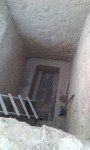
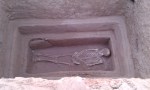
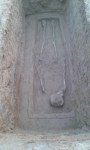
I’m apparently living out my dream in an Archaeology Dig!  Students were told today that in the building of the new college library here on campus, they found a massive ancient burial ground!  According to what I’ve been told, they estimate at least 1400 years old.  They believe that the people here were commoners who died peacefully, and after looking at the bodies, they are certainly mostly whole.  It is incredibly fascinating to see.  The students are allowed to simply wander around the burial spots at least until Monday when they will be closed off by the historians and archeologists.  I’ll post more pictures soon.  So Cool!!