Asia
Organized Crime, Military Linked to Theft of Cambodian Artifacts
Organized Crime, Military Linked to Theft of Cambodian Artifacts
by Robert Carmichael via “VOA News“
PHNOM PENH —
Over the past 40 years Cambodia’s cultural heritage has been looted on a massive scale, with countless thousands of artifacts taken from hundreds of sites, smuggled out of the country and into museums and private collections around the world. New research indicates that not only was much of this the work of organized networks, but that most pieces have disappeared from public view – probably forever.
Between the start of Cambodia’s civil war in 1970 and the eventual end of hostilities some 30 years later, the country’s 1,000-year-old temples and other historic sites were comprehensively plundered. In one incident in the early 1970s, government soldiers used a military helicopter to airlift artifacts from the 12th century citadel of Banteay Chhmar in the northwest.
At the same complex in 1998 – generals spent a fortnight tearing down and carting away 30 tons of the building. Just one of the six military trucks that went to neighboring Thailand loaded with artifacts was stopped and its contents returned. The rest disappeared, likely sold on the black market.
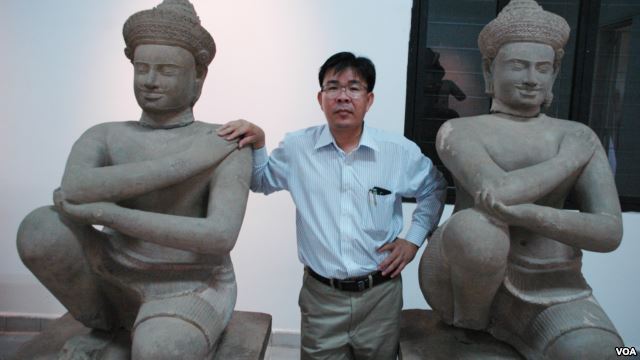
 The Duryodhana statue is one of three returned to Cambodia from the United States in early June, Phnom Penh. (Robert Carmichael/VOA)
For many years, researchers assumed that such brazen, well-organized looting was the exception rather than the norm, and that most of the looting of Cambodia’s heritage was a low-level affair, with local people plundering ancient sites and selling statues, carvings and stone reliefs in haphazard fashion.
But a new study carried out by researchers from the University of Glasgow in Scotland shows that was not the case.
“The organized looting and trafficking of Cambodian antiquities was tied very closely to the Cambodian civil war and to organized crime in the country,” explained Tess Davis, a lawyer and archaeologist, and member of the study team that also included criminologists.
“It began with the war, but it long outlived it, and was actually a very complicated operation, a very organized operation, that brought antiquities directly from looted sites here in the country to the very top collectors, museums and auction houses in the world,” she added.
Davis said the Cambodian and Thai militaries were often involved in looting, as was organized crime. Local people were often forced to work as laborers.
Researchers say that at the end of the chain in Thailand was a Bangkok-based dealer who provided the laundering link between the criminals and the collectors and museums.
READ MORE
Art Agenda: ‘Here and Elsewhere,’ Singapore Heritage Festival
Art Agenda: ‘Here and Elsewhere,’ Singapore Heritage Festival
via “RelaxNews“

Singapore Heritage Festival
July 18-27
Singapore
The 11th edition of Singapore’s annual exploration of cultural history, this year with the theme of “Our Islands, Our Home,” promising a voyage across the 50-island Singaporean archipelago with plentiful festival hubs, island tours and heritage trails.
heritagefest.org.sg
READ MORE
Coming Exhibition: Leang Seckon ~ Hell on Earth
“Leang Seckon ~ Hell on Earth “

Who: Rossi Rossi ~ London Gallery
When: June 27, 2014 – July 25, 2014 (Mon-Sat. 10 a.m. – 6 p.m.)
Where:
ASIA HOUSE
63 NEW CAVENDISH STREET
LONDON W1G 7LP
How Much: Reservations recommended with information on their website.
More Information: Here
“Rossi & Rossi is pleased to announce Hell on Earth, contemporary Cambodian artist Leang Seckon’s second solo show with the gallery. The exhibition, held at Asia House, London, features a body of recent paintings, collages and video works by the artist.
Seckon grew up during the devastating period of Khmer Rouge rule, witnessing firsthand the government-enforced policies that led to famine and disease, as well as state executions. He describes this period as “hell on earth”, when the haunting prophecies found in a set of popular nineteenth-century Buddhist texts, the Buddh Damnay, were realized: “war will break out on all sides…blood will flow up to the bellies of elephants; there will be houses with no people in them, roads upon which no-one travels; there will be rice but nothing to eat”. The prophecies provided Cambodians with an explanation for the violence and destruction of the Khmer Rouge, placing the period within the cyclical pattern of Buddhist history.
The artist’s collages and paintings are intimate narratives of his memories from the period and the civil war that followed. The process of creating artworks simultaneously allows him to experience and express the freedom that was denied to him as a youth. However, Seckon’s work also acts as a warning: like the Buddh Damnay, it cautions against corruption and the destruction of the environment, drawing parallels between Cambodia’s present and its past.
A fully illustrated catalogue with an essay by renowned curator Jens Hoffmann accompanies the exhibition.
On 28 June, Leang Seckon will be joined by Dr. Peter Sharrock (SOAS) to discuss the artist’s approaches to his work and the impact of Cambodia’s turbulent and complex history on his practice. The talk is free to attend, however seat reservations are recommended. To reserve a seat please visit: leangseckon.eventbrite.co.uk.”
“
4,000-Year-Old Burial with Chariots Discovered in South Caucasus
4,000-Year-Old Burial with Chariots Discovered in South Caucasus
by Owen Jarus via “Yahoo!News“

An ancient burial containing chariots, gold artifacts and possible human sacrifices has been discovered by archaeologists in the country of Georgia, in the south Caucasus. (more…)
 The Cultured Muse