Culture

Swiss Museum Publishes List of Nazi Loot Art Trove

“Swiss Museum Publishes List of Nazi Loot Art Trove”

via “Reuters

File picture showing the facade of the Kunsmuseum Bern art museum in Bern

ZURICH (Reuters) – A Swiss museum published a list on Thursday of all the art found in the possession of Cornelius Gurlitt, a German recluse whose secret collection included masterpieces looted from their Jewish owners by the Nazis.

The Bern Art Museum was named as sole heir to the collection and on Monday reluctantly accepted the bequest, making clear that it would adopt a policy of total transparency to head off any criticism over its decision to take in the artwork.

“We have promised transparency and are now acting accordingly,” Matthias Frehner, director of the Kunstmuseum Bern, said in a statement.

Gurlitt’s collection of over 1,200 artworks had been hidden away for decades until German tax inspectors stumbled upon it during a raid on his Munich apartment in 2012. A government task force identified three pieces that were indisputably looted by the Nazis which would be returned to the heirs.

Bern Art Museum has said it will not accept any piece which experts believed might have been stolen and by publishing the full list it hopes it might still discover the rightful owners.

Switzerland has worked hard in recent years to shake-off its reputation as a haven for ill-gotten gains, and the museum is anxious to avoid the legal risks associated with accepting disputed art works.

READ MORE

Meet China’s New Power Collectors (Part I): Three Influential Figures From The Art World

“Meet China’s New Power Collectors (Part I):

Three Influential Figures From The Art World”

by Alexandre Emera via “Forbes

The busy months of October and November for the art world have been an opportunity to witness the omnipresence of a new wave of young and influential collectors from China. Whether it was in London for Frieze, in Paris for FIAC and the opening of the Inside China, an exhibition at the Palais de Tokyo led by art patron Adrian Cheng (34, Chairman of the K11 Art Foundation, who just made his entry to the ArtReview Power 100 List), or in New York for the exhibition of Chinese artist Wang Jianwei at the Guggenheim Museum, this new group of Chinese collectors was very much in focus.

This week, many of them are meeting again in Shanghai, for the second edition of Art021, an art fair founded itself by two young collectors, and already attracting international names such as Marian Goodman, White Cube, and Perrotin, as well as leading galleries from China.

“Meet China’s New Power Collectors” is a three-part focus series, exploring who are these new collectors and what does their emergence mean for the international art scene.

In this first part, three leading figures of this generation are sharing with us their approach on collecting, their vision, and long term strategies. They are Kelly Ying, Lin Han, and Chong Zhou.

From left to right: Lin Han, Kelly Ying, Chong Zhou

Kelly Ying (KY)

I don’t think you can truly collect art without being involved in the other aspects of the industry 

Young and active collector from Shanghai. Originally working in the fashion industry, Ying is now focusing entirely on art. She is the co-founder of Art021, and the wife of collector David Chau (Zhou Dawei), 29, who is himself much involved in the art scene in China, supporting galleries and other cultural institutions.

Chong Zhou (CZ)

Art collecting is 50% of my career 

25, graduated with a degree of art history from UCLA. He is a second-generation collector, and made his first art purchase art in 2010. His family runs a large pharmaceutical group. Zhou is based in Shanghai, where he also owns a restaurant, “Macasa”, displaying his art.

Lin Han (LH) 

We are breaking or revising a lot of boundaries 

27, studied animation design at Northumbria University in the United Kingdom. His first art purchase was a Zeng Fanzhi painting in 2013, which was the cover of Sotheby’s 40th anniversary day auction. Since then, he has opened the first private art museum in Beijing’s 798 Art District, the M Woods Museum, featuring more than 200 works. Lin is based in Beijing.

What motivated you to start collecting?

CZ: My family has been influential in this decision. They started collecting in 2001, a very early time for local Chinese collectors to buy contemporary art. My motivation today is to find and acquire influential young artists, including names like Sun Xun, Yang Yongliang, Gao Lei, Shi Zhiying, etc. I believe I have a strong sense of duty towards their development, since I am myself born in 1989. Trying to discover the next important artists is also motivating me, just like my family did in their time. . . .

READ MORE

“The Art of Storytelling”

“The Art of Storytelling”

by Yvonne Yan via “Huffington Post

My introduction to pingshu, traditional Chinese storytelling, was Yuan KuoCheng’s “Journey to the West”, a classical Chinese novel popular among all ages. Since then, pingshu has become a significant part of my bedtime story. I fall asleep imagining the Handsome Monkey King angering all the gods and fighting against the deities, swinging his 17,550-pound golden rod from heaven to hell, and using his 72 transformations to overcome all challenges throughout the journey. Words come out of Yuan’s mouth like clips of movies, vivid and captivating, as if the characters appear right in front of me. Listening to pingshu has allowed me, along with generations of Chinese, to appreciate the art of oral stories and the most powerful aspects of Chinese culture.

Most of the pingshu stories that I have listened to are drawn from Chinese history and can be broken into several classifications. The story of loyal and law-abiding officials or chivalrous and dauntless folk heroes, for instance, is my favorite. The characters in this type of pingshu, such as the “Pure Official Bao”, help the commoners fight against evil and corruption in society, symbolizing the virtues of leniency and integrity.

Other types of pingshu also have their own characteristics: the conflicts during the Three Kingdom Period following the Han Dynasty and the early heroes of the Tang Dynasty are typical stories of the establishment of Chinese dynasties; the widely known stories of the Yang family and the renowned Chinese hero Yue Fei both depict tales of dynasties and conflicts, relating to a specific group of soldier’s experiences in resisting barbarian invasions; the last type of story, which differs from the previous three types in both content and narration style, is about fictional legends of monsters, ghosts, or about being challenged in life. The most well known story of this type is “Journey to the West,” which depicts the arduous journey of a small group traveling to see Buddha in order to gain enlightenment.

During my brief interactions with contemporary pingshu artists, I have come to learn more about the art as a folk tradition of telling stories. Since the mid-Qing dynasty, pingshu gradually became an important recreational tool for people to communicate information, share interests, and enjoy their glorious history. Traditional pingshu artists usually perform in teahouses or small theaters, where people can gather around on a nice afternoon.

Like calligraphy and many other Chinese traditional art forms, pingshu requires years of training. Such experience comes from a long apprenticeship with a master. An aspiring storyteller might have to perform years of basic chores, such as cooking for the family and cleaning the house. Most importantly, the artists must passionately devote time, effort, and talent to the business of attracting a permanent audience. The famous Pingshu artist Yuan, who retired several years ago, once characterized pingshu as “difficult mental and physical labor.” Not only do the artists have to memorize long passages, sometimes hundreds of thousands of words long, they also have to incorporate the origins of certain customs, the backgrounds of characters, the history and geography, and other enchanting facts about the stories they tell.

To help the artists narrate stories in a more exciting way, pingshu has also developed a few widely used stage props: a table, a folding fan, and an attention-catching wood (xingmu). It is incredible to imagine that riveting performances can be achieved using such simple objects. The performer usually stands behind the stable during the entire performance. The attention-catching wood, a rectangular piece of dark wood, is knocked against the table to start the performance and to highlight climactic moments of the story. The artist uses the folding fan to illustrate certain physical actions, such as brandishing a sword or reading a book. . . .

READ MORE

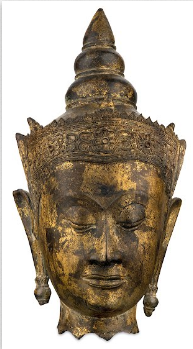
Head of Crowned Buddha

buddha

16th Century Thailand

Two historic statues lost in Libya’s Tripoli

“Two historic statues lost in Libya’s Tripoli”

via “Xinhuanet

TRIPOLI, Nov. 9 (Xinhua) — Unidentified men have hid a historic statue of Omar Al-Mukhtar, a historic figure, in the Libyan capital Tripoli, an official in the Libyan Antiquities Authority announced on Sunday.

Omar Al-Mukhtar is a hero and the leader of the Libyan resistance against the Italian regime for 20 years in the 1920’s and 30’s. The statue was placed in front of the headquarters of the municipal council of Al-Maya region on the coastal road west of Tripoli.

“The archaeological statue disappeared in mysterious circumstances similar to the circumstances in which another archaeological statue, known the gazelle statue, one of the most important historical monuments located in downtown Tripoli, disappeared.” said the official, who requested anonymity.

The statue, known in Tripoli as gazelle statue, it is a small fountain with a statue of nude woman holding a deer. The fountain was designed by the Italian artist Angelo Vanity in early 1930s during the Italian occupation of Libya.

“The statue was uprooted from its place by an unknown group in early hours of Tuesday, most likely because of the nudity features of the statue, which are rejected for religious reasons.” Witnesses told Xinhua.

Several similar threats were issued earlier. In October, the statue was targeted by an RPG missile, causing damage. In 2012, Islamist militants threatened to remove it.

On the other hand, an explosion on last Monday destroyed a historic shrine in the Libyan capital. The shrine, located next to a mosque, is over 700 years old and is officially registered within the Libyan monuments.

Libya is a country rich in cultural and human heritage of Greek and Roman civilizations. However, the country has been unstable since the overthrow of former Muammar Gaddafi regime in 2011.

The capital and several other Libyan cities witnessed similar attacks targeting religious monuments and shrines by Islamist groups described by the Libyan authorities as extremists.

READ ORIGINAL