Exhibition

Unique Exhibition Showcases Works of Central Asian Artists

“Unique Exhibition Showcases Works of Central Asian Artists”

by RUFIYA OSPANOVA via “The Astana Times

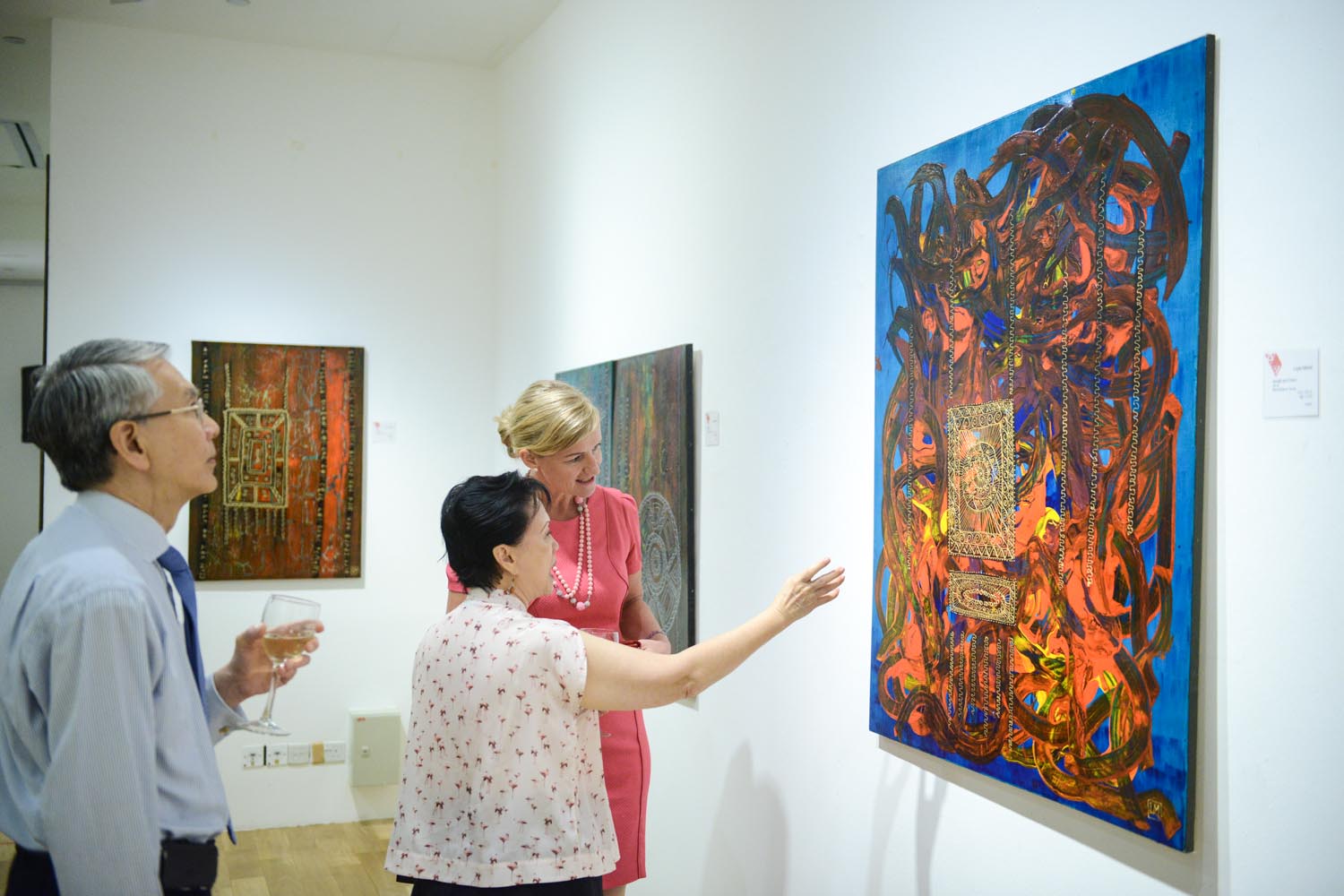
SINGAPORE – “New Silk Roads: Painting Beyond Borders,” the first exhibition of Central Asian artists, was showcased April 21 in Icon Gallery here. The event was organised by ENE Central Asian Arts with the support of the Kazakh Embassy in Singapore and Lassale Singapore University of Art.
BIL_3116

The exhibition showed 37 works, including those of artists from Kazakhstan, Turkmenistan and Uzbekistan. Paintings and abstract compositions by Central Asian artists generated great interest among the many visitors. 

Kazakhstan demonstrated paintings of the Amulet series by the nation’s renowned artist Leyla Mahat. In her works, Mahat tells about the role of amulets in the daily life of nomads, which were used not only as decoration but also as charms from the evil eye.

Amulet paintings recreate ancient jewellery uncovered in archaeological excavations and reconstructed by Kazakh scientists and her images relive the work of archaeologist Zeinolla Samashev. 
BIL_3029

Artist, archaeologist and artisan are all connected through the materiality of the gold ornaments and their contemporary artistic representations, as well as by the land once inhabited by the ancient peoples which now forms their burial place and the physical basis of the modern state. The choice of depicting jewellery, the wearing of which was an aristocratic prerogative, is also suggestive of the lineage which the artist claims as validation for the modern state. The appeals to the forces of history and heredity are perhaps nowhere better illustrated than in “Amulet and Colour” (2014), where their potency seems to glow red-hot, their vividness embodying itself in the profuse viscosity of paint, tactile and Medusa-like in its writhing. 

According to the organisers, such exhibitions in general allow representatives of Central Asian countries not only to learn more about the historical values of each other, but in particular help to strengthen ties between Kazakhstan and Singapore.  . . .

READ MORE

Coming Exhibition: Dolce Vita? From the Liberty to Italian Design (1900-1940)

“Dolce Vita? From the Liberty to Italian Design (1900-1940)”

Who:  Musée d’Orsay 

When: Apr. 14, 2015 – Sept. 13, 2015 (View Hours Here)

Where: 

Musee d’Orsay
1 Rue de la Légion d’Honneur, 
75007 Paris, France

How Much:  (View Pricing Here)

More Information: Here

“In Italy in the early twentieth century the decorative arts were used to interpret the desire for progress of a nation that had only just found its unity. Cabinetmakers, ceramicists and glass-makers all worked together with the leading artists, creating a veritable “Italian style”.

This period of extraordinary creativity is recalled through around a hundred works in a chronological display. The “Liberty” style, which came into its own at the turn of the century, is recalled with designs by Carlo Bugatti, Eugenio Quarti and Federico Tesio mixed with works by the Divisionist painters. A second section is devoted to Futurism, its esthetic inspired by progress and speed extending to every aspect of life.

Later, the return to classicism in Italy came in various guises, finding its expression in the ceramics of Gio Ponti or the glass creations of Carlo Scarpa, up to the stern language of the “Novecento”.
Meanwhile, the rationalist style marked the advent of modern “design”.“

Exhibition honors Vietnamese female soldiers in Vietnam War

“Exhibition honors Vietnamese female soldiers in Vietnam War”

by Minh Hung via “Thanh Nien News”

The Southern Vietnam Women Museum has launched an exhibition of profiles and keepsakes of Vietnamese women who migrated from the north to the south in 1959 to fight for the liberation of southern Vietnam. Photos: Minh Hung
The exhibition, which opens until June 30 and for free at 202 Vo Thi Sau Street, District 3 has attracted foreign visitors on the first day (April 7). Another exhibition is being held at the same place to honor Vietnamese women’s contribution to the country’s workforce.
Water bottle and medical instrument kit that Labor Hero Do Kim Hong used when searching for the remains of her comrades who died in the Vietnam War.
A scarf that Hong used in her searches for the remains of her comrades. Besides the items, the museum also display hundreds of photos, keepsakes of Vietnamese female soldier who migrated from the north in 1959 to fight for the south’s liberation in a hope to find them or their relatives.
A foreign woman watching an item at the exhibition, placed near a statue of a mother armed with a gun while caring her two children and the slogan that reads: The enemies arriving at our home, even women will fight.
Mats displayed at the exhibition to honor Vietnamese women’s activeness at work.

READ MORE

Kenyans learn Chinese culture at festival in capital

“Kenyans learn Chinese culture at festival in capital”

via “Xinhua News Agency

Kenyans learn Chinese culture at festival in capital

NAIROBI, April 19 (Xinhua) — Many Kenyans thronged a Chinese stand at the Third Nairobi Cultural Festival to learn more about the Chinese culture during the international event held Sunday.

China was represented at the festival held at the National Museum of Kenya by the Confucius Institute at the University of Nairobi during the event that attracted 15 countries and two international organizations.

Guo Hong from the Confucius Institute led the staff in displaying Chinese traditional clothes, food, calligraphy, games, and masks among other exhibits.

“This is the first time China is taking part in the event, and we are in Kenya to teach people Chinese language and culture and let people know one another,” Guo told Xinhua.

Peter Kimura, a visitor at the festival, said he came to the stand to learn more about the Asian nation’s culture after reading in books about the diversity of Chinese culture. “As China and Kenya forge closer international relationship, it is important to learn some aspects of the Chinese culture,” Kimura said.

The festival, conceived in 2013 by the Liaison Manager of Research Institute of Swahili Studies of Eastern Africa at the National Museums of Kenya, Munira Mohammed, in a bid to promote the Swahili culture at first and finally becomes an annual event.

“In 2013, we attracted nine countries, whereas in the second year 12 countries participated and come next year we anticipate the figure to soar,” Mohammed told Xinhua.

Mohammed said the aim of this year’s event is to unite the world through heritage and diversity of cultures.

Other countries that participated at the event included the United States, Switzerland, Somalia, Philippines, Mexico, Nigeria, Spain and Indonesia.

Kenyan Cabinet Secretary for Sports Culture and Arts, Hassan Wario, was welcomed at the Chinese stand by the choir from Confucius Institute that received him with a Chinese rendition of “Karibu Kenya” (Welcome to Kenya).

Wario emphasized the importance culture plays in life and promised to make the event a bigger carnival next year.

“Food and music are part of culture,” said Wario, adding one does not necessarily have to visit the respective countries to learn about other people’s culture. “You can even learn some aspects of customs from a forum like this.”

READ MORE

Coming Exhibition: Collectionism and Modernity

“Collectionism and Modernity:

Two Case Studies~ The Im Obersteg and Rudolf Staechelin Collections”

Pablo Picasso. Buveuse d’absinthe (The Absinthe Drinker), 1901. Oil on canvas, 81 x 60 cm. Im Obersteg Foundation, permanent loan to the Kunstmuseum Basel. Photography: Mark Gisler, Müllheim

Who:  Museo Nacional Centro de Arte, The Phillips Collection, the Im Obersteg Foundation, the Rudolf Staechelin Foundation

When: Mar. 18, 2015 – Sept. 14, 2015 (View Hours Here)

Where: 

Museo Nacional Centro de Arte
Calle Santa Isabel 52 
Madrid, Spain 28012

How Much:  (View Pricing Here)

More Information: Here

It was not the work of artists, critics and curators alone that made the development of modern and contemporary art possible. Another factor related to both economic and social concerns intervened as a catalyst in the process. This was art collecting.

This exhibition brings together two leading collections of early modernist art that now form part of the holdings of the Kunstmuseum Basel (Basel, Switzerland), the Im Obersteg Collection and the Rudolf Staechelin Collection, offering an opportunity to enjoy works by the most reputed early modernist masters, the vast majority of which have never before been seen in Spain. It is moreover a chance to explore the phenomenon of collecting, with a focus on its centrality to the formation of modern art.

Private collections of early modernism have traditionally been studied and exhibited with an emphasis on the contemplation of the works on display, neglecting the economic, social and political implications inherent to the activity of collecting in a context like that of Europe in the first decades of the 20th century. Nevertheless, collecting is above all discursive, and may be studied as such. A collection of whatever kind is made up not only of the works it contains but also of the narratives it successfully generates. It was in this sense that Walter Benjamin regarded the collector in his Arcades Project, viewing the act of collecting as related to the desire to understand and organize theworld as a cosmos: “Perhaps in this way it is possible to concretize the secret motive that underlies collecting: the fight against dispersion. The great collector is perturbed from the outset by the dispersion and chaos that subsume everything in theworld.”

.”