History

Paul Revere’s Time Capsule

“Samuel Adams and Paul Revere time capsule unearthed in Boston”

by Douglas Ernst  via “Washington Times”

Image: Twitter, Carl Stevens, WBZ NewsRadio

Samuel Adams and Paul Revere buried a time capsule in 1795. A Boston crew at the Massachusetts State House is now digging it up.

Repair work on a water leak of the State House prompted a crew to remove the cornerstone of the building, which encases the capsule. The Museum of Fine Arts will present the artifacts when the artifact is opened.

“As soon as the box is freed from the stone, we will show the box, then send it to the MFA, they will X-ray it over the weekend and open it sometime there next week,” Massachusetts Secretary of State William Galvin said Thursday, CNN reported.

The capsule, which was dug up during repairs in 1855, is said to house rare coins and papers dating back to the 1600s.

“There were some coins that were tossed in the 1855 ceremony in the mix of the mortar. They are in good condition so we are optimistic that the box itself has withstood the test of time and that it will therefore be holding the contents securely,” Mr. Galvin said, CNN reported.

READ ORIGINAL

Swiss Museum Publishes List of Nazi Loot Art Trove

“Swiss Museum Publishes List of Nazi Loot Art Trove”

via “Reuters

File picture showing the facade of the Kunsmuseum Bern art museum in Bern

ZURICH (Reuters) – A Swiss museum published a list on Thursday of all the art found in the possession of Cornelius Gurlitt, a German recluse whose secret collection included masterpieces looted from their Jewish owners by the Nazis.

The Bern Art Museum was named as sole heir to the collection and on Monday reluctantly accepted the bequest, making clear that it would adopt a policy of total transparency to head off any criticism over its decision to take in the artwork.

“We have promised transparency and are now acting accordingly,” Matthias Frehner, director of the Kunstmuseum Bern, said in a statement.

Gurlitt’s collection of over 1,200 artworks had been hidden away for decades until German tax inspectors stumbled upon it during a raid on his Munich apartment in 2012. A government task force identified three pieces that were indisputably looted by the Nazis which would be returned to the heirs.

Bern Art Museum has said it will not accept any piece which experts believed might have been stolen and by publishing the full list it hopes it might still discover the rightful owners.

Switzerland has worked hard in recent years to shake-off its reputation as a haven for ill-gotten gains, and the museum is anxious to avoid the legal risks associated with accepting disputed art works.

READ MORE

“The Art of Storytelling”

“The Art of Storytelling”

by Yvonne Yan via “Huffington Post

My introduction to pingshu, traditional Chinese storytelling, was Yuan KuoCheng’s “Journey to the West”, a classical Chinese novel popular among all ages. Since then, pingshu has become a significant part of my bedtime story. I fall asleep imagining the Handsome Monkey King angering all the gods and fighting against the deities, swinging his 17,550-pound golden rod from heaven to hell, and using his 72 transformations to overcome all challenges throughout the journey. Words come out of Yuan’s mouth like clips of movies, vivid and captivating, as if the characters appear right in front of me. Listening to pingshu has allowed me, along with generations of Chinese, to appreciate the art of oral stories and the most powerful aspects of Chinese culture.

Most of the pingshu stories that I have listened to are drawn from Chinese history and can be broken into several classifications. The story of loyal and law-abiding officials or chivalrous and dauntless folk heroes, for instance, is my favorite. The characters in this type of pingshu, such as the “Pure Official Bao”, help the commoners fight against evil and corruption in society, symbolizing the virtues of leniency and integrity.

Other types of pingshu also have their own characteristics: the conflicts during the Three Kingdom Period following the Han Dynasty and the early heroes of the Tang Dynasty are typical stories of the establishment of Chinese dynasties; the widely known stories of the Yang family and the renowned Chinese hero Yue Fei both depict tales of dynasties and conflicts, relating to a specific group of soldier’s experiences in resisting barbarian invasions; the last type of story, which differs from the previous three types in both content and narration style, is about fictional legends of monsters, ghosts, or about being challenged in life. The most well known story of this type is “Journey to the West,” which depicts the arduous journey of a small group traveling to see Buddha in order to gain enlightenment.

During my brief interactions with contemporary pingshu artists, I have come to learn more about the art as a folk tradition of telling stories. Since the mid-Qing dynasty, pingshu gradually became an important recreational tool for people to communicate information, share interests, and enjoy their glorious history. Traditional pingshu artists usually perform in teahouses or small theaters, where people can gather around on a nice afternoon.

Like calligraphy and many other Chinese traditional art forms, pingshu requires years of training. Such experience comes from a long apprenticeship with a master. An aspiring storyteller might have to perform years of basic chores, such as cooking for the family and cleaning the house. Most importantly, the artists must passionately devote time, effort, and talent to the business of attracting a permanent audience. The famous Pingshu artist Yuan, who retired several years ago, once characterized pingshu as “difficult mental and physical labor.” Not only do the artists have to memorize long passages, sometimes hundreds of thousands of words long, they also have to incorporate the origins of certain customs, the backgrounds of characters, the history and geography, and other enchanting facts about the stories they tell.

To help the artists narrate stories in a more exciting way, pingshu has also developed a few widely used stage props: a table, a folding fan, and an attention-catching wood (xingmu). It is incredible to imagine that riveting performances can be achieved using such simple objects. The performer usually stands behind the stable during the entire performance. The attention-catching wood, a rectangular piece of dark wood, is knocked against the table to start the performance and to highlight climactic moments of the story. The artist uses the folding fan to illustrate certain physical actions, such as brandishing a sword or reading a book. . . .

READ MORE

Thomas Lamadieu Takes Photos of the Sky and Draws on Top of It

“Thomas Lamadieu Takes Photos of the Sky and Draws on Top of It”

via “Twisted Sifter”

sky art by thomas lamadieu roots art (2)


In his ongoing series entitled Sky Art, Thomas Lamadieu aka Roots Art (featured previously), takes skyward photos of buildings wherever he travels. Most of his images point directly upwards using a fisheye lens. He then uses the sky in each photo as his canvas, filling it in with illustrations and playing with perspective.

To see the entire series check out Lamadieu’s website and be sure to follow him on Facebook and Twitter for the latest.


1.

sky art by thomas lamadieu roots art (10)

THOMAS LAMADIEU/ROOTS ART
Website | Facebook | Twitter


2.

sky art by thomas lamadieu roots art (5)

THOMAS LAMADIEU/ROOTS ART
Website | Facebook | Twitter


3.

sky art by thomas lamadieu roots art (6)

THOMAS LAMADIEU/ROOTS ART
Website | Facebook | Twitter


4.

sky art by thomas lamadieu roots art (15)

THOMAS LAMADIEU/ROOTS ART
Website | Facebook | Twitter


5.

sky art by thomas lamadieu roots art (8)

THOMAS LAMADIEU/ROOTS ART
Website | Facebook | Twitter


6.

sky art by thomas lamadieu roots art (11)

THOMAS LAMADIEU/ROOTS ART
Website | Facebook | Twitter


7.

sky art by thomas lamadieu roots art (12)

THOMAS LAMADIEU/ROOTS ART
Website | Facebook | Twitter


8.

sky art by thomas lamadieu roots art (9)

THOMAS LAMADIEU/ROOTS ART
Website | Facebook | Twitter . . .. .

READ MORE

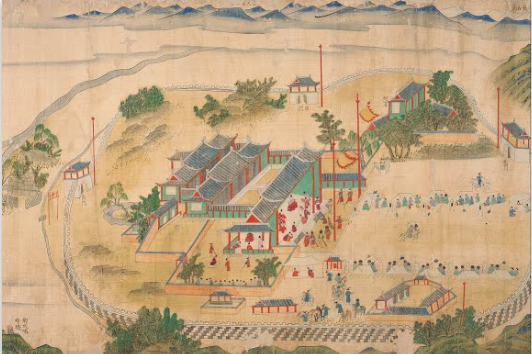
Scroll of Special Examination at the Northern Peripheral Territories

1731 ~ Korean Scroll. Currently housed in the National Museum of Korea at Jeju

1731 ~ Korean Scroll.
Currently housed in the National Museum of Korea at Jeju