Korea

Korean culture conference makes Japan debut

“Korean culture conference makes Japan debut”

via “Korea JoongAng Daily”

When you’re into a person, you’re naturally drawn to discovering his or her most intimate details.

The same goes for fans of K-pop stars.

Followers of these celebrities want more than to simply see their favorite singers perform at concerts or act on screen. They want to get to know them personally – finding out about the clothes they wear, the makeup they use, the food they eat, how they eat it and where they hang out.

Essentially, that’s what KCON, one of Korea’s largest conventions on so-called K-culture, hopes to provide. The event is organized by CJ E&M, also known as CJ Entertainment, the showbiz affiliate of CJ Group.

The annual convention, which concludes with a large-scale K-pop concert, began in 2012 in Los Angeles, a city with a large population of Koreans.

CJ Group executives, including Chairman Lee Jay-Hyun, has said on numerous occasions that the company’s goal is to make people around the world watch two or three Korean films a year; eat Korean food once or twice a month; watch one or two Korean dramas a week; and listen to Korean music every day. CJ has film, food, restaurants, retail and logistics businesses, among others.

One of the conventions will be held in Japan for the first time this year. KCON 2015 Japan will start on April 22 at Saitama Super Arena in Saitama amid soured bilateral ties between Seoul and Tokyo due to intensified historical and territorial disputes.

Why Japan and why now?

The word “CON” in KCON stands for three things – convention, concert and cultural content – three things visitors can experience at the event.

“In order to increase KCON’s presence in 2015, we’ve added more destinations,” CJ E&M said through a press release. “Besides Los Angeles, where it has been held every year, we’ve added the east side of the U.S. as well as Japan. A total of three KCONs will be held this year.”

CJ E&M chose to hold a KCON in Japan as it has hosted the “M Countdown” K-pop concert in the nation around this time most years anyway and because it is where Hallyu, or the popularity of Korean pop culture abroad, began more than a decade ago. . . .

READ MORE

Shanghai collector tries to list chopsticks as a cultural heritage

“Shanghai collector tries to list chopsticks as a cultural heritage”

via CCTV

Chopsticks have been around in China for 3,000 years and have deeply influenced Chinese life in terms of etiquette, cuisine and even philosophy. And they could be listed as an intangible cultural heritage in Shanghai this year, thanks to the efforts of an enthusiast.

Lan Xiang’s pride and joy is collection of more than 2,000 pairs of chopsticks, ranging from the largest to the smallest kind.

Now in his eighties, Lan has been collecting chopsticks for more than 30 years, and in 1998 he set up a museum, the first of its kind in the country.

Lan Xiang

Lan Xiang

It is his way of sharing his passion with others and to preserve and promote the culture of chopsticks.

“Chopsticks have a history of more than 3,000 years in China,” Lan said.

“As something that we use on a daily basis, the chopsticks are not that well preserved in China. I’ve visited Japan several times, and it struck me how highly they regard the culture of chopsticks. It’s not just the organizations that study it; they’ve also made every August 4 the Chopsticks Festival. So I’m applying to list the chopsticks as an intangible cultural heritage in Shanghai.” . . . .

READ MORE

Incheon SK Street Art

Two

Coming Exhibition: Collecting Asian Objects in Colonial Korea, 1910-1945

“Collecting Asian Objects in Colonial Korea, 1910-1945”

Lady riding a horse, Astana Tombs, Turpan, 7th-8th century, color on clay, 38.5cm high.

Who:  

National Museum of Korea

When: Oct. 28, 2014 – January 11, 2015 (Hours Vary)

Where: 

National Museum of Korea
137, Seoubinggo-ro (168-6, Yongsan-dong 6-ga)
Yongsan-gu, Seoul 140-797

More Information: Here and Here.

In the late nineteenth century, as Western powers expanded deeper into Asia, the cultures of the East were eagerly commodified to satisfy westerners’ penchant for the exotic. Tomb thefts were just as prevalent as legitimate archeological investigations. With the concurrent boom in the antique market, the acquired artifacts were smoothly incorporated into the category of ‘fine arts’.
At the center of this movement were museums established through the emergence of modern states. Korea, however, was unable to play a leading role in the current of this era. At the time, Japan regarded itself as the only civilized country in Asia, and thus the only country capable of leading the primitive East into modern civilization. Based on this belief, Japan re-interpreted the histories of other Asian countries from its own perspective and attempted to promote these historical revisions through museums.
Notably, the so-called cultural assets collected in museums at that time originated from all across Asia, ranging from Central Asia to China and Japan. Why did Japan collect cultural assets from other Asian countries under its colonial rule? This exhibition represents the first step of a long journey that will yield both a question and a corresponding answer about our museum’s collection of Asian cultural assets and its origins.

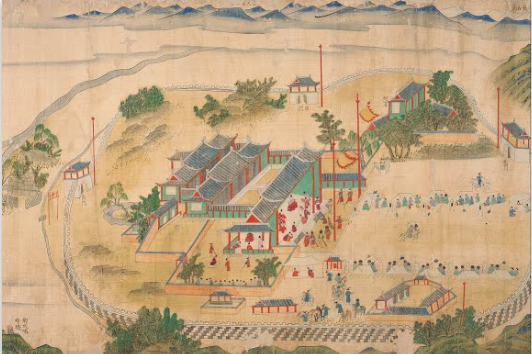
Scroll of Special Examination at the Northern Peripheral Territories

1731 ~ Korean Scroll. Currently housed in the National Museum of Korea at Jeju

1731 ~ Korean Scroll.
Currently housed in the National Museum of Korea at Jeju