2000s

Mixed Media Art ~ “Realistic Animal Drawings Surrounded By The Tools Used To Create Them”

“Realistic Animal Drawings Surrounded By The Tools Used To Create Them”

by Dovas via “BoredPanda”

Talented artist Karla Mialynne isn’t content with simply sharing her stunning hyper-realistic art with her 44,000 Instagram followers – she posts these mixed-media images together with the artistic utensils she used to create these pieces, as if to prove that these are indeed drawings and not photographs.

The utensils, which include pencils, markers and acrylic paints, also show the beautiful rich color palette that Mialynne uses in each of her pictures.


“Gaga for Gangnam: $20 Million Bet on Bringing Korean Pop Culture to China”

“Gaga for Gangnam: $20 Million Bet on Bringing Korean Pop Culture to China”

by Lilian Lin via “The Independent

Korean pop with Chinese characteristics? As the Korean pop culture craze in China continues to grow, some companies are betting heavily on the Middle Kingdom’s appetite for more Gangnam Style-style entertainment.

Hong Kong’s Media Asia and Taiwan’s Fubon Group recently teamed up with South Korea’s SM Entertainment, the country’s music and artist management giant, to set up an investment fund with $20 million in seed money to support various film &TV projects, focusing on China and global Chinese-language audiences.

SM, which manages a slate of top-tier Korean artists, including Girls’ Generation — a popular Korean girl band that won big at the YouTube Music Awards last year – says China is its most important market. According to the agreement, MediaAsia will also begin representing three artists currently backed by S.M Entertainment, including the Korean boy band EXO – a currently 11-member group that has three Chinese members and battled Justin Bieber and One Direction for Worldwide Act at MTV European Music Award last year.

The deal comes after Chinese President Xi Jinping’s visit earlier this year to Seoul, when the two countries signed a string of deals to accelerate cultural exchanges, including an agreement to allow China-Korea co-production films to be seen as domestic films, allowing them to bypass strict imported film quotas in China’s theaters.

“Korean and Chinese government are looking forward to accelerating culture exchanges,” said Han Se-min, CEO of S.M Culture & Contents. “It definitely facilitates our cooperation.”

China’s obsession with all things Korean spans, of course, Psy’s smash hit Gangnam style, which remains beloved by China’s middle-age women who love to dance in public parks, as well as toddlers encouraged to dance in kindergarten classrooms.

This year’s K-pop craze in China, though, has been given further fuel by the rom-com Korean TV series “My Love From the Star.”

The smash hit TV series not only sparked a new fondness in China for fried chicken and beer – a dish often eaten by characters on the show – it also turned Kim Soo-hyun, a fresh-faced Korean heartthrob best known for playing the show’s ageless alien character, into a most-wanted star for China’s advertisers. Ads featuring his image touting everything from mineral water to shoes to moon cakes are ubiquitous in China. The show has been watched more than 14.5 billion times since last December’s debut. . . . .

READ MORE

Art I Love: “Missouri Landscape” by Brent Sanders

(c) Brent Sanders 2012

(c) Brent Sanders 2012

Korean Cultural Heritage Festival Marries Contemporary and Cool with Traditional Arts

“Korean Cultural Heritage Festival Marries Contemporary and Cool with Traditional Arts”

by Carlito Pablo via “Georgia Straight

THIS YEAR’S KOREAN Cultural Heritage Festival will have a modern feel.

According to festival spokesperson Mike Suk, it’s going to be vibrant and cutting-edge, reflecting South Korea’s status as a major global tastemaker, from cars to smart phones to pop culture. The festival’s theme is Dynamics of a Modern Korea.

“We want to show people the new Korea,” Suk told the Georgia Straight in a phone interview.

According to Suk, Hyundai will roll out its latest cars at Swangard Stadium in Burnaby’s Central Park, the venue for the 13th annual festival organized by the Korean Cultural Heritage Society.

He added that for the first time, huge TV screens will be set up to play Korean pop-music (K-pop) videos and commercials throughout Saturday (August 16). On-stage, local performers will sing and dance to K-pop songs.

“The energy is going to feel different,” Suk said. “It is important to note, this festival is not exclusive to the Korean community but rather a true celebration of a multicultural Canada”

Historically, the festival has been about traditional elements, and Suk said those will be present as well. A drum dance will open the festivities, followed by a reenactment of a traditional Korean royal wedding.

There will be a demonstration of the Korean martial art tae kwon do, and there will be tightrope-walking, or jultagi. A food pavilion will offer Korean food, beer, and wine, and traditional Korean souvenirs and gifts will be sold.

B.C.’s Korean community has grown to about 80,000. According to Suk’s organization, it is second in size in Canada to Ontario’s. . . . .”


Read More

Organized Crime, Military Linked to Theft of Cambodian Artifacts

Organized Crime, Military Linked to Theft of Cambodian Artifacts

by Robert Carmichael via “VOA News

Seoul

 —

Over the past 40 years Cambodia’s cultural heritage has been looted on a massive scale, with countless thousands of artifacts taken from hundreds of sites, smuggled out of the country and into museums and private collections around the world. New research indicates that not only was much of this the work of organized networks, but that most pieces have disappeared from public view – probably forever.

Between the start of Cambodia’s civil war in 1970 and the eventual end of hostilities some 30 years later, the country’s 1,000-year-old temples and other historic sites were comprehensively plundered. In one incident in the early 1970s, government soldiers used a military helicopter to airlift artifacts from the 12th century citadel of Banteay Chhmar in the northwest.

At the same complex in 1998 – generals spent a fortnight tearing down and carting away 30 tons of the building. Just one of the six military trucks that went to neighboring Thailand loaded with artifacts was stopped and its contents returned. The rest disappeared, likely sold on the black market.

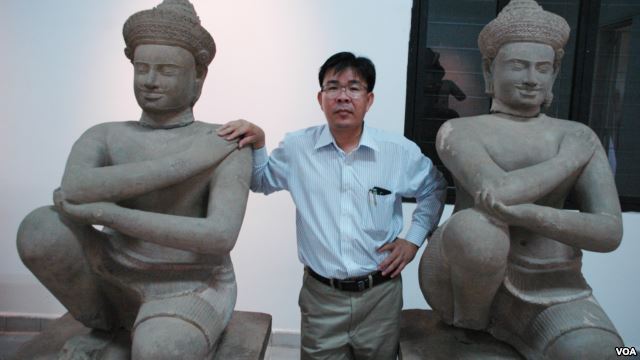
The Duryodhana statue is one of three returned to Cambodia from the United States in early June, Phnom Penh. (Robert Carmichael/VOA)The Duryodhana statue is one of three returned to Cambodia from the United States in early June, Phnom Penh. (Robert Carmichael/VOA)

For many years, researchers assumed that such brazen, well-organized looting was the exception rather than the norm, and that most of the looting of Cambodia’s heritage was a low-level affair, with local people plundering ancient sites and selling statues, carvings and stone reliefs in haphazard fashion.

But a new study carried out by researchers from the University of Glasgow in Scotland shows that was not the case.

“The organized looting and trafficking of Cambodian antiquities was tied very closely to the Cambodian civil war and to organized crime in the country,” explained Tess Davis, a lawyer and archaeologist, and member of the study team that also included criminologists.

“It began with the war, but it long outlived it, and was actually a very complicated operation, a very organized operation, that brought antiquities directly from looted sites here in the country to the very top collectors, museums and auction houses in the world,” she added.

Davis said the Cambodian and Thai militaries were often involved in looting, as was organized crime. Local people were often forced to work as laborers.

Researchers say that at the end of the chain in Thailand was a Bangkok-based dealer who provided the laundering link between the criminals and the collectors and museums.

READ MORE