Asian
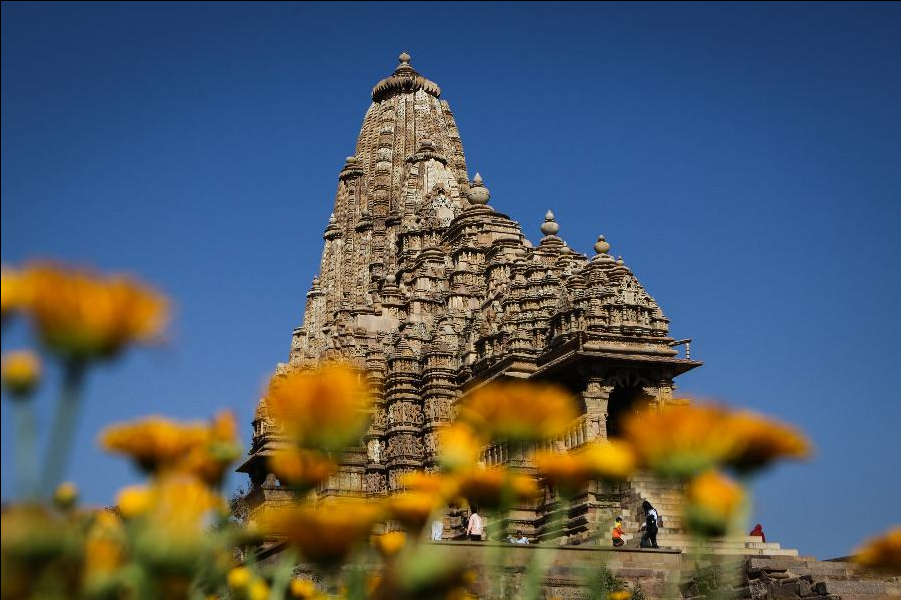
“Australia Returns Two Stolen Ancient, Priceless Idols to India”
“Australia Returns Two Stolen Ancient, Priceless Idols to India”
via “IBNLive.com”
New Delhi: Australian Prime Minister Tony Abbott who is on a state visit to India is returning two looted idols seized from Australian museums during a meeting with the Prime Minister Narendra Modi in New Delhi on Friday.
Abbott is personally delivering the National Gallery of Australia’s Rs 30 crore ($5 million) Dancing Shiva or Nataraja Ardand and the Art Gallery of New South Wales’s Rs 2 crore ($300,000) Ardhanarishvara to Modi as a “gesture of good will” at a state reception at the Rashtrapati Bhawan in the evening.
Both priceless objects were stolen from temples in India and later sold to the museums by Manhattan dealer Subhash Kapoor, who, his gallery manager has admitted, created falsified ownership documents to hide their illicit origins.

Australian Prime Minister Tony Abbott is personally delivering the Dancing Shiva or Nataraja Ardand and Ardhanarishvara to Narendra Modi.
The Australian returns mark the first major repatriations in the Kapoor case, but are unlikely to be the last. Dozens more Kapoor objects acquired by the Australian museums were sold with false ownership histories similar to those used with the returned objects. Several will likely play a prominent role in Kapoor’s criminal trial in Chennai, India, which has been on hold pending the return of the NGA’s looted Shiva says an exclusive website for the Hunt for Looted Antiquities in the World’s Museums ‘Chasing Aphrodite’.
The Tamil Nadu Police had produced evidence to establish that the idol was stolen from a temple at Sripuranthan in Tamil Nadu. They had arrested Kapoor for his alleged involvement in the theft. He is now lodged in the Chennai prison and is facing trial.
Meanwhile, Kapoor’s international network of looters and smugglers is still being mapped by authorities in the United States, who have already seized over Rs 600 crore ($100 million) in art from the dealer’s Manhattan gallery and storage facilities.
Federal investigators in the United States are methodically working through mountains of evidence seized from Kapoor, probing his ties to a number of American and foreign museums that did business with the dealer. Indian authorities, meanwhile, are considering a broader campaign to reclaim stolen antiquities from foreign institutions.
Over the past two years, we’ve traced hundreds of suspect Kapoor objects to museums around the world. To date, the Kapoor case has received the most attention in Australia, whose National Gallery for months stonewalled press and government inquiries and dismissed mounting evidence before agreeing to take the stolen idol off display. The Art Gallery of New South Wales took a slightly more proactive approach, releasing the ownership history that Kapoor supplied for its sculpture of Ardhanarishvara (left.) Soon after, Indian art blogger Vijay Kumar identified the temple from which the sculpture was stolen. . . . .
READ MORE
Coming Exhibition: Loving Devotion: Enter the Mandala
“Enter the Mandala”

“Taima Mandala” (1300s – 1400s)
Who: Asian Art Museum
When: Mar. 14, 2014 – Oct. 26, 2014 (Tues-Sun. 10 a.m. – 5 p.m.; Thurs. 10 a.m. – 9 pm.)
Where:
Asian Art Museum
200 Larkin Street
San Francisco, CA
How Much:
- Adults ~ $15
- Seniors, Students, Youth ~ $10
More Information: Here.
“Mandalas are maps of Buddhist visionary worlds.
Minutely detailed and saturated with philosophical meaning, these works (most often paintings or sculptures) are a feast for the eyes and the mind—nested squares and circles are arrayed to represent the center of the cosmos and the four cardinal directions. For Buddhist practitioners, however, mandalas are not just images to view, but worlds to enter—after recreating the image in their mind’s eye, meditators imaginatively enter its realm.But is it possible to have this experience without years of meditative discipline?
Enter the Mandala says yes. In this exhibition, 14th-century paintings align a gallery with the cardinal directions, transforming open space into an architectural mandala—a chance to experience the images in three dimensions, to dwell in the midst of the cosmic symbols and be transported to another world. Visitors can literally “enter the mandala,” exploring places in the cosmos—and perhaps themselves—that might otherwise remain invisible. “
Enter the Mandala says yes. In this exhibition, 14th-century paintings align a gallery with the cardinal directions, transforming open space into an architectural mandala—a chance to experience the images in three dimensions, to dwell in the midst of the cosmic symbols and be transported to another world. Visitors can literally “enter the mandala,” exploring places in the cosmos—and perhaps themselves—that might otherwise remain invisible. “
Organized Crime, Military Linked to Theft of Cambodian Artifacts
Organized Crime, Military Linked to Theft of Cambodian Artifacts
by Robert Carmichael via “VOA News“
PHNOM PENH —
Over the past 40 years Cambodia’s cultural heritage has been looted on a massive scale, with countless thousands of artifacts taken from hundreds of sites, smuggled out of the country and into museums and private collections around the world. New research indicates that not only was much of this the work of organized networks, but that most pieces have disappeared from public view – probably forever.
Between the start of Cambodia’s civil war in 1970 and the eventual end of hostilities some 30 years later, the country’s 1,000-year-old temples and other historic sites were comprehensively plundered. In one incident in the early 1970s, government soldiers used a military helicopter to airlift artifacts from the 12th century citadel of Banteay Chhmar in the northwest.
At the same complex in 1998 – generals spent a fortnight tearing down and carting away 30 tons of the building. Just one of the six military trucks that went to neighboring Thailand loaded with artifacts was stopped and its contents returned. The rest disappeared, likely sold on the black market.
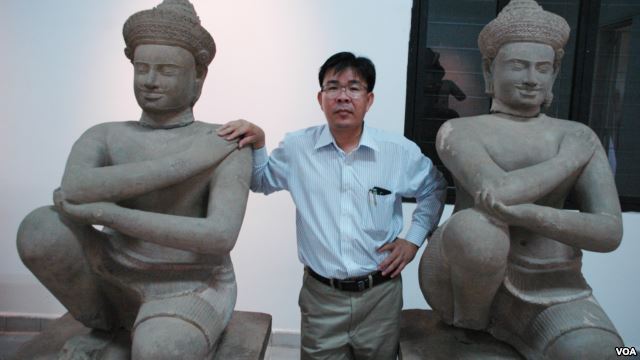
 The Duryodhana statue is one of three returned to Cambodia from the United States in early June, Phnom Penh. (Robert Carmichael/VOA)
For many years, researchers assumed that such brazen, well-organized looting was the exception rather than the norm, and that most of the looting of Cambodia’s heritage was a low-level affair, with local people plundering ancient sites and selling statues, carvings and stone reliefs in haphazard fashion.
But a new study carried out by researchers from the University of Glasgow in Scotland shows that was not the case.
“The organized looting and trafficking of Cambodian antiquities was tied very closely to the Cambodian civil war and to organized crime in the country,” explained Tess Davis, a lawyer and archaeologist, and member of the study team that also included criminologists.
“It began with the war, but it long outlived it, and was actually a very complicated operation, a very organized operation, that brought antiquities directly from looted sites here in the country to the very top collectors, museums and auction houses in the world,” she added.
Davis said the Cambodian and Thai militaries were often involved in looting, as was organized crime. Local people were often forced to work as laborers.
Researchers say that at the end of the chain in Thailand was a Bangkok-based dealer who provided the laundering link between the criminals and the collectors and museums.
READ MORE
4,000-Year-Old Burial with Chariots Discovered in South Caucasus
4,000-Year-Old Burial with Chariots Discovered in South Caucasus
by Owen Jarus via “Yahoo!News“

An ancient burial containing chariots, gold artifacts and possible human sacrifices has been discovered by archaeologists in the country of Georgia, in the south Caucasus. (more…)
 The Cultured Muse