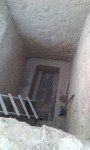
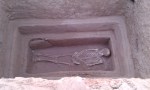
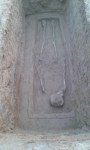
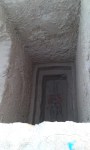
They closed off the site before we could see any more of the progress; however, we do know that they have uncovered about 40 tombs so far. There are estimated to be at least 200 more not yet excavated. They have been finding random odds and ends in the graves, including pottery and some gold jewelry. It is believed that this was the burial ground for the village, so it is a mixture of lovely graves and less up-kept ones. At least some date back to the 3rd Century B.C.E., around the late Warring States Kingdom of Han. Right now, the government has closed the area off to students and visitors, and they will be monitoring the progress. Xinzheng is the “Birthplace” of China because Emperor Huangdi was born here. It was the central-point for several dynastic governments, and there is a lot of history here. It will be fascinating to see what they uncover!
Archaeology
I’m Living In An Archaeology Dig!
I’m apparently living out my dream in an Archaeology Dig! Students were told today that in the building of the new college library here on campus, they found a massive ancient burial ground! According to what I’ve been told, they estimate at least 1400 years old. They believe that the people here were commoners who died peacefully, and after looking at the bodies, they are certainly mostly whole. It is incredibly fascinating to see. The students are allowed to simply wander around the burial spots at least until Monday when they will be closed off by the historians and archeologists. I’ll post more pictures soon. So Cool!!






Islamic State Raids Biblical City of Ninevah, Sells Ancient Treasures For Millions
Islamic State Raids Biblical City of Ninevah, Sells Ancient Treasures For Millions
by Thomas D. Williams via “Breitbart“

The sale of archaeological treasures from the Biblical city of Nineveh and the surrounding territory is becoming one of the main sources of funding of the Islamic State in Kurdistan as well as in Syria, according to reports by the Italian newspaper Corriere della Sera.
A USB stick recovered from an Islamic State militant by Iraqi intelligence in August documents the value of revenues on the black market at $32 million. Among the items for sale: hundreds of headstones, inscriptions, mosaics, and adornments.
According to Qais Hussein Rasheed, head of the state-run Museums Department in Iraq, black market dealers are entering areas under Islamic State control to buy these items.
In their zeal to destroy what they consider to be heresy, Islamic State militants have demolished many artifacts but they are cashing in at the same time, extracting valuable relics to sell on the international black market.
Profiting from religious artifacts represents a curious double game. On the one hand, the precepts of Wahhabism, a fundamentalist Islamic sect, require the destruction of every object of worship not directed to Allah. This has justified the demolition of churches, mosques, and tombs, and has been carried out with maximum media exposure.
On the other hand—this time without advertising it—the same IS leaders are now either selling artifacts directly or granting access to occupied archeological zones to teams of professional looters. They then split the revenues from the plunder according to the Islamic law of Khums: a fifth of the spoils must be paid to God, ie, the Islamic state.
The Turkish border is only a few hours away with Western brokers waiting to transfer the artifacts to the major black art markets: London, New York, and Tokyo. . . . .
READ MORE
“Archaeologists Train “Monuments Men” to Save Syria’s Past”
“Archaeologists Train “Monuments Men” to Save Syria’s Past”
by Andrew Curry via “National Geographic“
Amid the devastation and danger of civil war, Syrian archaeologists and activists are risking their lives in the battle against looting. . . .

The ancient city of Dura-Europos sits on a bluff above the Tigris River a few miles from Syria’s border with Iraq, its mud-brick walls facing a bleak expanse of desert. Just a year ago the city’s precise grid of streets—laid down by Greek and Roman residents 2,000 years ago—was largely intact. Temples, houses, and a substantial Roman outpost were preserved for centuries by the desert sands.
“It stood out for its remarkable preservation,” saysSimon James, an archaeologist at the U.K.’s University of Leicester who spent years studying the site’s Roman garrison. “Until now.” (See before and after pictures of archaeological site looting.)
Satellite images of the site released by the U.S. State Department in June show a shocking picture of devastation. In the past year, as fighting continued to rage between the government of President Bashar al Assad’s troops and rebels—including the Islamic State in Iraq and Syria—the site has been ravaged by industrial-scale looting.

Aleppo’s Umayyad Mosque is seen here in 2009, before being damaged in the civil unrest.
PHOTOGRAPH BY BRYAN DENTON, CORBIS
“It’s a lunar landscape of spoil heaps,” says James. “Obviously, the looters were bankrolled to a massive extent to do something like this.”
It may be too late to save Dura-Europos, but archaeologists and activists are scrambling to preserve what’s left of Syria’s rich history, which stretches back more than 10,000 years. The efforts are focused on training locals to save ancient monuments and museum collections in the midst of a war zone.
Organizations including the University of Pennsylvania’s Cultural Heritage Center, the International Council on Monuments and Sites (ICOMOS), and Heritage for Peace, a network of volunteers and activists based in Spain, have been holding workshops to train Syrian archaeologists, curators, and activists in “first aid for objects and sites,” says Emma Cunliffe, a consultant specializing in heritage protection during conflicts. . . .”
READ MORE
“Over 1,000 Ancient Buddha Statues Uncovered in China”
“Over 1,000 Ancient Buddha Statues Uncovered in China”
by April Holloway via “Epoch Times“

“Archaeologists have discovered more than 1,000 ancient Buddha statues in three stone caves on a cliff-face in Yangqu County, in north China’s Shanxi Province, according to a report in China.org.cn. Although official dating has not yet been carried out, it is believed that the statues date back to the Ming Dynasty.
The Ming dynasty, was the ruling dynasty of China for 276 years (1368–1644 AD) following the collapse of the Mongol-led Yuan dynasty. The Ming, described by some as “one of the greatest eras of orderly government and social stability in human history”, was the last dynasty in China ruled by ethnic Han Chinese. The creation of stone Buddha statues reached its peak during the period from the Northern and Southern Dynasties (420-589) to the Tang Dynasty (618-907), so it is rare to find stone Buddha statues from the Ming Dynasty.
According to traditional accounts, Buddhism was introduced in China during the Han dynasty (206 BC-220 AD) after an emperor dreamed of a flying golden man thought to be the Buddha. Although the archaeological record confirms that Buddhism was introduced sometime during the Han dynasty, it did not flourish in China until the Six Dynasties period (220-589 AD). The year 67 CE saw Buddhism’s official introduction to China with the coming of the two monks Moton and Chufarlan.
The latest finding including stone statues carved into the cave walls and measuring 12 to 25 centimetres long, said Yang Jifu, director of the county’s cultural heritage tourism bureau. Yang said two of the caves had been restored in the Ming Dynasty, according to the record on two steles in the caves. . . . .”
 The Cultured Muse