Asia

Colombian carnival meets Korean folk art

Colombian carnival meets Korean folk art”

via “The Korean Herald

Colombian pair of traditional artists visited Korea A in September to showcase the country’s carnival music and dance and engage in a cultural exchange with Korean artists. Dancer and researcher Maribel Egea Garia and instrumentalist and professor Jarry Jose Julio Arjona came to Korea on Sept.At the request of the Colombian Embassy 8, and performed at schools and events across the country.They also took lessons on traditional Korean music and dance, provided by the Korean Classical Music Corporation.

Both are natives of Barranquilla, a city in northern Colombia by the Caribbean Sea that is famous for its carnival in February. The four-day festival is considered one of Latin America’s three major carnivals, along with those of Rio de Janeiro and Miami. Declared a National Cultural Heritage by the Congress of Colombia in 2001 and recognized by UNESCO in 2003, the event has become a universalby incorporating cultural influences over waves of celebration the years. “The carnival is a cultural melting pot, mixing the legacies of Spanish colonialists, African slaves and their accompanying South American natives,” Garia told The Korea Herald. “It passionately fuses the different elements, which manifest themselves in characteristic ways during the festivity.” As various ethnicities and groups live harmoniously in Colombia, no apparent tensions or conflicts exist between them, Arjona said. People the PREPARE for the event for weeks or months on end, depending on their roles, he said, with the exception of few native tribes who live deep in the forests in the Sierra Nevada de Santa Marta region – the Kogis, Arawakas and Wayuus. “They have the Colombian national identity in their heart, but been largely outliers to the event due to their culturally indigenous ways of life.” According to Garia, the carnival originated from cultures surrounding the Caribbean Sea. The most famous dance is “la cumbia,” comprised of a pair of male and female dancers, the WHERE the man makes moves that resemble seducing his female partner, she said. Arjona said that spectators can “indirectly” participate from the side of the road , singing and dancing, taking photographs and interacting with other crowds, but can not jump into the carnival. Barranquilla lies next to the Magdalena River delta facing the Caribbean, and has served as a strategic port for the riverside and maritime industries. . . .

READ MORE
 

Unique Exhibition Showcases Works of Central Asian Artists

“Unique Exhibition Showcases Works of Central Asian Artists”

by RUFIYA OSPANOVA via “The Astana Times

SINGAPORE – “New Silk Roads: Painting Beyond Borders,” the first exhibition of Central Asian artists, was showcased April 21 in Icon Gallery here. The event was organised by ENE Central Asian Arts with the support of the Kazakh Embassy in Singapore and Lassale Singapore University of Art.

BIL_3116

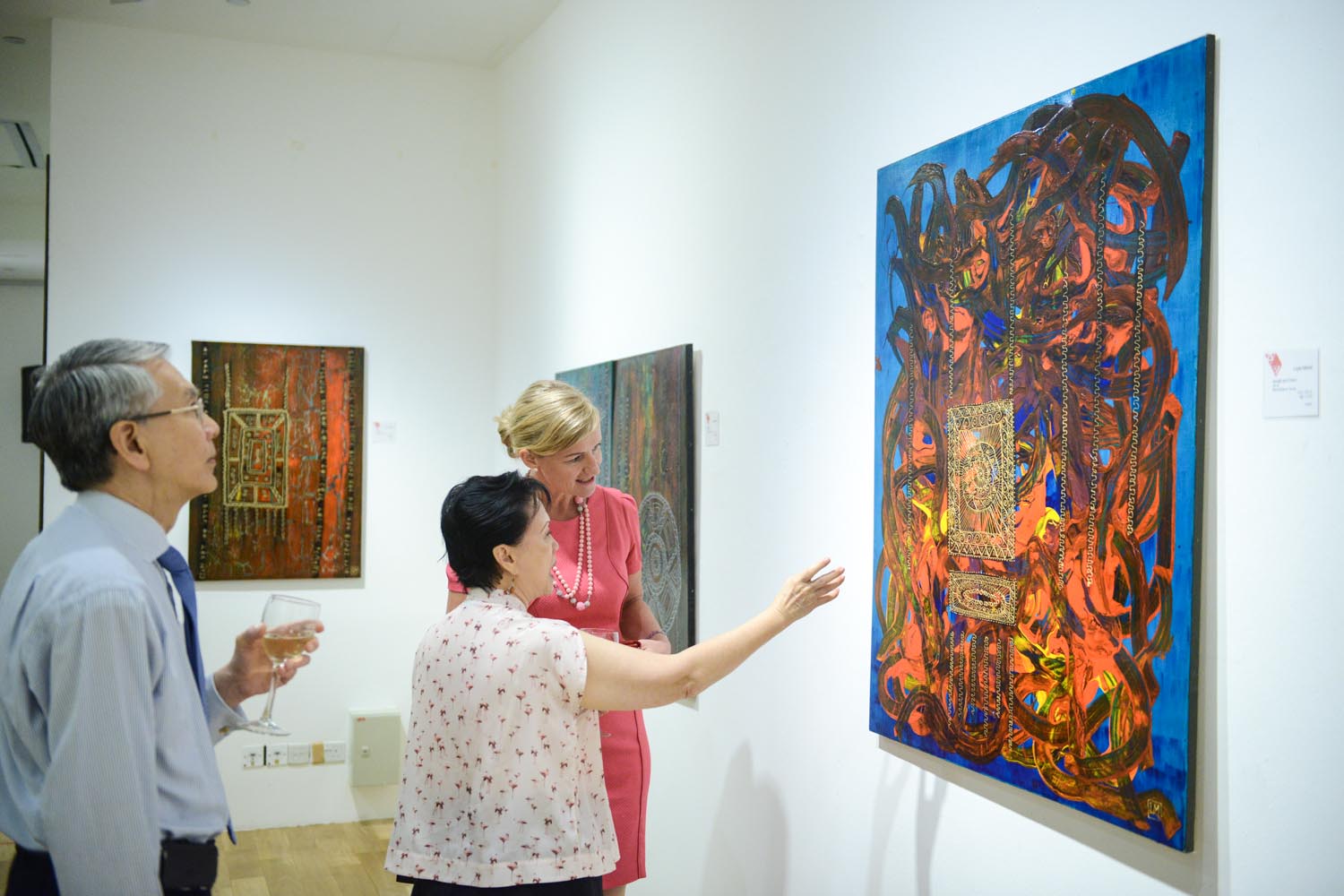
The exhibition showed 37 works, including those of artists from Kazakhstan, Turkmenistan and Uzbekistan. Paintings and abstract compositions by Central Asian artists generated great interest among the many visitors. 

Kazakhstan demonstrated paintings of the Amulet series by the nation’s renowned artist Leyla Mahat. In her works, Mahat tells about the role of amulets in the daily life of nomads, which were used not only as decoration but also as charms from the evil eye.

Amulet paintings recreate ancient jewellery uncovered in archaeological excavations and reconstructed by Kazakh scientists and her images relive the work of archaeologist Zeinolla Samashev. 

BIL_3029

Artist, archaeologist and artisan are all connected through the materiality of the gold ornaments and their contemporary artistic representations, as well as by the land once inhabited by the ancient peoples which now forms their burial place and the physical basis of the modern state. The choice of depicting jewellery, the wearing of which was an aristocratic prerogative, is also suggestive of the lineage which the artist claims as validation for the modern state. The appeals to the forces of history and heredity are perhaps nowhere better illustrated than in “Amulet and Colour” (2014), where their potency seems to glow red-hot, their vividness embodying itself in the profuse viscosity of paint, tactile and Medusa-like in its writhing. 

According to the organisers, such exhibitions in general allow representatives of Central Asian countries not only to learn more about the historical values of each other, but in particular help to strengthen ties between Kazakhstan and Singapore.  . . .

READ MORE

Korean culture conference makes Japan debut

“Korean culture conference makes Japan debut”

via “Korea JoongAng Daily”

When you’re into a person, you’re naturally drawn to discovering his or her most intimate details.

The same goes for fans of K-pop stars.

Followers of these celebrities want more than to simply see their favorite singers perform at concerts or act on screen. They want to get to know them personally – finding out about the clothes they wear, the makeup they use, the food they eat, how they eat it and where they hang out.

Essentially, that’s what KCON, one of Korea’s largest conventions on so-called K-culture, hopes to provide. The event is organized by CJ E&M, also known as CJ Entertainment, the showbiz affiliate of CJ Group.

The annual convention, which concludes with a large-scale K-pop concert, began in 2012 in Los Angeles, a city with a large population of Koreans.

CJ Group executives, including Chairman Lee Jay-Hyun, has said on numerous occasions that the company’s goal is to make people around the world watch two or three Korean films a year; eat Korean food once or twice a month; watch one or two Korean dramas a week; and listen to Korean music every day. CJ has film, food, restaurants, retail and logistics businesses, among others.

One of the conventions will be held in Japan for the first time this year. KCON 2015 Japan will start on April 22 at Saitama Super Arena in Saitama amid soured bilateral ties between Seoul and Tokyo due to intensified historical and territorial disputes.

Why Japan and why now?

The word “CON” in KCON stands for three things – convention, concert and cultural content – three things visitors can experience at the event.

“In order to increase KCON’s presence in 2015, we’ve added more destinations,” CJ E&M said through a press release. “Besides Los Angeles, where it has been held every year, we’ve added the east side of the U.S. as well as Japan. A total of three KCONs will be held this year.”

CJ E&M chose to hold a KCON in Japan as it has hosted the “M Countdown” K-pop concert in the nation around this time most years anyway and because it is where Hallyu, or the popularity of Korean pop culture abroad, began more than a decade ago. . . .

READ MORE

Stone-Faced Buddha ~ Longmen Grottoes

DSC08726

Longmen Grottoes

Took a little trip to the Luòyáng , China this past weekend as part of a culture trip hosted by the University! 

Pronounced something like “loi yahng,” this beautiful home to the National Peony Festival (I’ll add an update on the Peony Garden later) is one of the “cradles of Chinese Civiliazation” and one of the ancient capital cities of China (Henan has 2 of them! – Luoyang and Xinzheng).  The city itself is amazingly clean and open, the streets are unlittered and it’s pretty modern.  

DSC08783

The best part of my visit by far though was the Longmen Grottoes and the Peony Garden.  This week was part of the 2 week festival they have each year for the Peony festival, so people were everywhere despite the rain.  

DSC08653

The Longmen Grottoes themselves are absolutely mind-blowing ~ an amazing feat of human design and capability. To imagine that such intricate  design, specific carvings, and gentle touch art were feasible so many centuries ago is one of those things that always stops me in my tracks. I know a lot of people aren’t as interested as I in history and stone statues (several of the teachers I was with were fairly denigrating about spending so much time in a “Stone Garden). But to me, standing on the same ground, touching the rocks they touched, seeing the art they created, glimpsing pieces of hearts long past. It’s simply miraculous.

DSC08700

The Grottoes are home to thousands and thousands of carvings on the stone faces of the mountain cliffs. Most are of Buddha or his followers, some are pagodas, buildings, and other designs. The varying stone colors used to frame and decorate the statues, each one different from the rest.  Carved over a period of centuries (5th – 15th Century AD), each set was designed by a different artist, many from completely different times. You can trace the changes, both in religion and philosophy (skinny to fat Buddhas for example) and in art styles.

DSC08696

One of the other reasons the grottoes is so stunning is the River Yi (pron. ee) that runs alongside the valley in front of the rocks. The river is clean and beautiful, sweeping along a lovely walkway as antique-style dragon boats float up and down.  Stone bridges line the view, criss-crossing over to the other side that offers views of antique buildings lining the mountain paths.

DSC08661

 It’s just a beautiful way to spend a day


Kenyans learn Chinese culture at festival in capital

“Kenyans learn Chinese culture at festival in capital”

via “Xinhua News Agency

Kenyans learn Chinese culture at festival in capital

NAIROBI, April 19 (Xinhua) — Many Kenyans thronged a Chinese stand at the Third Nairobi Cultural Festival to learn more about the Chinese culture during the international event held Sunday.

China was represented at the festival held at the National Museum of Kenya by the Confucius Institute at the University of Nairobi during the event that attracted 15 countries and two international organizations.

Guo Hong from the Confucius Institute led the staff in displaying Chinese traditional clothes, food, calligraphy, games, and masks among other exhibits.

“This is the first time China is taking part in the event, and we are in Kenya to teach people Chinese language and culture and let people know one another,” Guo told Xinhua.

Peter Kimura, a visitor at the festival, said he came to the stand to learn more about the Asian nation’s culture after reading in books about the diversity of Chinese culture. “As China and Kenya forge closer international relationship, it is important to learn some aspects of the Chinese culture,” Kimura said.

The festival, conceived in 2013 by the Liaison Manager of Research Institute of Swahili Studies of Eastern Africa at the National Museums of Kenya, Munira Mohammed, in a bid to promote the Swahili culture at first and finally becomes an annual event.

“In 2013, we attracted nine countries, whereas in the second year 12 countries participated and come next year we anticipate the figure to soar,” Mohammed told Xinhua.

Mohammed said the aim of this year’s event is to unite the world through heritage and diversity of cultures.

Other countries that participated at the event included the United States, Switzerland, Somalia, Philippines, Mexico, Nigeria, Spain and Indonesia.

Kenyan Cabinet Secretary for Sports Culture and Arts, Hassan Wario, was welcomed at the Chinese stand by the choir from Confucius Institute that received him with a Chinese rendition of “Karibu Kenya” (Welcome to Kenya).

Wario emphasized the importance culture plays in life and promised to make the event a bigger carnival next year.

“Food and music are part of culture,” said Wario, adding one does not necessarily have to visit the respective countries to learn about other people’s culture. “You can even learn some aspects of customs from a forum like this.”

READ MORE