China

Europe’s Largest Display of Chinese Lanterns and Illuminations for Festival of Light at Longleat

“Europe’s Largest Display of Chinese Lanterns and Illuminations for Festival of Light at Longleat”

by Nancy Connolly via “Bath Chronicle

Finishing touches are being added to a stunning display of illuminated Chinese scenes at the Longleat estate and visitor attraction in Wiltshire.

A total of around 7,000 individual lanterns, miles and miles of silk and thousands of dazzling LED lights are being used to create a series of stunning tableaux for the Festival of Light at the rural estate.

The highlights of the spectacular event include a 70 metre dragon made up of 23,000 lit porcelain cups, bowls and plates,  and mythical creatures called ‘qilin’, which are each made from over 65,000 glass phials filled with coloured liquid.

The outdoor extravaganza also features a 20 metre tall Chinese temple, huge traditional Chinese masks, a family of life size pandas in a bamboo forest, giant elephants and other animals including zebras, lions and deer.

In total, 30 tonnes of steel has been used to build the frames for the illuminated structures.

A team of 100 highly skilled craftsmen from the village of Zigong in China’s Sichuan province have spent six months creating the structures, which will remain at Longleat from November 14 until the New Year.

Written records of lantern festivals in China date back 2,000 years, and Zigong is considered to be their spiritual home.

Bob Montgomery, Longleat’s chief executive, said: “The Festival of Light is something truly unique.

“We are taking the age old tradition of the Chinese lantern and completely transforming it for a modern audience using giant LED illuminated structures.

“There will be around 20 different scenes to explore within 30 acres, featuring literally thousands of individual illuminations, created from a mixture of silk, satin and vinyl.

“Nothing like it has been attempted on this scale before in the UK – it’s about as far away from those familiar lightweight flying lanterns as it is possible to get.”

READ MORE

Coming Exhibition: Collecting Asian Objects in Colonial Korea, 1910-1945

“Collecting Asian Objects in Colonial Korea, 1910-1945”

Lady riding a horse, Astana Tombs, Turpan, 7th-8th century, color on clay, 38.5cm high.

Who:  

National Museum of Korea

When: Oct. 28, 2014 – January 11, 2015 (Hours Vary)

Where: 

National Museum of Korea
137, Seoubinggo-ro (168-6, Yongsan-dong 6-ga)
Yongsan-gu, Seoul 140-797

More Information: Here and Here.

In the late nineteenth century, as Western powers expanded deeper into Asia, the cultures of the East were eagerly commodified to satisfy westerners’ penchant for the exotic. Tomb thefts were just as prevalent as legitimate archeological investigations. With the concurrent boom in the antique market, the acquired artifacts were smoothly incorporated into the category of ‘fine arts’.
At the center of this movement were museums established through the emergence of modern states. Korea, however, was unable to play a leading role in the current of this era. At the time, Japan regarded itself as the only civilized country in Asia, and thus the only country capable of leading the primitive East into modern civilization. Based on this belief, Japan re-interpreted the histories of other Asian countries from its own perspective and attempted to promote these historical revisions through museums.
Notably, the so-called cultural assets collected in museums at that time originated from all across Asia, ranging from Central Asia to China and Japan. Why did Japan collect cultural assets from other Asian countries under its colonial rule? This exhibition represents the first step of a long journey that will yield both a question and a corresponding answer about our museum’s collection of Asian cultural assets and its origins.

Coming Exhibition: Art Basel ~ Shanghai Art Fair

“Shanghai Art Fair”

Shanghai Art Fair

Who:  Shanghai Art Fair (Various Exhibitors)

When: Nov. 13, 2014 – Nov. 15, 2014 (View Hours Here)

Where: 

ShanhaiMart
99, Xingyi Rd.
Shanghai, China

How Much:  50 Yuan

More Information: Here

Shanghai Art Fair 2014 (18th), as Aisa’s celebrated art exchange with long history and high internationalization degree, will be grandly held from Nov.13-16 at ShanghaiMART, continuing the scale as before, presenting domestic and overseas collectors a gorgeous art event in Shanghai as well.
Shanghai Art Fair, established in 1997, has been successfully held under the support of Saulterretimized art event, which not only bridged the gap between worldwide and Shanghai, public and art, but also shaped a paradigm for the domestic art fairs.
More than 20 countries and areas’ art galleries, organizations, agencies participated in this lively art exchange during the past dozen years. Many original artworks from the world-class masters, such as Picasso, Rembrandt, Chagall, Dali, Renoir, Monet, Zhu Dequn, Qi Baishi, Xu Beihong, Zhang Daqian, made the debut in China or Asia through the great stage established by Shanghai Art Fair. Number of spectators was around 60000 persons, turnover of 2013 exceeded one hundred and forty million yuan. Meanwhile, Shanghai art Fair creates a proud history of the transaction:
SAF 2000: The most spectacular one is Rodin”s sculpture called, The Thinker, brought by Sayegh Gallery (France), which was purchased at the price of $1,000,000 by Pudong Lianyang Land Development Company and set in Shanghai forever. This has been the biggest overseas transaction in Shanghai Art Fair.
SAF 2002: Another sculpture, called Cesar”s Thumb, was collected at the price of 2,600,000 RMB by Shanghai Zendai Group.
SAF 2003: One of Zhang Daqian”s paintings was sold at 5,500,000 RMB, which became the highlight of the fair.
SAF 2007: Saulterre’s “Series of Angel” was collected by Jing’an Sculpture Park at a high price…
Peter Denger, the famous curator of Basel Art Fair which is called Olympic in art, once gave Shanghai Art Fair a high rating “It”s a great international art fair with bright future”.

Update on Xinzheng Burial Ground

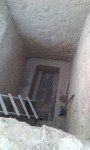
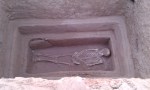
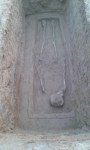
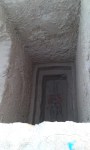
They closed off the site before we could see any more of the progress; however, we do know that they have uncovered about 40 tombs so far.  There are estimated to be at least 200 more not yet excavated.  They have been finding random odds and ends in the graves, including pottery and some gold jewelry.  It is believed that this was the burial ground for the village, so it is  a mixture of lovely graves and less up-kept ones.   At least some date back to the 3rd Century B.C.E., around the late Warring States Kingdom of Han.  Right now, the government has closed the area off to students and visitors, and they will be monitoring the progress.  Xinzheng is the “Birthplace” of China because Emperor Huangdi was born here.  It was the central-point for several dynastic governments, and there is a lot of history here.  It will be fascinating to see what they uncover!

I’m Living In An Archaeology Dig!

I’m apparently living out my dream in an Archaeology Dig!  Students were told today that in the building of the new college library here on campus, they found a massive ancient burial ground!  According to what I’ve been told, they estimate at least 1400 years old.  They believe that the people here were commoners who died peacefully, and after looking at the bodies, they are certainly mostly whole.  It is incredibly fascinating to see.  The students are allowed to simply wander around the burial spots at least until Monday when they will be closed off by the historians and archeologists.  I’ll post more pictures soon.  So Cool!!