Chinese art

New Broad Exhibit Showcases Range, Diversity of Art in China

“New Broad Exhibit Showcases Range, Diversity of Art in China”

by Matthew Miller via “Lansing Journal”

Broad Art Museum 4.jpg

“What’s wrong, I think, is the position of the dragon.”

Wang Chuan was gesturing at one of his own photographs, an image of a bright golden statuette of a dragon — a potent image in Chinese culture, a symbol of the nation itself — presiding over a collection of grimy soup pots.

“This is a stew,” he said, meaning the contents of those pots. “This is in a popular restaurant in a suburb of Beijing. It’s run by the farmers who don’t do farm work anymore. This is the wrong place.”

Wang’s dragon photos, part of “Future Returns,” an exhibition of Chinese contemporary art that opened last month at the Eli and Edythe Broad Art Museum at Michigan State University, are on their face an exploration of the hapless fate of a cultural icon.

In one image, a long costume used in the traditional dragon dance sits crumpled on the back of a three wheeler. Another shows coins tossed for luck onto the image of a dragon at a temple, all of the smallest denominations.

But, in a broader sense, they are a mediation on the erasure of tradition in a fast-changing country.

“Gradually, people begin to care if the tradition is too quick to be erased by the modernization and the development of the economy and the incoming of the culture from the Western world,” Wang said. “The pace of vanishing of all the old things is shocking.”

The exhibition, which includes the work of more than two dozen artists, is the first brought to the museum by Wang Chunchen, a respected art critic and head of the Department of Curatorial Research at the CAFA Art Museum at the Central Academy of Fine Arts China in Beijing who is also an adjunct curator for the Broad.

“China is changed greatly in the past three decades,” Wang said, as he took a group of journalists, artists and translators through the exhibition last month. “So the art I selected her represents, stands for that kind of change, culturally, socially, psychologically.” . . . .

READ MORE

Coming Exhibition: Art Basel ~ Shanghai Art Fair

“Shanghai Art Fair”

Shanghai Art Fair

Who:  Shanghai Art Fair (Various Exhibitors)

When: Nov. 13, 2014 – Nov. 15, 2014 (View Hours Here)

Where: 

ShanhaiMart
99, Xingyi Rd.
Shanghai, China

How Much:  50 Yuan

More Information: Here

Shanghai Art Fair 2014 (18th), as Aisa’s celebrated art exchange with long history and high internationalization degree, will be grandly held from Nov.13-16 at ShanghaiMART, continuing the scale as before, presenting domestic and overseas collectors a gorgeous art event in Shanghai as well.
Shanghai Art Fair, established in 1997, has been successfully held under the support of Saulterretimized art event, which not only bridged the gap between worldwide and Shanghai, public and art, but also shaped a paradigm for the domestic art fairs.
More than 20 countries and areas’ art galleries, organizations, agencies participated in this lively art exchange during the past dozen years. Many original artworks from the world-class masters, such as Picasso, Rembrandt, Chagall, Dali, Renoir, Monet, Zhu Dequn, Qi Baishi, Xu Beihong, Zhang Daqian, made the debut in China or Asia through the great stage established by Shanghai Art Fair. Number of spectators was around 60000 persons, turnover of 2013 exceeded one hundred and forty million yuan. Meanwhile, Shanghai art Fair creates a proud history of the transaction:
SAF 2000: The most spectacular one is Rodin”s sculpture called, The Thinker, brought by Sayegh Gallery (France), which was purchased at the price of $1,000,000 by Pudong Lianyang Land Development Company and set in Shanghai forever. This has been the biggest overseas transaction in Shanghai Art Fair.
SAF 2002: Another sculpture, called Cesar”s Thumb, was collected at the price of 2,600,000 RMB by Shanghai Zendai Group.
SAF 2003: One of Zhang Daqian”s paintings was sold at 5,500,000 RMB, which became the highlight of the fair.
SAF 2007: Saulterre’s “Series of Angel” was collected by Jing’an Sculpture Park at a high price…
Peter Denger, the famous curator of Basel Art Fair which is called Olympic in art, once gave Shanghai Art Fair a high rating “It”s a great international art fair with bright future”.

I’m Living In An Archaeology Dig!

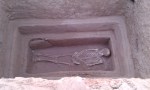
I’m apparently living out my dream in an Archaeology Dig!  Students were told today that in the building of the new college library here on campus, they found a massive ancient burial ground!  According to what I’ve been told, they estimate at least 1400 years old.  They believe that the people here were commoners who died peacefully, and after looking at the bodies, they are certainly mostly whole.  It is incredibly fascinating to see.  The students are allowed to simply wander around the burial spots at least until Monday when they will be closed off by the historians and archeologists.  I’ll post more pictures soon.  So Cool!!

A Family Battles Over a Disappearing Trove of Chinese Paintings

“A Family Battles Over a Disappearing Trove of Chinese Paintings”

By Graham Bowley via “New York Times

It has evolved into one of New York’s longest-running fights over an estate.

For more than a decade, the family of C. C. Wang, a collector whose name graces a gallery at the Metropolitan Museum of Art, has been battling over a trove of classical Chinese paintings and scrolls that has been described as among the finest in the world.

Now, the feud has escalated. In the past month, two of Mr. Wang’s children, who have been fighting in Surrogate’s Court in Manhattan since his death in 2003 at 96, filed lawsuits in state and federal courts accusing each other of looting and deceit.

But beyond the family strife, a broader issue is dismaying Chinese-art experts for whom the Wang collection has long been a source of wonder.

Dozens, perhaps hundreds, of works from an estate once valued in court papers at more than $60 million have gone missing, including an 11th-century scroll, “The Procession of Taoist Immortals,” that is viewed in China as a national treasure.

“This is heartbreaking, and it is happening right here in the city,” said Laura B. Whitman, a specialist in Chinese art formerly with Sotheby’s and Christie’s, who used to visit Mr. Wang at his apartment in New York to view his collection.

Divining who rightfully owns these works, and who is to blame for the disappearance of so many of them, has consumed the family for more than a decade.

The case has become so complex, and so expensive, that the Surrogate’s Court has suspended discussing matters of inheritance until it can come up with a reliable inventory of what was initially in the collection to see if the estate will be able to pay lawyers and other creditors.

Among the few certainties at this point is that Mr. Wang demonstrated the ability to acquire objects of historical importance, objects that since his death have increased many times in value as the Chinese art market has boomed.

Born near Suzhou, China, in 1907, he moved to the United States during China’s political upheavals in 1949, settling in Manhattan, where he built a career teaching, consulting at Sotheby’s, and dealing in real estate and in art. He became the dean of the rarefied market for Chinese art in New York and was an accomplished artist in his own right. By the end of the 1990s, the Met had bought some 60 works that were once part of his collection and named a gallery in his honor.

Among the Met acquisitions was a colossal hanging scroll titled “Riverbank,” attributed to the 10th-century painter Dong Yuan, but which attracted its own controversy after some scholars declared it a 20th-century forgery.

Maxwell K. Hearn, chairman of the Met’s Asian art department, said Mr. Wang acquired much of his important collection early on, when the market for Chinese art didn’t exist.

“He saw their continued relevance as sources of artistic inspiration,” Mr. Hearn said. “Now, they have become enormously valuable, because people are recognizing their cultural significance and acknowledge him as a source of validation.”

Before his death, Mr. Wang left some works to his daughter Yien-Koo Wang King, now 79, and some to his son, Shou-Kung Wang, now 85, both of whom served during different periods as confidant and business agent to their father.

READ MORE

“Chinese Painting”

“Chinese Painting”

via the Metropolitan Museum of Art

The Chinese way of appreciating a painting is often expressed by the words du hua, “to read a painting.” How does one do that? 

Consider Night-Shining White by Han Gan (1977.78), an image of a horse. Originally little more than a foot square, it is now mounted as a handscroll that is twenty feet long as a result of the myriad inscriptions and seals (marks of ownership) that have been added over the centuries, some directly on the painted surface, so that the horse is all but overwhelmed by this enthusiastic display of appreciation. Miraculously, the animal’s energy shines . . . .”