Cultural Heritage

This painting was looted by the Nazis, then seized from my living room

“This painting was looted by the Nazis, then seized from my living room”

by Craig Gilmore via “LA Times”
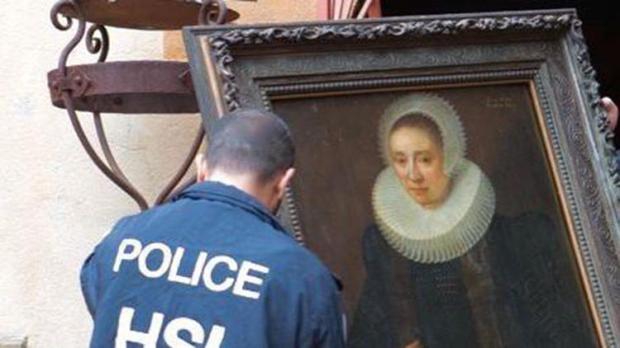
la-dfunke-1480872321-snap-photo

Two agents from U.S. Homeland Security’s ICE unit arrived at my door in September looking for a Polish lady — not a person, but a painting: Melchior Geldorp’s “Portrait of a Lady.” She had, they informed me, been looted by the Nazis from the National Museum in Warsaw.

Unsure if these gentlemen were indeed who they claimed to be, I didn’t invite them in. But I knew exactly what they were seeking: My partner, David, and I had purchased this very portrait — ostensibly the work of a different artist — a decade earlier from a major auction house in New York. 

Upon their leaving, I stood dumbfounded, holding a packet of information about the alleged provenance of our painting. After calling David at work to drop this bombshell, I began a Googling frenzy, eventually bringing me to Poland’s Division for Looted Art website. Seconds later I was gawking at an old black-and-white photo of our beloved lady, a beautiful portrait painted on oak panel in 1628. Tears welled in my eyes with the realization that, without question, if this were true we needed to do our duty and get her safely home.

Being an opera singer, I was among a group of vocalists on a government-sponsored tour of Israel some years ago. During a visit to a community center for Holocaust survivors I was asked to sing. The emotion of being surrounded by people who had prevailed through such unimaginable horrors was overwhelming, and I found myself unable. Excusing myself, I attempted to make up for it by spinning several of the ladies around the dance floor — all the while trying not to look down at the numbers tattooed on their wrists. 

Now this memory flooded back to me, and I found myself once again in tears, hyper-aware of how Nazi atrocities affect us still to this day.

The toll of World War II in Poland — including the deaths of 6 million Poles, Jews, and other outcasts, including homosexuals — is unimaginable. Being gay men, David and I feel a personal connection with these losses and are conscious of how political shiftings can lead to vulnerability. This, added to the knowledge that Poland’s LGBTQ community is still in a struggle for its basic rights, has weighed heavily on our minds. 

READ MORE

Steve McCurry Photography

The Librarian Who Saved Timbuktu’s Cultural Treasures From al Qaeda

“The Librarian Who Saved Timbuktu’s Cultural Treasures From al Qaeda”

by Joshua Hammer via “Wall Street Journal

Abdel Kader Haidara with ancient family-owned manuscripts, Timbuktu, Mali, 2007.

For custodians of the ancient heritage of the Middle East and North Africa, the recent rise of Islamist extremist groups has posed a dire challenge. Since its seizure of the historic Iraqi city of Mosul in early 2014, Islamic State has pillaged and demolished mosques, shrines, churches and other sacred sites across the region. The group continues to launch “cultural cleansing” operations from Tikrit to Tripoli.

In this grim procession, there have been occasional victories for culture over extremism, like the recapture last month of the ancient Syrian city of Palmyra, which may now be restored to something of its previous glory. A less familiar case of cultural rescue features an unlikely hero: a 51-year-old book collector and librarian named Abdel Kader Haidarain the fabled city of Timbuktu, in the West African country of Mali.

The story begins in April 2012, when Mr. Haidara returned home from a business trip to learn that the weak Malian army had collapsed and that nearly 1,000 Islamist fighters from one of al Qaeda’s African affiliates, al Qaeda in the Islamic Maghreb, had occupied his city. He encountered looters, gunfire and black flags flying from government buildings, and he feared that the city’s dozens of libraries and repositories—home to hundreds of thousands of rare Arabic manuscripts—would be pillaged.

The prizes in Mr. Haidara’s own private collection, housed in his Mamma Haidara Commemorative Library, include a tiny, irregularly shaped Quran from the 12th century, written on parchment made from the dried skin of a fish and glittering with illuminated blue Arabic letters and droplets of gold. His collection also boasts many secular volumes: manuscripts about astronomy, poetry, mathematics, occult sciences and medicine, such as a 254-page volume on surgery and elixirs derived from birds, lizards and plants, written in Timbuktu in 1684. “Many of the manuscripts show that Islam is a religion of tolerance,” he told me.

Mr. Haidara knew that many of the works in the city’s repositories were ancient examples of the reasoned discourse and intellectual inquiry that the jihadists, with their intolerance and rigid views of Islam, wanted to destroy. The manuscripts, he thought, would inevitably become a target.

READ MORE

Turkey: Church discovered in world’s biggest underground city in Nevşehir with never-before-seen frescos

“Turkey: Church discovered in world’s biggest underground city in Nevşehir with never-before-seen frescos”

by Matt Atherton via “IBT

Church fresco

An 1,500-year-old underground church has been discovered in Turkey with never-before-seen frescoes depicting Jesus and “bad souls being killed”. The church was found in the world’s largest known underground city in the Cappadocia region of central Turkey.

The frescoes have been described as depicting Jesus rising into the sky – known in Christianity as the Ascension – and the destroying of evil – known as the Last Judgement. The discovery of the church itself – which archaeologists suggest could be more than 1,500 years old – still has secrets to be revealed, as so far only the roof and uppermost part of the walls have been uncovered.

“Only a few of the paintings have been revealed,” said researcher Ali Aydin, who told the Hurriyet Daily News: “There are important paintings in the front part of the church showing the crucifixion of Jesus and his ascension to heaven. There are also frescoes showing the apostles, the saints and other prophets Moses and Elyesa.”

An urban housing project was taking place in the city of Nevşehir, where the church was found. It is part of a huge number of early dwellings, which form the largest known ancient underground city. The underground city itself was discovered in 2014, and around four miles of tunnels have been uncovered. The experts believe people lived here around 5,000 years ago.

Archaeologists have had to pause their excavations, however, as the winter humidity can damage the paintings. However, they have managed to reveal the ceiling of the structure which mainly sits underground, and were fascinated by the huge frescoes which can be found across the inside of the roof and top of the walls.

“We know that such frescoes have so far never been seen in any other church,” said Hasan Ünver, mayor of Nevşehir. “It was built underground and has original frescoes that have survived to this day. This place is even bigger than the other historical churches in Cappadocia.

“It is reported that some of the frescoes here are unique. There are exciting depictions like fish falling from the hand of Jesus Christ, him rising up into the sky, and the bad souls being killed. When the church is completely revealed, Cappadocia could become an even bigger pilgrimage center of Orthodoxy,.”

READ MORE

Goddess of Mercy

Mercy

This beautiful statue of the Buddhist Goddess of Mercy lies in Daxiangguo Temple in Kaifeng, Henan, China.  Gold-plated, it is a memorial to both propriety and filial piety, two of the great Chinese Confucian virtues.  The story below is a combination of the story told by the tour guide and some local conversationalists who were happy to relate the story to me.  

Many centuries ago,

An old emperor of China grew very, very ill and saw that his country was suffering as well.  Realizing that the country was troubled and needed heavenly assistance, the worried king called out to Buddha and asked for guidance on how to appease the heavens and reclaim the blessings from above.  

Buddha responded that the country and its king had done some very wicked things in the past and that now a sacrifice would be required to repair the damage.  Buddha asked that the Emperor offer up to the heavens one arm and one eye from someone within his family. If he did so, Buddhas said, the country and emperor would be healed and would live in peace once more.  

The Emperor was very saddened and worried, because the only family he had left were his three young daughters.  The Princesses though were very concerned about their father and finally convinced him to share what Buddha commanded.  Upon hearing of the sacrifice required, the sisters were quite upset.

 The eldest daughter went to her father ~ “My king, although I love you and would do anything else that you asked of me, I cannot do this for you. I am a new mother, my baby is still nursing. If I only have one arm and one eye, how could I possibly care for my baby the way a good mother is supposed to?” (more…)